Deducting Openings From a Wall Pour
Poured-in-place concrete walls — basement foundations, above-grade ICF panels, cistern walls, and retaining elements — involve a calculation step that slabs and flatwork never require: subtracting opening voids. Every window, door, and vent in a poured wall displaces concrete, and estimators who skip this deduction routinely over-order. The unique failure mode for wall concrete is compounding error across multiple openings: a single 24-foot basement wall with two windows and an egress door contains more than 44 cubic feet of void — nearly 1.7 cubic yards of concrete you should never pay for. Across 6–8 walls on a full foundation pour, uncorrected over-ordering easily reaches 8–12 cubic yards of waste. For the opening-deduction method with worked examples, see our pillar guide on wall concrete estimation with openings.
This calculator takes wall length, height, and thickness, then lets you enter any number of door, window, or vent openings — each defined by width, height, and count — and subtracts each void from the gross wall volume to produce a true net pourable volume, with each opening's deduction shown individually so you can audit the total before ordering. It also computes dry ingredient quantities for on-site batching: cement bags, sand volume, aggregate volume, and water from a nominated mix (1:1.5:3, 1:2:4, or 1:3:6) and your specified water-to-cement ratio, using the ACI 211.1-91 dry-volume factor of 1.54. Output switches between m³, ft³, and yd³, with ordering helpers at +5% and +10% above the net volume. For block-wall alternatives, see our guide on estimating concrete blocks for a wall; for the floor slab the wall sits on, how to calculate concrete for a slab; and for garden retaining panels, retaining-wall concrete quantities.
Worked Example: Basement Wall with Two Windows and an Egress Door
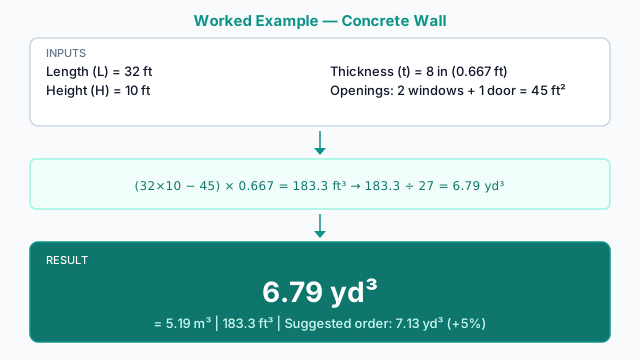
A contractor is pouring a 32-foot-long, 10-foot-tall basement foundation wall, 8 inches thick. The wall contains two double-hung windows (each 3 ft × 4 ft) and one egress door (3 ft × 7 ft). Mix is 1:2:4 with w/c = 0.50.
- Convert thickness: 8 in ÷ 12 = 0.667 ft
- Gross wall volume: 32 ft × 10 ft × 0.667 ft = 213.3 ft³ (7.90 yd³)
- Window deductions (×2): 3 ft × 4 ft × 0.667 ft × 2 = 16.0 ft³ (0.59 yd³)
- Door deduction (×1): 3 ft × 7 ft × 0.667 ft × 1 = 14.0 ft³ (0.52 yd³)
- Total opening deduction: 16.0 + 14.0 = 30.0 ft³ (1.11 yd³)
- Net concrete volume: 213.3 − 30.0 = 183.3 ft³ = 6.79 yd³
- Order quantity (+5%): 6.79 × 1.05 = 7.13 yd³ — place a 7.25 yd³ order (typical ¼-yard batching increment at most US ready-mix plants)
Skipping the opening deductions and ordering on gross volume (7.90 × 1.05 = 8.30 yd³) wastes 1.17 cubic yards — roughly $175–210 at $150–180/yd³. On a six-wall foundation pour with similar openings on each wall, the uncorrected total over-order exceeds half a full ready-mix truck load. The calculator runs this deduction chain in under two seconds, and the Print / Save button produces a formatted sheet you can attach to the concrete order.
How to Use the Wall Concrete Calculator
- 1Enter wall Length and Height in your chosen units (m or ft). For a wall that wraps a corner, break it into straight segments — run one calculation per segment and sum the net volumes at the end.
- 2Enter wall Thickness and choose its unit (m, cm, or in). Foundation walls typically run 8–12 inches (200–300 mm); above-grade poured or ICF walls commonly use 6-inch or 8-inch concrete cores. Enter the formed concrete thickness — not the total assembly width including insulation.
- 3Select the Nominal Mix: 1:1.5:3 for high-strength structural or exposed-to-freeze–thaw walls; 1:2:4 for standard foundation and basement walls; 1:3:6 only for lean-fill or mass concrete where structural strength is not a requirement.
- 4Enter the Water–Cement Ratio. ACI 318-19 limits w/c to 0.45 for freeze–thaw exposure, 0.50 for moderate exposure, and up to 0.60 for protected interior walls not subject to moisture. Use 0.50 when in doubt for a basement application.
- 5Open the Openings tab. For each window, door, vent, or block-out, enter Width, Height, and Count. Opening depth is assumed to equal the full wall thickness — if a niche or recess does not penetrate the full wall, enter its actual recess depth in the Height field instead.
- 6Select your Output Volume Unit. Choose yd³ for US ready-mix orders, m³ for metric procurement, or ft³ if you are cross-referencing a bag-count guide.
- 7Click Calculate. Review the Gross Volume line, each opening deduction, the total deduction, and the Net Concrete Volume at the bottom of the results.
- 8Use the Yardage Helper to set your order quantity. Add +5% for a direct-pour wall with well-fitted forms; add +10% for pump placements, walls over 12 ft tall, or any pour where a cold joint is a real risk if the supply is interrupted.
The Wall Concrete Volume Formulas
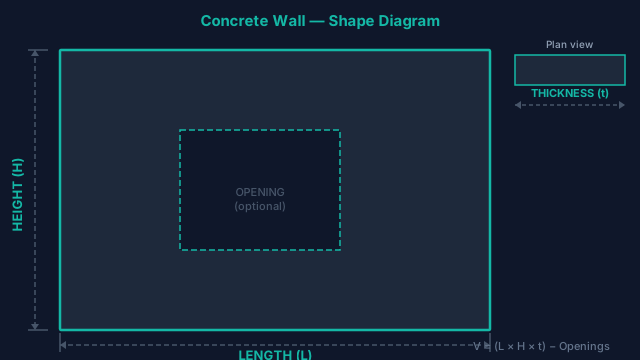
- 1) Gross Wall VolumeVgross = Length × Height × Thickness
All three dimensions must share the same linear unit before multiplying. Convert thickness to ft or m to match the L and H unit first. - 2) Opening Volume — per opening typeVopening = Opening Width × Opening Height × Wall Thickness × Count
Wall thickness is applied to every opening because each void penetrates the full thickness. Enter the net clear dimensions of the void in the wall face — not the rough framing or door frame size. - 3) Net Concrete VolumeVnet = Vgross − Σ Vopening
The sum is taken across all opening entries. If total opening volume somehow exceeds gross (data-entry error), the result is clamped to zero rather than returning a negative volume. - 4) Dry Volume and Mix Ingredient QuantitiesVdry = Vnet × 1.54
Cement Volume = (Cement Parts ÷ Total Parts) × Vdry
Sand Volume = (Sand Parts ÷ Total Parts) × Vdry
Aggregate Volume = (Aggregate Parts ÷ Total Parts) × Vdry
For 1:2:4, Total Parts = 7. For 1:1.5:3, Total Parts = 5.5. For 1:3:6, Total Parts = 10. The 1.54 factor accounts for the air voids and bulking that occur when dry aggregates are compacted into wet concrete. - 5) Cement Bags and WaterCement Mass (kg) = Cement Volume (m³) × 1440 kg/m³
Bags = ⌈ Cement Mass ÷ 50 kg ⌉
Water (liters ≈ kg) = w/c × Cement Mass
Bulk cement density ≈ 1440 kg/m³ per ACI 211.1-91. Bag count is ceiling-rounded so you never arrive on site short. Water is reported in liters because 1 liter of water weighs 1 kg at standard conditions.
Opening Deduction Reference Guide
Concrete void volumes for common residential opening types at 8-inch and 10-inch wall thickness. Always enter net clear dimensions — not rough framing or door frame size.
| Opening Type | Typical W × H | Void @ 8″ wall | Void @ 10″ wall | Notes |
|---|---|---|---|---|
| Basement window | 2.67′ × 2.0′ | 3.6 ft³ | 4.4 ft³ | Window buck framing typically reduces net clear by 1–2 in per side; measure the concrete void, not the frame. |
| Double-hung window | 3.0′ × 4.0′ | 8.0 ft³ | 10.0 ft³ | Most common residential window; enter net clear void at the wall face, not the rough opening. |
| Picture / fixed window | 5.0′ × 4.0′ | 13.3 ft³ | 16.7 ft³ | Larger void is easily underestimated in mental arithmetic — always add it to the Openings tab. |
| Exterior man door | 3.0′ × 7.0′ | 14.0 ft³ (0.52 yd³) | 17.5 ft³ (0.65 yd³) | Enter net void at the wall face; door frame and jamb are not concrete and should not be added to the wall volume. |
| Egress door (basement) | 3.0′ × 7.0′ | 14.0 ft³ (0.52 yd³) | 17.5 ft³ (0.65 yd³) | IRC R310 requires min 32″ clear width and 78″ clear height for egress openings in sleeping rooms. |
| Single garage door | 9.0′ × 7.0′ | 42.0 ft³ (1.56 yd³) | 52.5 ft³ (1.94 yd³) | Largest single opening on most residential foundation walls — never omit this deduction. |
| Double garage door | 16.0′ × 7.0′ | 74.7 ft³ (2.77 yd³) | 93.3 ft³ (3.46 yd³) | Omitting this deduction at $150/yd³ wastes $415–$520 per wall. Always enter it in the Openings tab. |
| Utility vent / block-out | 1.0′ × 1.5′ | 1.0 ft³ | 1.25 ft³ | Small individually but multiplies quickly when many vents are present in the same wall. |
All void volumes = W × H × full wall thickness. The calculator sums all opening entries automatically — add every opening type present, even small vents.
Ordering Mistakes That Waste Money on a Wall Pour
- 1Skipping opening deductions entirely
Ordering on gross wall volume without subtracting openings is the most expensive estimating error in residential foundation pours. A wall with a single-car garage door opening at 8-inch wall thickness contains 1.56 cubic yards of void — concrete you should never pay for. On a project with a double garage door, two windows, and a walk-out door, the total uncorrected overage routinely exceeds 3 cubic yards at current ready-mix prices.
- 2Using rough framing size instead of net clear void
Rough openings are dimensioned larger than the net clear window or door dimension to accommodate framing lumber, bucks, and shims. Entering the rough framing size (e.g., 38" × 50" for a 36" × 48" window) slightly overstates the deduction. More commonly, estimators use the nominal unit size rather than the net void in the concrete wall face — the difference is small per opening but accumulates across many windows on a larger wall system.
- 3Ordering without a waste or pump-prime factor
Net calculated volume assumes a plumb, fully-formed wall with no pump-line prime. Real wall pours have form deflection, minor thickness irregularity, pump-line prime volume (0.5–1.5 ft³ per 100 linear feet of pump line), and residual concrete in the truck drum at washout. A +5% factor covers most direct-pour walls; increase to +10% for any pump placement, walls over 12 ft tall, or narrow walls under 6 inches thick where form bulge per linear foot is proportionally larger.
- 4Applying nominal wall thickness instead of formed thickness
Structural drawings specify a nominal dimension — but snap-tie systems and wall forms can deliver 0.125–0.25 inches more than nominal due to hydrostatic pressure deflection during the pour. For conservative ordering on critical pours, add the expected deflection allowance to the nominal thickness before entering the value in the calculator. ACI 318-19 §26.4.2 addresses tolerance on wall thickness; on walls exceeding 12 ft in height, form deflection becomes a material source of additional volume.
Pairing the Wall Calculator with Other Tools
Use this Wall Concrete Calculator for any poured-in-place vertical wall element — basement foundation walls, above-grade poured or ICF walls, cistern panels, and garden retaining panels — where the key estimation challenge is deducting openings (windows, doors, vents) from a gross rectangular volume. The Openings tab handles any number of void types in a single calculation and displays each deduction individually.
If your project is horizontal flatwork, switch to the Slab Concrete Calculator, which handles rectangular, circular, and irregular-perimeter slabs with sub-base options and reinforcement guidance. For a combined footing-plus-wall system (mat and stem wall poured together), calculate each element separately and sum the net volumes.
For a quick rectangular volume without the opening deduction tab or dry-ingredient breakdown — for example, a solid block of lean concrete under a machine base — the Concrete Yards Calculator is simpler and faster. It omits the openings workflow because that is not needed for solid fills.
To confirm concrete bag counts for a site-mixed repair pour or a small wall patch, Concrete Bag Calculator provides brand-by-brand yield tables (Quikrete, Sakrete, ProMix) so you can cross-check the calculator's bag count against the actual bag size in stock at your supplier. For wall cost estimation without the mix breakdown, the embedded cost module in this calculator or the Concrete Driveway Cost Calculator both provide a rate-per-m³ cost output. For a below-grade cistern or basement wall that is part of a hollow tank or trench structure rather than a simple straight run, the Tank / Trench Concrete Calculator handles the outer-minus-inner shell subtraction this wall calculator does not model. And if you are batching dry materials on site rather than ordering ready-mix, the Nominal Mix M5–M25 Calculator converts this wall's net volume into a per-grade cement, sand, and aggregate bag count.
Mix & Placement Standards
Governs minimum bearing-wall thickness (8 in per §11.3.1.1), minimum horizontal and vertical reinforcement ratios for poured walls, concrete cover requirements, and water-to-cement ratio limits by exposure class (Table 19.3.3.1: 0.45 max for freeze–thaw exposure, 0.50 for moderate sulfate exposure). The minimum compressive strength for structural walls subject to freeze–thaw is f'c = 3,000 PSI per Table 19.3.2.1 — establishing the range this calculator's 1:1.5:3 and 1:2:4 mixes are calibrated to meet.
The basis for the 1.54 dry-volume factor used in this calculator's ingredient calculations. ACI 211.1-91 provides the methodology for converting compacted wet concrete volume back to bulk dry ingredient volumes, accounting for air voids and aggregate bulking. The 1440 kg/m³ cement bulk density used in the bag-count formula is also consistent with this standard's mix-design guidance.
Specifies production, delivery, and discharge requirements for ready-mix concrete used in wall pours, including maximum drum rotation counts after water addition, maximum slump loss in transit, and the 90-minute or 300-revolution limit before discharge. These limits govern wall pours where the truck must wait for form assembly to finish — relevance is especially high for tall walls where the pump prime and hose purge can consume 10–15 minutes of the delivery window.
Fresh concrete exerts full hydrostatic pressure against wall formwork; pour lift heights and placement rates must be engineered to prevent form blowouts — consult a licensed structural engineer for formwork design on walls taller than 8 ft or poured at rates exceeding 5 ft/hr.
Wall Concrete — Questions Before You Order
What is the formula for concrete wall volume with openings?
Net Volume = (Length × Height × Thickness) − Σ(Opening Width × Opening Height × Thickness × Count). The gross wall volume is calculated first (L × H × t), then each opening's volume — opening area multiplied by the full wall thickness — is subtracted. The net figure is the actual pourable volume to place your ready-mix order against.
How does the calculator handle multiple opening types?
The Openings tab accepts any number of rows. Each row has a Width, Height, and Count field. The calculator computes W × H × wall thickness × count for each row and sums all opening volumes before subtracting the total from gross. You can enter windows and a door as separate rows, and the deduction is cumulative across all rows.
What wall thickness should I use for a residential foundation wall?
ACI 318-19 §11.3.1.1 requires a minimum of 8 inches for bearing walls. Most residential poured concrete basement walls are specified at 8–10 inches. ICF (insulated concrete form) walls commonly use 6-inch concrete cores with insulating foam panels on each face. Enter only the formed concrete thickness — not the total wall assembly width including insulation or cladding.
What nominal mix is best for a structural foundation wall?
Use 1:2:4 (approximately M20 / 3,000 PSI) for standard residential basement and foundation walls. Use 1:1.5:3 (approximately M25 / 4,000 PSI) for walls with higher structural demand, freeze–thaw exposure, or below-grade waterproofing requirements where lower permeability matters. Reserve 1:3:6 for non-structural lean fill or blinding concrete — it does not meet ACI 318-19's minimum 2,500 PSI for structural wall elements.
What w/c ratio should I use for a basement wall?
ACI 318-19 Table 19.3.3.1 limits w/c to 0.45 for concrete exposed to freezing and thawing in a moist condition (Exposure Class F2), and 0.50 for moderate freeze–thaw exposure (F1). For a protected interior basement wall not subject to direct moisture or freeze cycles, 0.50–0.55 is acceptable. Walls receiving a crystalline or membrane waterproofing system should still be designed at 0.50 or lower to minimize concrete porosity before the coating is applied.
Why does the dry-volume factor (1.54) matter for wall pours?
When dry cement, sand, and aggregate are combined with water, the mix compacts — air voids between aggregate particles are filled by cement paste and fines, reducing the total volume. The result is that 1.54 m³ of bulk dry ingredients yield approximately 1.0 m³ of compacted fresh concrete. Without this factor, dry material quantities would be underestimated by about 35%, leaving you short of ingredients before the wall form is full. The 1.54 multiplier is specified in ACI 211.1-91 mix-design methodology.
How do I handle a wall that wraps a corner?
Break the wall plan into straight segments at each inside corner. Calculate each segment separately using its individual length, then sum the net volumes for the total project pour quantity. Avoid double-counting the corner volume where one wall's thickness overlaps an adjacent wall's thickness — that corner block can be computed as a small rectangular column (thickness × thickness × height) added separately, or assigned to one wall segment and omitted from the other.
What waste percentage should I add to a wall pour?
Use +5% as a baseline for direct-pour walls with well-fitted forms in good condition. Increase to +10% for: pump placements where prime volume in the line is 0.5–1.5 ft³ per 100 linear feet, walls over 12 ft tall where a pour stall creates a cold joint risk, walls thinner than 6 inches where form bulge per linear foot is proportionally larger, and any pour where concrete must travel more than 50 feet horizontally from the truck.
Can I use this calculator for above-grade walls?
Yes. The wall type — basement foundation, above-grade poured wall, ICF, tilt-up panel, or cast-in-place retaining wall — does not change the volume formula. Enter wall length, height, and formed concrete thickness, add any openings, and select the appropriate mix. For ICF walls, enter only the concrete core thickness (typically 6", 8", or 10") — not the full ICF assembly width including the foam form panels.
How is this calculator different from the Slab Concrete Calculator?
The Slab Concrete Calculator is designed for horizontal flatwork: driveways, patios, garage floors, and slabs-on-grade. It handles irregular polygon slabs, sub-base gravel volume, and weight-per-area outputs. The Wall Concrete Calculator is designed for vertical elements and adds the opening deduction tab that slab calculations never require. For a combined slab-and-wall pour such as a garage floor and stem wall, calculate each element separately and sum the results.
What should I enter for a partial-depth opening or recess?
For a recess, niche, or block-out that does not penetrate the full wall thickness — for example, a 4-inch-deep electrical panel recess in an 8-inch wall — enter the actual recess depth as the Height field value in the Openings tab, and adjust the Width and Count to match. The calculator treats each opening as W × H × depth × count, which correctly estimates the displaced concrete volume regardless of whether the void is a full penetration or a partial recess.
What is formwork pressure and why does it affect ordering accuracy?
Fresh concrete exerts lateral pressure against wall forms that increases with pour height and placement rate — at full hydrostatic pressure, a 10-foot wall exerts approximately 1,450 lb/ft² at the base. If forms deflect or blow out during a pour, concrete spills and the effective wall volume increases beyond the calculated figure. The +5% to +10% waste factor in the calculator's ordering helper accounts for this variability. For walls over 8 ft tall, form blowout is the primary risk that the waste factor must cover.
How accurate is the wall concrete calculator for field use?
The calculator uses exact rectangular volume formulas with precise opening subtraction, so the math is accurate to the dimensions you enter. Field accuracy depends on how precisely your wall forms match the entered values. Form deflection under hydrostatic pressure, minor wall irregularity, and pump-line prime volume are field variables not computed from inputs — they are covered by the waste factor. For critical or high-cost foundation pours, verify the result against a manual hand-check using the formula V = (L × H × t) − Σ openings before placing the order.
Can I calculate a curved wall with this calculator?
The calculator handles straight rectangular walls only. For a curved wall, measure the arc length of the wall centerline and use that as the Length input — this gives an accurate volume because the cross-section (height × thickness) is uniform regardless of plan curvature. For very tight-radius curves where form thickness varies significantly on the inner versus outer face, use the average of the inner and outer arc lengths as the Length input.
What concrete compressive strength should I specify for foundation walls?
ACI 318-19 Table 19.3.2.1 requires f'c ≥ 3,000 PSI (20.7 MPa) for concrete exposed to freezing and thawing in a moist condition, which applies to most below-grade residential foundation walls. For walls in a moderate or protected exposure class, 2,500 PSI minimum is required. In practice, most residential structural engineers specify 3,000–4,000 PSI for poured walls to ensure durability in ground contact. The 1:2:4 nominal mix in this calculator approximates 3,000 PSI; 1:1.5:3 approximates 4,000 PSI.
Related Calculators
Retaining Wall Calculator
Estimate SRW blocks, drainage gravel, geogrid layers, and installed cost — with IBC 2021 §1807.2.3 compliance checks for walls over 4 ft.
Footing Concrete Calculator
Continuous, isolated, and combined footings.
Concrete Block Calculator
Estimate concrete blocks, mortar, grout, reinforcement, and cost for CMU block walls.
CMU Block Calculator
Estimate CMU block quantity, deduct openings, add waste, and calculate full installed wall cost.
Beam Concrete Calculator
Estimate concrete for beams and lintels.
Tank or Trench Concrete Calc
Calculate concrete volume for tanks or trench structures easily.