Sizing a Segmental Retaining Wall: Blocks, Drainage, and Geogrid
Our Retaining Wall Calculator is a complete project estimator for segmental retaining walls (SRW). Enter your wall length, height, and block size — the tool instantly returns the exact number of blocks you need, the volume and weight of drainage gravel required behind the wall, and geogrid reinforcement layers for taller walls. For the block, mortar, and grout takeoff that sits behind any masonry wall, see our pillar guide on estimating concrete blocks for a wall.
Whether you are building a 2-foot garden border, a 4-foot retaining wall, or an engineered 6-foot-plus structure, this calculator covers the full material takeoff. It factors in waste allowance, supports multiple standard SRW block sizes (12 × 4 × 8 through 24 × 8 × 18), estimates drainage aggregate, and produces an installed-cost estimate with materials, labor, delivery, and tax. For poured-concrete retaining panels, see our note on retaining-wall concrete quantities; for the footing under the wall, our concrete footing calculations; and to size the drainage stone, our gravel coverage & tonnage guide.
Retaining Wall Block Size & Weight Reference
U.S. segmental retaining wall manufacturers (Allan Block, Versa-Lok, Keystone, Pavestone) produce blocks in a wide size range. Use this table to match your wall height to the correct block and anticipated weight per block.
| Block Type | Nominal Size (L × H × D) | Weight | Typical Use |
|---|---|---|---|
| Small Garden | 12 × 4 × 8 in | ~20 lb | Borders, flower beds up to 2 ft |
| Medium SRW | 16 × 6 × 10 in | ~50 lb | Landscape walls 2–3 ft |
| Standard SRW | 18 × 8 × 12 in | ~80 lb | Retaining walls 3–5 ft |
| Large Gravity | 24 × 8 × 18 in | ~120 lb | Engineered walls 5 ft+ |
Entering Your Retaining Wall Quantities
- 1Select a Project Type preset — Small Garden, Standard Retaining, or Engineered — to load sensible defaults.
- 2Choose your unit system: imperial (ft/in) or metric (m/cm).
- 3Enter the wall length and wall height as gross (total) dimensions along the run.
- 4Pick the block size from the catalog — Garden (12 × 4 × 8), Medium, Standard (18 × 8 × 12), Large, or Custom.
- 5Set the drainage gravel depth behind the wall — 12 inches minimum for walls over 3 ft per NCMA TEK 2-4B.
- 6Select the drainage aggregate type — crushed #57 stone, pea gravel, or river rock.
- 7Adjust the waste percentage (default 5%) based on layout complexity and curved runs.
- 8Switch to Advanced mode to enable geogrid reinforcement layers for walls over 4 ft.
- 9Enter geogrid vertical spacing (typical: every 2 courses) and embedment length (typical: 0.6 × wall height).
- 10In Advanced mode, enter cost per block, per ton of gravel, labor rate, delivery, and tax.
- 11Click Calculate to see blocks needed, gravel weight, geogrid area, and full cost breakdown.
- 12Use Print / Save to export a permit-ready PDF summary for your contractor, engineer, or building department.
How the Retaining Wall Material Count Is Calculated
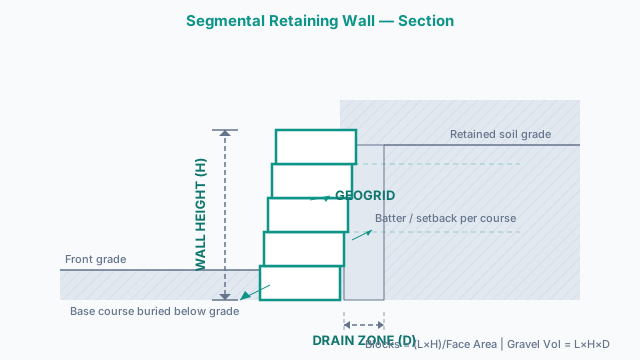
- 1) Block Face AreaFace Area (ft²) = (Block Length × Block Height) / 144
Example: 18 × 8 in block → (18 × 8) / 144 = 1.00 ft² - 2) Block QuantityBlocks Before Waste = (Wall Length × Wall Height) / Face Area
Final Blocks = ⌈ Blocks Before Waste × (1 + Waste%) ⌉ - 3) Drainage Gravel VolumeGravel Volume (ft³) = Wall Length × Wall Height × Backfill Depth
Gravel Volume with Waste = Volume × (1 + Waste%)
Convert to yd³ by dividing by 27. - 4) Drainage Gravel WeightWeight (lb) = Volume (ft³) × Density (lb/ft³)
Crushed #57 stone ≈ 100 lb/ft³ · Pea gravel ≈ 96 lb/ft³ · River rock ≈ 105 lb/ft³
Tons = Weight (lb) / 2000 - 5) Geogrid Layers (Walls > 4 ft)Number of Courses = Wall Height (in) / Block Height (in)
Layers = max(0, ⌊ Courses / Layer Spacing ⌋ − 1)
Total Geogrid Area (ft²) = Layers × Wall Length × Embedment Length - 6) Installed CostMaterial Cost = Blocks × $/Block + Gravel Tons × $/Ton
Labor Cost = Wall Area × $/ft² or Hours × $/Hour
Total = (Material + Labor + Delivery) × (1 + Tax%)
Worked Takeoff: A 20 ft × 4 ft Standard SRW Wall
You are building a 20 ft long, 4 ft tall garden retaining wall using Standard SRW blocks (18 × 8 × 12 in, face area 1.0 ft²) with a 12-inch drainage zone behind it.
- Blocks before waste: (20 × 4) ÷ 1.0 = 80 blocks
- With 5% waste: 80 × 1.05 = 84 → order 84 blocks
- Drainage gravel volume: 20 × 4 × 1 ft = 80 ft³ (≈ 2.96 yd³, round to 3 yd³)
- Drainage gravel weight (crushed #57 at 100 lb/ft³): 80 × 100 = 8,000 lb ≈ 4 tons
- Geogrid: at exactly 4 ft, this wall sits at the IBC 2021 §1807.2.3 threshold — no engineered geogrid schedule is required, but a 6 ft version of this same wall would need reinforcement layers every 2 courses
84 blocks and 4 tons of crushed stone is the material order for this wall. Bump the height to 6 ft on the same 20 ft run and the block count roughly doubles to 168 blocks, the gravel triples toward 6 tons, and geogrid reinforcement plus an engineered design become mandatory — which is why height, not length, is the number that decides whether this stays a weekend DIY project or needs a permit.
Quantity Mistakes That Leave a Retaining Wall Short
- Not burying enough of the base course. A standard rule is to bury one block course, or at least 10% of wall height, below grade — 6 inches minimum on a 4 ft wall. Skipping this leaves the base exposed to frost heave and erosion undermining the first course.
- Undersizing the drainage zone on taller walls. NCMA TEK 2-4B calls for at least a 12-inch drainage zone behind any wall over 3 ft. A shallower zone traps hydrostatic pressure behind the wall, which is the single most common cause of SRW wall failure.
- Forgetting capstones and corner blocks. The block count from length × height covers the wall face only — it does not itemize capstones (roughly 1 per linear foot of wall top) or specialty corner blocks (2–4 per 90° corner). Add these to the order separately.
- Skipping geogrid because the wall “looks” short enough. Walls over 4 ft — and shorter walls carrying a surcharge load like a driveway or slope above them — need geogrid reinforcement layers even if the exposed face looks similar to a shorter, unreinforced wall.
When to Use the Retaining Wall Calculator vs. Related Tools
This Retaining Wall Calculator is optimized for segmental retaining wall (SRW) block systems. For poured-in-place concrete retaining walls with a stem and footing, use the wall concrete calculator for the stem volume and the footing concrete calculator for the footing. Rebar quantity for a cast concrete retaining wall is handled by the rebar calculator. The drainage aggregate behind SRW walls can be cross-checked for volume and tonnage using the gravel calculator. For estimating block counts for a standard structural block wall (not a retaining wall), the concrete block calculator is the appropriate tool.
ASTM Material Specs
Section 1807.2.3 requires engineered design for retaining walls taller than 4 feet (measured from bottom of footing to top of wall). Most U.S. jurisdictions adopt IBC and require a permit and engineered drawings for walls exceeding this height.
Provides the lateral earth pressure and surcharge load specifications used to design retaining walls, including soil unit weights, active/passive pressure coefficients, and surcharge load definitions.
National Concrete Masonry Association technical guidance for SRW design and construction, including the 12-inch minimum drainage zone requirement for walls over 3 feet and geogrid placement recommendations used in this calculator.
Retaining walls must resist active soil pressure, surcharge loads, and hydrostatic uplift; drainage aggregate and weep holes are mandatory to prevent pore-pressure buildup — engage a licensed geotechnical or structural engineer for walls exceeding 4 ft.
Retaining Wall Takeoff FAQ
How many retaining wall blocks do I need?
Divide the wall face area (length × height) by the block face area (block length × block height), then round up and add 5–10% for waste. For example, a 20 ft long × 4 ft tall wall using 18 × 8 in blocks needs (20 × 4) ÷ 1.0 = 80 blocks before waste, or 84 with 5% extra.
Do retaining walls over 4 feet need an engineer?
Yes. Per the International Building Code (IBC) 2021 §1807.2.3, retaining walls with an exposed height greater than 4 feet (measured from top of footing) require a permit and engineered design. Many jurisdictions also require geotechnical analysis of the soil.
How much drainage gravel do I need behind a retaining wall?
NCMA TEK 2-4B recommends a drainage zone at least 12 inches wide behind walls over 3 feet tall. For a 20 ft long × 4 ft tall wall with a 12-inch backfill, you need roughly 80 ft³ (~3 yd³) of crushed stone — about 4 tons.
What is geogrid and when do I need it?
Geogrid is a polymer reinforcement fabric placed between block courses and extended back into the retained soil. It creates a reinforced soil mass that resists lateral pressure. Walls over 4 feet — and shorter walls with heavy surcharge loads (driveways, slopes) — typically require geogrid layers every 2 courses.
How long should geogrid layers extend into the soil?
A common rule of thumb is geogrid embedment length = 60% of the wall height (minimum 4 ft). For a 6 ft wall, use 3.6 ft of embedment (round up to 4 ft). Always follow the specific engineered design for your site and soil type.
What size block is best for a 4-foot retaining wall?
An 18 × 8 × 12 in standard SRW block is the most common choice for 3–5 ft walls. It has enough setback and mass for good stability, and is widely stocked at home improvement stores. For walls over 5 ft, consider 24 × 8 × 18 in large gravity blocks or an engineered system.
Do I need a concrete footing for a retaining wall?
Most SRW systems are dry-stacked on a compacted crushed-stone base (6 inches for walls under 4 ft, 12 inches or more for taller walls). A concrete footing is generally not required for segmental blocks but is recommended for poured-in-place concrete retaining walls or mortared CMU walls.
Why does a retaining wall need drainage?
Without drainage, water builds up behind the wall and creates hydrostatic pressure that can push the wall forward or cause it to fail. A drainage zone of crushed stone plus a 4-inch perforated drain pipe at the base allows water to escape safely.
What is the cost of building a retaining wall?
Installed cost typically ranges from $20–$50 per face-ft² for DIY SRW walls, and $35–$100+ per face-ft² for professionally installed walls with engineering, geogrid, and drainage. Enter your local block, gravel, and labor rates in Advanced mode for an accurate site-specific estimate.
How deep should a retaining wall base be buried?
A standard rule is to bury one block course (or at least 10% of wall height) below grade. For a 4 ft wall, bury at least 6 inches. In frost-prone regions, extend the base below the frost line to prevent seasonal heaving.
What is batter (setback) and why does it matter?
Batter is the backward lean of the wall face. Most SRW systems build in a 1–2° setback per course, which shifts the wall's center of gravity toward the retained soil and improves stability. This calculator assumes standard manufacturer setback; follow your specific block system's instructions.
Can I build a retaining wall without a permit?
In most U.S. jurisdictions, walls under 4 ft (measured from bottom of footing to top of wall) do not require a permit. Walls over 4 ft, walls retaining a surcharge (driveway, slope), and walls near property lines typically require a permit and engineered plans. Always check with your local building department.
Can I use this tool for poured concrete retaining walls?
This calculator is optimized for segmental (block) retaining walls. For poured-in-place concrete retaining walls with footings and stems, use our Wall Concrete Calculator plus the Footing Calculator to estimate concrete volume, and the Rebar Calculator for steel.
What waste percentage should I use?
5% is the default for straight runs with minimal cutting. Use 7–10% for walls with curves, corners, step-downs, or when using split/cap blocks that require cutting. Waste accounts for damaged blocks during delivery and cuts that can't be reused.
Does this calculator account for capstones or corner blocks?
The block count includes all courses in the wall face. It does not separately itemize capstones (usually 1 per linear foot of wall top) or specialty corner blocks. Add these to your order based on your specific block system's recommendations — we recommend 1 cap per ft of wall length plus 2–4 corner blocks per 90° corner.
Related Calculators
Wall Concrete Calculator
Vertical concrete wall volumes, single or multi-segment.
Concrete Block Calculator
Estimate concrete blocks, mortar, grout, reinforcement, and cost for CMU block walls.
CMU Block Calculator
Estimate CMU block quantity, deduct openings, add waste, and calculate full installed wall cost.
Gravel Calculator
Calculate gravel volume, tons, cubic yards, and estimated cost.
Mortar Calculator
Estimate 80 lb, 60 lb, and 40 lb mortar bag counts for block walls, brick veneer, and stone veneer with ASTM C270 type selection and waste allowance.