CMU Block Estimating: Nominal Sizes, Coverage Rates, and Bid-Level Takeoffs
An estimator reading a set of architectural drawings needs more than a block count — they need to know the exact nominal-vs-actual dimension for every CMU size specified, how many pieces land per 100 square feet for each width, how many mortar bags the takeoff requires, what a full pallet holds, and how the total block weight affects delivery logistics. This CMU block calculator is built for that context: it is the trade-level sizing and coverage reference for standard U.S. Concrete Masonry Units from 4″ to 12″ nominal width, expressed in the vocabulary of a bid sheet. For the full block-wall workflow — CMU, cinder block, and mortar quantities together — see our pillar guide on estimating concrete blocks for a wall.
Enter your gross wall area and block size, add openings as they appear on the drawings (width × height × quantity), and the calculator outputs net wall area in square feet, total block count with waste, mortar bag takeoff for both 60 lb and 80 lb bags, approximate block weight, and pallet order quantity — all in one pass. The CMU size reference table below anchors every size from 4″ to 12″ with face area, pieces per 100 sf, mortar bags per 100 blocks, typical weight per block, and standard pallet quantities so estimators can cross-check the output against what the supplier will actually deliver. To get the mortar mix right, see our guide on concrete mix ratios; for filled-cell and grouted walls, our note on retaining-wall concrete quantities; and to price the job, our overview of how much concrete costs.
Complete CMU Size & Coverage Reference — Nominal 4″ through 12″
This is the trade-level sizing reference that this page owns exclusively. The key insight: changing the nominal width from 4″ to 12″ changes block weight and wall thickness, but does not change face coverage — all standard U.S. CMU blocks use the same 8″ × 16″ nominal face, so the pieces-per-100-sf and mortar-bags-per-100-blocks figures are identical across every width.
| Nominal Size | Actual Size (w×h×l) | Face Area (sf) | Blocks / sf | Blocks / 100 sf | Mortar Bags (80 lb) / 100 blocks | Typical NW Weight | Blocks / Pallet (typical) |
|---|---|---|---|---|---|---|---|
| 4″×8″×16″ | 3-5/8×7-5/8×15-5/8" | 0.8889 | 1.125 | 112.5 | 8 | ~26 lb | 120–144 |
| 6″×8″×16″ | 5-5/8×7-5/8×15-5/8" | 0.8889 | 1.125 | 112.5 | 8 | ~32 lb | 108–120 |
| 8″×8″×16″ | 7-5/8×7-5/8×15-5/8" | 0.8889 | 1.125 | 112.5 | 8 | ~38 lb | 72–90 |
| 10″×8″×16″ | 9-5/8×7-5/8×15-5/8" | 0.8889 | 1.125 | 112.5 | 8 | ~45 lb | 60–72 |
| 12″×8″×16″ | 11-5/8×7-5/8×15-5/8" | 0.8889 | 1.125 | 112.5 | 8 | ~55 lb | 48–60 |
Weights shown are for normal-weight (NW, ≥125 pcf) ASTM C90 CMU. Medium-weight (MW, 105–125 pcf) blocks are approximately 10–15% lighter; lightweight (LW, 85–105 pcf) blocks are approximately 25–30% lighter. Pallet quantities vary by manufacturer — confirm with your masonry supplier before ordering.
ASTM C90 Density Classes at a Glance
| Density Class | Oven-Dry Density | Typical 8×8×16 Weight | Common Application |
|---|---|---|---|
| Normal Weight (NW) | ≥ 125 pcf | 33–38 lb | Standard structural walls, foundations |
| Medium Weight (MW) | 105–125 pcf | 28–33 lb | General-purpose where reduced weight is preferred |
| Lightweight (LW) | 85–105 pcf | 22–28 lb | Above-grade partitions, reduced-load applications |
Entering Your CMU Takeoff Quantities
- 1Enter gross wall length and height in feet and inches from your architectural drawings. Use the outer dimension of the wall face — do not subtract openings at this stage.
- 2Select nominal CMU width (4", 6", 8", 10", or 12") matching the specification on your drawings. Verify the nominal-vs-actual dimension in the reference table to confirm the correct face coverage is applied.
- 3Add openings from your door and window schedule: enter each opening's width and height with quantity, matching how they appear on the plans.
- 4Set waste percentage — 10% for standard bid accuracy on most commercial and residential CMU walls; reduce to 5% for highly controlled conditions with experienced crews.
- 5Select mortar bag size (60 lb or 80 lb) to match the supplier's available product. Both outputs are shown so you can price either option.
- 6Enable multi-wall input if the takeoff covers more than one wall segment and you want a single consolidated total.
- 7Check the CMU size reference table to confirm pieces per 100 sf and mortar bags per 100 blocks for your selected nominal width.
- 8Click Calculate to produce net wall area, block count, mortar bags, approximate weight, and pallet order quantity.
- 9Cross-check the block count against the pallet reference: for 8" CMU at 80 blocks/pallet, 320 blocks = exactly 4 pallets. Partial pallets typically carry a restocking charge — size your order to full pallet multiples where possible.
- 10Use the printable output to transfer the takeoff to your bid sheet or RFQ.
How the CMU Block Count Is Calculated
- 1) Net Wall Area & Opening DeductionGross Wall Area = Length × Height
Opening Area = Σ(Width × Height × Qty)
Net Wall Area = Gross Area − Opening AreaArchitects draw to nominal module — opening dimensions on plan are nominal, which is correct to use here.
- 2) Block Count (Nominal-Convention Estimating)Block Face Area = 0.8889 sf (for all standard 8-high CMU: 8/12 × 16/12 = 0.8889)
Blocks Needed = Net Wall Area ÷ 0.8889
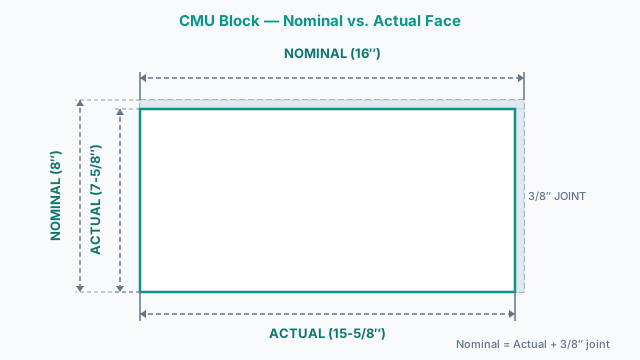
Blocks with Waste = ⌈Blocks Needed × (1 + Waste%)⌉Estimating uses nominal dimensions, not actual — the 3/8″ mortar joint is absorbed into the 8×16 module. Using actual dimensions (7-5/8×15-5/8) would overcount by ~5%.
- 3) Mortar BagsBags (80 lb) = ⌈Blocks with Waste ÷ 13⌉
Bags (60 lb) = ⌈Blocks with Waste ÷ 9.75⌉Coverage is the same for all standard CMU widths — bed and head joint surface area per block does not change with nominal width.
- 4) Pallet Order QuantityPallets = ⌈Blocks with Waste ÷ Blocks per Pallet⌉
(Blocks per pallet varies by nominal width — see the CMU size table)
Worked Takeoff: Bid-Level Takeoff for an Exterior 8″ CMU Wall
An estimator is taking off 8″ CMU blocks for a 24 ft long × 10 ft high exterior wall. The opening schedule shows one 3 ft × 4 ft window opening and one 3 ft × 7 ft door opening.
- Gross wall area: 24 ft × 10 ft = 240 sq ft
- Window opening: 3.0 ft × 4.0 ft = 12.0 sq ft
- Door opening: 3.0 ft × 7.0 ft = 21.0 sq ft
- Net wall area: 240 − 12 − 21 = 207 sq ft
- Blocks (no waste): 207 × 1.125 = 232.9 → 233 blocks
- 10% bid-level waste: 233 × 1.10 = 256.3 → order 258 blocks (rounded up to maintain full coursing)
- Mortar (80 lb bags): 258 ÷ 13 = 19.8 → 20 bags
- Pallet check: 258 ÷ 80 blocks/pallet = 3.23 → order 4 pallets (320 blocks, 62 extra for stockpile/contingency)
- Total block weight: 258 × 38 lb = 9,804 lb ≈ 4.9 tons — confirm delivery vehicle capacity
Ordering 4 full pallets (320 blocks) rather than a partial 4th pallet saves the restocking charge and leaves 62 blocks of contingency — standard practice for CMU takeoffs. If the project also specifies 6″ CMU for interior partitions, run a separate takeoff for that size: same 1.125 coverage rate, but 6″ NW blocks weigh ~32 lb, so the pallet weight and footing load calculations will differ.
Quantity Mistakes in CMU Estimating
- 1.Using actual dimensions instead of nominal in the area calculation.Architects draw to the nominal module (8×16), but actual blocks measure 7-5/8×15-5/8. Estimating to actual dimensions rather than nominal will overcount blocks by approximately 5% — roughly 56 extra blocks on a 1,000-block project. The industry convention is to calculate using nominal dimensions, which is what this calculator applies.
- 2.Recalculating coverage per size when it is actually identical across all widths.4", 6", 8", 10", and 12" CMU all land at exactly 112.5 blocks per 100 sq ft because the face height (8" nominal) and face length (16" nominal) do not change with width. An estimator who recalculates per size on a multi-size project wastes time and risks introducing a rounding error. Confirm once from the size table and apply 1.125 blocks/sf universally.
- 3.Not reconciling block count against pallet quantities before ordering.If your takeoff produces 258 blocks and your supplier's 8" CMU pallet holds 80 blocks, you are ordering 3.23 pallets. Most masonry suppliers charge a partial pallet fee of $30–75 or require a minimum full pallet order. Sizing your order to 4 full pallets (320 blocks) costs a few extra blocks but avoids the fee. Always convert block count to pallets before placing the order.
- 4.Treating mortar consumption as size-dependent.An 8" CMU and a 4" CMU have identical bed and head joint surface areas per block — mortar coverage is the same: 1 bag per 13 blocks (80 lb) or 1 bag per 9.75 blocks (60 lb), regardless of nominal width. Many estimators mistakenly recalculate mortar per size thinking wider blocks need more mortar per block, which is incorrect.
When to Use the CMU Calculator vs. Related Tools
This CMU sizing calculator is built for the estimating context: reading a set of architectural drawings, selecting a block size, and producing a bid-quality takeoff with coverage rates, mortar bag counts, pallet quantities, and weight totals. If the project has structural requirements — grouted cells, vertical rebar, bond beams, seismic detailing — use the Concrete Block Calculator, which is designed around the full structural reinforcement schedule including grout volume, rebar linear footage, and bond beam block counts. If you are a homeowner shopping at a home center and your primary question is “what will this wall cost in materials and how many blocks do I put in the truck?” — the Cinder Block Calculator leads with the DIY cost breakdown and current U.S. price ranges. When your CMU wall rests on a poured footing slab, the Slab Concrete Calculator estimates the footing volume, and the Concrete Slab Cost Calculator extends that to a footing budget. Where the takeoff includes a separate stone or brick veneer section priced apart from the CMU coursing, the Mortar Calculator isolates that mortar volume and bag count.
Product Standards & Specs
Defines nominal dimensions, actual dimensional tolerances (± 1/8″ on width and height, ± 1/4″ on length), density class requirements (NW/MW/LW), minimum net area compressive strength (1,900 psi), and maximum water absorption limits for all standard CMU produced in the U.S. The sizing table on this page is based on ASTM C90 nominal and actual dimension conventions.
Governs mortar types M (2,500 psi), S (1,800 psi), N (750 psi), and O (350 psi) used to bond CMU blocks. The mortar bag coverage rate used in this calculator (1 bag per 13 blocks for 80 lb bags) applies to Type S mortar at a standard 3/8″ joint — the most common specification for structural CMU walls.
The primary U.S. masonry structural code governing wall thickness minimums, reinforcement schedules, grouting requirements, and seismic design categories for CMU construction. This sizing calculator produces bid-level block counts; structural design for load-bearing CMU walls must follow TMS 402.
CMU sizing estimates from this calculator are for procurement and bid planning; grouting schedules, rebar sizing, bond beam requirements, and seismic reinforcement must be specified by a licensed structural engineer per TMS 402 for any load-bearing CMU application.
Quantity & Ordering Questions
What does CMU stand for in construction?
CMU stands for Concrete Masonry Unit — the technically correct term used by engineers, architects, and masonry contractors. CMU encompasses all hollow and solid concrete blocks regardless of nominal size, density class, or application. In everyday language, CMU blocks are called 'concrete blocks' or 'cinder blocks,' but in a specification or bid document, CMU is the proper term. ASTM C90 is the primary standard governing load-bearing CMU in the U.S.
What is the difference between nominal and actual CMU dimensions?
Nominal dimensions include one mortar joint (3/8" standard) in each direction. A nominal 8×8×16 CMU has actual manufactured dimensions of 7-5/8" × 7-5/8" × 15-5/8" — 3/8" less per face in width, height, and length. When assembled with a 3/8" mortar joint, the module measures exactly 8×16 nominal. Architectural drawings and estimating always use nominal dimensions; actual dimensions appear on the ASTM C90 tolerances specification and the manufacturer's product data sheet.
How many CMU blocks are in 100 square feet?
All standard U.S. CMU blocks with an 8×16 nominal face produce exactly 112.5 blocks per 100 square feet of wall face. This applies to 4", 6", 8", 10", and 12" nominal widths equally — the face area (0.8889 sf per block) is identical for all widths because only the wall thickness changes, not the face height or length. This is the most important number in CMU estimating: memorize 112.5 per 100 sf.
Do larger CMU widths (10", 12") require more blocks per square foot?
No. The face height and length of standard U.S. CMU remain 8"×16" nominal regardless of nominal width. A 12" CMU covers exactly the same 0.8889 sq ft per block as a 4" CMU. Changing width only changes wall thickness, weight per block, and unit cost — not the coverage rate. Estimators who recalculate coverage per size will always arrive at the same 1.125 blocks/sf answer.
How many 8×8×16 CMU blocks are on a standard pallet?
Standard pallet quantities for 8×8×16 normal-weight CMU typically run 72–90 blocks per pallet, depending on manufacturer and block weight class. A lighter medium-weight 8" CMU pallet may hold 84–90 blocks; heavier normal-weight 8" CMU typically ships 72–84 per pallet. Always confirm pallet size with your masonry supplier before placing the order, since partial pallets usually incur a restocking fee.
How much does a standard 8×8×16 CMU block weigh?
Weight depends on the ASTM C90 density class. Normal-weight (NW, ≥125 pcf) 8×8×16 CMU blocks weigh 33–38 lb per block. Medium-weight (MW, 105–125 pcf) blocks run 28–33 lb. Lightweight (LW, 85–105 pcf) blocks run 22–28 lb. A full pallet of 80 NW 8" blocks weighs approximately 2,720–3,040 lb — always confirm delivery vehicle capacity for multiple-pallet orders.
What is the coverage rate for 4" CMU vs 8" CMU?
Identical — both produce 1.125 blocks per square foot (112.5 per 100 sf). The 3/8" mortar joint convention applies the same way to all standard face-height CMU regardless of width. A 4" CMU and 12" CMU produce the same block count per square foot of wall face; only the wall thickness, dead load on the footing, and cost per block differ.
What is the standard mortar joint thickness for CMU construction?
The standard mortar joint for CMU construction is 3/8" (9.5 mm) for both bed joints (horizontal) and head joints (vertical). This joint thickness is built into the nominal module (block + 3/8" joint = nominal 8" height, nominal 16" length). Tooled-joint and raked-joint profiles vary in appearance but maintain the same 3/8" joint thickness for coverage rate calculation purposes.
How many mortar bags do I need per 100 CMU blocks?
Approximately 8 bags of 80 lb mortar per 100 standard CMU blocks at a standard 3/8" joint — the same figure applies to all nominal widths (4" through 12") because bed and head joint surface area per block does not change with width. For 60 lb bags, use approximately 11 bags per 100 blocks. These are average yields; actual consumption varies slightly by mortar mix consistency and mason technique.
What are the ASTM C90 density classifications for CMU?
ASTM C90 defines three density classes based on oven-dry density: Normal Weight (NW) at 125 pcf or greater, Medium Weight (MW) from 105 to 125 pcf, and Lightweight (LW) from 85 to 105 pcf. NW blocks use stone or gravel aggregate; MW blocks use a blend; LW blocks use expanded shale, clay, slate, or fly ash aggregate. All three classes must meet the same minimum 1,900 psi net area compressive strength requirement.
What is the difference between heavyweight, medium-weight, and lightweight CMU?
The difference is aggregate type and resulting density. Normal-weight CMU (stone/gravel aggregate) provides maximum structural density and is the standard for load-bearing and below-grade applications. Medium-weight CMU is used where moderate weight reduction is preferred without sacrificing too much structural density. Lightweight CMU (expanded aggregate) reduces dead load on footings and is easier to handle, but costs more per block and has lower thermal conductivity — making it preferred for above-grade partitions and energy-performance walls.
What is a half-block and when is it used in CMU construction?
A half-block is a CMU with a nominal length of 8" (half of the standard 16" block) used to maintain running-bond coursing at wall ends, corners, and beside openings. Without half-blocks, you would need to cut full blocks at every end, increasing waste and labor. Most masonry suppliers stock half-blocks in the same nominal widths as full blocks. When estimating, add approximately 5–10% half-block quantity for walls with many corners or closely spaced openings.
How do I convert a CMU block count to pallet orders?
Divide the total block count (including waste allowance) by the blocks-per-pallet for your nominal size, then round up to the nearest whole pallet. For 8" CMU at 80 blocks/pallet: 250 blocks ÷ 80 = 3.125 → order 4 pallets (320 blocks). Sizing to full pallets avoids partial-pallet restocking fees, which typically run $30–75 per pallet at most masonry suppliers. The leftover blocks serve as jobsite contingency for breakage and future repairs.
Where should I use 12" CMU instead of 8"?
12" CMU is specified when 8" cannot satisfy the combined structural demand: multi-story load-bearing walls where the combined gravity load exceeds 8" capacity, below-grade retaining walls exceeding approximately 8 ft of retained height, walls requiring larger vertical rebar (#6, #7) that would crowd an 8" core, and applications where high thermal mass or superior fire-resistance rating is needed. TMS 402 Table 5.3 sets minimum wall thickness ratios by height-to-thickness for various load conditions.
Can this CMU calculator be used for metric projects?
Yes. Enable the metric toggle to enter dimensions in meters and receive outputs in m² (net wall area), block count, kg (mortar), and metric weight per pallet. Note that metric CMU projects outside the U.S. may use different nominal block face dimensions — confirm with your regional standard (e.g., ISO 6364 for international CMU dimensions) if the project is not using U.S. standard 8×16 nominal face blocks.
What is the difference between a CMU block calculator and a concrete block calculator?
On this site, the CMU Block Calculator (this page) is the trade-level sizing and coverage reference — nominal vs actual dimensions, coverage per size, pallet quantities, and bid-level takeoffs. The Concrete Block Calculator is designed for structural applications, extending the block count to include grout volume, vertical rebar lengths, and bond beam scheduling required for load-bearing ASTM C90 walls. Both calculators use the same block count formula; the structural calculator adds the engineered reinforcement schedule on top.
Related Calculators
Concrete Block Calculator
Estimate concrete blocks, mortar, grout, reinforcement, and cost for CMU block walls.
Cinder Block Calculator
Calculate cinder block quantity, mortar bags, and total wall cost including openings deduction and waste allowance.
Mortar Calculator
Estimate 80 lb, 60 lb, and 40 lb mortar bag counts for block walls, brick veneer, and stone veneer with ASTM C270 type selection and waste allowance.
Wall Concrete Calculator
Vertical concrete wall volumes, single or multi-segment.
Retaining Wall Calculator
Estimate SRW blocks, drainage gravel, geogrid layers, and installed cost — with IBC 2021 §1807.2.3 compliance checks for walls over 4 ft.