Structural CMU Wall Estimating: Block Count, Grout Cells, and Reinforcement
Estimating a load-bearing CMU wall demands more than dividing wall area by block face coverage. A structural concrete block wall carries gravity loads, resists wind pressure, and — in seismic zones — must transfer lateral forces through fully grouted and reinforced cells. Miscounting grouted cells can leave a wall 20–40% short on grout volume; skipping bond beam blocks forces a mid-project special order that stalls the crew. The failure mode is systematic: every course above the missed schedule multiplies the undercount. For the complete block-wall estimating workflow, see our pillar guide on estimating concrete blocks for a wall.
This structural concrete block calculator computes your block count from gross wall dimensions and opening deductions, then extends the estimate to grout volume for partial or full cell fill, vertical rebar lengths by spacing and bar size, and bond beam block counts at any course interval. Outputs are expressed in the units a structural spec requires: block count with waste, grout in cubic feet and cubic yards, rebar in linear feet by bar size (#4 or #5), mortar bags for both 60 lb and 80 lb options, and an optional structural wall cost. To get the grout and mortar mix right, see our guide on concrete mix ratios; for the vertical bars and bond beams, our rebar sizing & spacing reference; and to budget the wall, our overview of how much concrete costs.
Grouting & Reinforcement Schedule — Structural CMU Reference
The table below reflects TMS 402 / ACI 530 prescriptive guidance for common residential and light-commercial CMU wall applications. It is an estimating reference — retaining walls, seismic SDC C and above, walls carrying floor or roof framing, and any application requiring an engineered design must have a licensed structural engineer specify the actual schedule.
| Application | ASTM Class | Grouting | Vertical Rebar | Bond Beam Spacing |
|---|---|---|---|---|
| Interior partition (non-structural) | ASTM C129 | None required | None | Not required |
| Interior load-bearing wall | ASTM C90 | Partial — every other cell | #4 @ 48″ o.c. | Every 8 courses (~64″) |
| Exterior load-bearing wall | ASTM C90 | Partial — every other cell | #4 @ 24″ o.c. | Every 4 courses (~32″) |
| Below-grade foundation wall | ASTM C90 | Full grout — all cells | #5 @ 24″ o.c. | Every 4 courses (~32″) |
| Seismic Design Cat. C–D | ASTM C90 | Full grout — all cells | #5 @ 16″ o.c. | Every other course (~16″) |
Entering Your Structural CMU Wall Quantities
- 1Enter gross wall length and height in feet and inches (outer dimensions, before deducting openings).
- 2Select your structural CMU width — 8", 10", or 12" for most load-bearing applications; 6" for lighter bearing walls; 4" for non-structural partitions only.
- 3Add wall openings (doors, windows, pass-throughs) with their width, height, and quantity.
- 4Set your waste percentage — 5% for standard running bond structural walls, 8–10% for complex coursing patterns, corners, or seismic detailing.
- 5Enable Grout/Core Fill: choose full grout (all cells filled, required for SDC C–D) or partial grout (specify spacing — e.g., every other cell = every 16").
- 6Enable Reinforcement: enter vertical rebar spacing (16", 24", or 48" o.c.) and select bar size (#4 or #5) per your structural drawings.
- 7Set bond beam spacing in courses (every 4th course = 32" height is typical for exterior load-bearing) or enter the spacing in inches.
- 8Select mortar bag size (60 lb or 80 lb) and enter optional unit prices for block, mortar, grout, and rebar to generate a structural wall cost estimate.
- 9Click Calculate to generate block count, mortar bags, grout volume (cf and yd³), rebar linear footage, bond beam block count, and optional cost breakdown.
- 10Review the reinforcement schedule summary and cross-check against your structural drawings before placing the material order.
How the Structural CMU Block Count Is Calculated
- 1) Net Wall AreaGross Wall Area = Length × Height
Net Wall Area = Gross Area − Σ(Opening Width × Opening Height × Qty)Opening deductions use the full rough opening dimension, not the finish frame size.
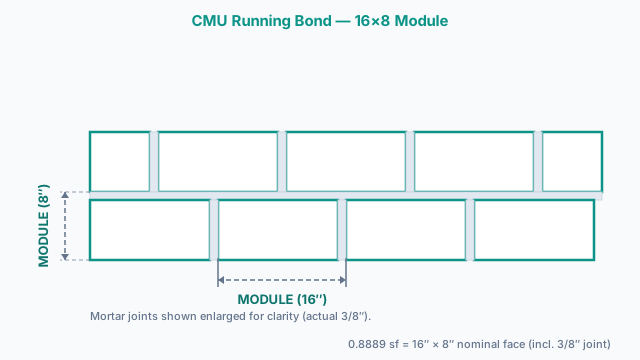
- 2) Block Count with WasteBase Blocks = Net Wall Area ÷ 0.8889 sf
Final Blocks = ⌈Base Blocks × (1 + Waste% ÷ 100)⌉Face coverage of 0.8889 sf is identical for all nominal widths (4″ through 12″) — height and length stay at 8″ × 16″ nominal.
- 3) Mortar EstimationMortar Bags (80 lb) = ⌈Final Blocks ÷ 13⌉
Mortar Bags (60 lb) = ⌈Final Blocks ÷ 9.75⌉ - 4) Grout VolumeFully grouted: Total Grout (cf) = Final Blocks × 0.0185 cf per block
Partially grouted (every Nth cell): Total Grout = (Final Blocks ÷ N) × 0.0185 cf
Grout in Cubic Yards = Total cf ÷ 270.0185 cf is the approximate net core volume per two-cell 8×8×16 CMU block. Actual volume varies slightly by manufacturer core geometry.
- 5) Vertical RebarGrouted Cell Columns = Wall Length ÷ Rebar Spacing (ft)
Total Rebar Length = Cell Columns × Wall Height + Lap Splices (24× bar diameter per splice) - 6) Bond Beam BlocksBond Beam Courses = ⌊Wall Height ÷ Bond Beam Spacing⌋
Bond Beam Blocks per Course = Wall Length ÷ 1.333 ft (per block module)
Total Bond Beam Blocks = Bond Beam Courses × Blocks per Course
Worked Takeoff: Exterior Load-Bearing 8″ CMU Wall
A contractor is building a 40 ft long × 8 ft high exterior load-bearing wall using 8″ CMU (ASTM C90), with two 3 ft × 7 ft door openings. The structural engineer has specified partial grouting every other cell with #4 vertical rebar at 24″ o.c., and bond beams every 4 courses.
- Gross wall area: 40 ft × 8 ft = 320 sq ft
- Opening deduction: 2 openings × (3 ft × 7 ft) = 42 sq ft
- Net wall area: 320 − 42 = 278 sq ft
- Base block count: 278 ÷ 0.8889 = 312.7 → 313 blocks
- With 5% waste: 313 × 1.05 = 328.7 → order 330 blocks
- Mortar (80 lb bags): 330 ÷ 13 = 25.4 → 26 bags (Type S)
- Grout (partial, every other cell): 330 ÷ 2 = 165 grouted cells × 0.0185 cf = 3.05 cf (0.11 yd³)
- Vertical rebar (#4 @ 24″ o.c.): 40 ft ÷ 2 ft = 20 vertical bars × 8 ft = 160 LF total
- Bond beams (every 4 courses = 32″): 8 ft ÷ 2.67 ft ≈ 3 bond beam courses × (40 ft ÷ 1.333 ft) = 90 bond beam CMU blocks
The reinforcement materials — 160 LF of #4 rebar, 90 special bond beam blocks, and 3 cf of masonry grout — would be entirely missing from a simple block-count estimate. For a wall this size, grout and rebar typically add 15–25% to the material cost, and the bond beam blocks require a separate SKU from your masonry supplier.
Quantity Mistakes in Structural CMU Estimation
- 1.Estimating blocks only and omitting grout volume.Fully grouted 8″ CMU walls need approximately 0.185 cf of grout per 10 standard two-cell blocks. On a 2,000 sq ft project, that is 37 cf (1.37 yd³) of grout that disappears from a block-only count. Adding grout as an afterthought during construction often means ordering a separate partial batch at premium pricing.
- 2.Specifying ASTM C129 blocks for a load-bearing application.ASTM C129 (non-load-bearing) minimum net compressive strength is 500 psi. ASTM C90 (load-bearing) requires 1,900 psi. The blocks look identical on the pallet — the ASTM classification is on the shipping tag, not the block face. Using the wrong class will fail inspection, and replacing installed blocks mid-wall is extremely costly.
- 3.Omitting bond beam CMU blocks from the material takeoff.Bond beam blocks have an open-top U-channel that accepts horizontal rebar — they are a different SKU from standard stretcher blocks and must be specifically ordered. A 40 ft wall at 4-course bond beam spacing needs approximately 30 special bond beam CMU blocks per course. Missing them means a mid-project special order that stalls the masonry crew for days.
- 4.Applying a rule-of-thumb rebar spacing without checking the Seismic Design Category.Vertical rebar spacing that satisfies TMS 402 prescriptive requirements in Seismic Design Category A (48″ o.c. maximum) is non-compliant in SDC C (24″ o.c.) and SDC D (16″ o.c.). The rebar quantity difference between SDC A and SDC D on the same wall can be 3× — always confirm the SDC with the structural engineer before finalizing the estimate.
When to Use the Structural CMU Calculator vs. Related Tools
This structural concrete block calculator is designed for walls that must carry loads: foundations, load-bearing walls, below-grade retaining walls, and seismically reinforced partitions. If your project is a homeowner DIY job — a garden bed border, a low screen wall, or a decorative backyard feature — and your primary question is total material cost at current home-center prices, the Cinder Block Calculator leads with the cost-driver table and DIY budget breakdown, including per-block pricing and delivery estimates. For trade estimators reading architectural drawings who need a coverage-per-size lookup — how many 4″, 6″, 10″, and 12″ CMU land in 100 sq ft, with pallet counts and mortar bags per size — use the CMU Block Calculator, which owns the full nominal-vs-actual size reference table. When structural CMU walls include poured concrete footings, the Slab Concrete Calculator estimates the footing concrete volume, and the Concrete Slab Cost Calculator can extend that into a footing budget. For the vertical bars this calculator's grouted cells are sized around, the Rebar Calculator cross-checks total bar length and count against the reinforcement schedule. And if the wall also needs a separate mortar bag count for a mixed-material bid — say a stone or brick veneer alongside the CMU — the Mortar Calculator gives a dedicated mortar-only estimate.
ASTM Material Specs
Sets the minimum net area compressive strength (1,900 psi), maximum water absorption, and dimensional tolerances for all load-bearing CMU blocks used in the structural wall systems estimated by this calculator.
Covers non-structural CMU (minimum 500 psi net area) for partitions and infill. Distinguishing ASTM C90 from C129 is the first classification decision in any structural CMU estimate — the two grades look identical on the pallet.
The primary U.S. masonry structural code — governs grout schedules (Chapter 5), reinforcement requirements by Seismic Design Category (Chapter 7), bond beam spacing, and maximum rebar size for each wall thickness. The prescriptive reference table above is derived from TMS 402 allowable stress design provisions.
Specifies fine and coarse masonry grout proportions and minimum 28-day compressive strength (2,000 psi) for CMU cell filling. The grout volume outputs from this calculator should be ordered to ASTM C476 for any structural grouting application.
Grouting schedules, reinforcement sizing, bond beam spacing, and seismic design requirements must be specified by a licensed structural or masonry engineer per TMS 402; block counts from this calculator are for planning and procurement, not structural design.
Structural CMU Takeoff FAQ
What is the difference between ASTM C90 and ASTM C129 concrete blocks?
ASTM C90 specifies load-bearing CMU with a minimum net area compressive strength of 1,900 psi and strict water absorption limits. ASTM C129 covers non-load-bearing CMU with a minimum of 500 psi — used only for partitions and infill. Both produce blocks that look identical; the ASTM class is on the shipping tag or manufacturer's test report. Never use C129 in a wall that carries structural loads.
When does a CMU wall require grout?
Grouting is required whenever a CMU wall carries structural loads through reinforced cells. TMS 402 requires grout in all cells containing vertical rebar, and full-cell grouting in all cells for walls in Seismic Design Categories C and above. Non-structural partition walls (ASTM C129) do not require grout. For residential exterior load-bearing walls in low-seismic areas, partial grouting at every other cell is typically acceptable.
How do you calculate grout volume for a grouted CMU wall?
Multiply the number of grouted cells by the core volume per cell. A standard 8×8×16 two-cell CMU has a net core volume of approximately 0.0185 cubic feet per block course. Fully grouted: Total Grout (cf) = Block Count × 0.0185. Partially grouted (every other cell): Total Grout = (Block Count ÷ 2) × 0.0185. Convert to cubic yards by dividing by 27 — a 1,000-block fully grouted wall needs roughly 0.69 yd³ of masonry grout.
What is a bond beam in CMU construction?
A bond beam is a horizontal reinforced course that ties a CMU wall together and distributes lateral loads. Bond beam blocks have an open-top U-channel that lets horizontal rebar run continuously through the course before the channel is grouted solid. TMS 402 prescriptive design requires bond beams every 4 courses (32″) for typical exterior load-bearing walls, and every other course (16″) in seismic SDC C–D.
How far apart should vertical rebar be spaced in a load-bearing CMU wall?
TMS 402 prescriptive spacings for vertical rebar: 48″ o.c. maximum for low-seismic interior load-bearing walls, 24″ o.c. for exterior load-bearing walls in SDC A–B, and 16″ o.c. for SDC C–D. These are estimating reference values — confirm with the engineer of record, since actual spacing also depends on wall height, wall thickness, and the magnitude of gravity and lateral loads.
What mortar type is used for structural CMU walls?
ASTM C270 defines four types. Type S (minimum 1,800 psi) is standard for exterior and below-grade load-bearing CMU. Type M (2,500 psi) is used for very high-load or severe-exposure below-grade applications. Type N (750 psi) is acceptable only for above-grade non-structural walls. For any structural CMU wall, specify Type S unless the engineer calls for Type M.
What is the minimum wall thickness for a load-bearing CMU wall?
TMS 402 sets the minimum nominal thickness at 6″ for load-bearing CMU walls, but 8″ is the standard for most residential and commercial applications. 10″ and 12″ CMU are specified for multi-story bearing walls, heavy roof or floor loads, retaining walls taller than 8 ft, or any application where the structural engineer determines that 8″ is insufficient for the combined load case.
What is the difference between a fully grouted and partially grouted CMU wall?
A fully grouted wall has every cell (core) filled with masonry grout regardless of rebar location — maximizing compressive strength, thermal mass, and lateral resistance. A partially grouted wall fills only the cells containing vertical rebar. Partial grouting is more economical for low-to-moderate seismic zones and lightly loaded walls; TMS 402 requires full grouting in SDC C–D and for most retaining wall designs.
How many bond beam courses are needed for a typical 8-foot CMU wall?
For a standard exterior load-bearing CMU wall using TMS 402 prescriptive design, bond beams every 4 courses equals one bond beam every 32 inches. An 8 ft (96″) wall typically needs bond beams at approximately 32″, 64″, and 96" — three bond beam courses. Each course requires special open-top bond beam CMU blocks (not standard stretchers) spanning the full wall length.
What is the compressive strength of ASTM C90 concrete blocks?
ASTM C90 requires a minimum net area compressive strength of 1,900 psi. Most manufacturers produce blocks at 2,000–3,000 psi net area in practice. Note that gross area strength (which includes the hollow core) is considerably lower — typically 700–1,200 psi — but structural design calculations for CMU always use the net area value. Request the manufacturer's ASTM C90 test report to confirm the specific lot strength.
When should I specify 10″ or 12″ CMU instead of 8″?
10" and 12" CMU are used when 8" CMU cannot satisfy the combined structural demand: multi-story bearing walls, heavily loaded single-story industrial floors, below-grade retaining walls exceeding approximately 8 ft height, or walls requiring larger-diameter rebar (#6 or #7) that won't fit properly inside an 8" core. TMS 402 Table 5.3 ties minimum wall thickness to height-to-thickness ratios and load conditions.
Do I need special lintel blocks above openings in a structural CMU wall?
Yes. The courses above door and window openings in a structural CMU wall require lintel blocks (also called U-blocks or beam blocks), which are filled with horizontal rebar and grout to form a continuous lintel beam. Lintel spans up to 6 ft wide can often be handled by a single-course lintel; wider spans or heavy loads may need multi-course lintels or steel angle lintels. Lintel blocks are a different SKU from standard CMU stretchers and must be included in the material takeoff separately.
How many concrete blocks are on a standard pallet?
Standard pallet quantities for 8×8×16 CMU blocks typically run 72–90 blocks per pallet depending on the manufacturer and weight class. Lighter 6″ CMU usually packs 90–108 per pallet; narrow 4" CMU runs 120–144 per pallet. Heavier 10" and 12" CMU typically packs 48–72 per pallet. Confirm pallet size with your masonry supplier before ordering — partial pallets at most suppliers incur a restocking charge.
Can this calculator be used for retaining walls?
This calculator can produce a block count for a retaining wall, but retaining wall structural design requires engineering. Retaining walls must resist lateral earth pressure whose magnitude depends on soil type, surcharge loads, wall height, and drainage — none of which this calculator can assess. Use the block count and grout volume outputs for procurement planning only, and have a licensed structural engineer specify the actual rebar schedule, footing dimensions, and drainage design.
How accurate is the block count from this calculator?
Block counts are accurate to within ±3–5% when wall dimensions, openings, and waste are correctly entered. Grout volume estimates assume standard two-cell 8×8×16 CMU with a 0.0185 cf core volume per block — actual grout volume varies slightly by manufacturer core geometry. Rebar length estimates assume straight wall runs; for walls with lap splices, add 24× bar diameter (12″ for #4 rebar) at each splice location.
Related Calculators
Cinder Block Calculator
Calculate cinder block quantity, mortar bags, and total wall cost including openings deduction and waste allowance.
CMU Block Calculator
Estimate CMU block quantity, deduct openings, add waste, and calculate full installed wall cost.
Mortar Calculator
Estimate 80 lb, 60 lb, and 40 lb mortar bag counts for block walls, brick veneer, and stone veneer with ASTM C270 type selection and waste allowance.
Wall Concrete Calculator
Vertical concrete wall volumes, single or multi-segment.
Retaining Wall Calculator
Estimate SRW blocks, drainage gravel, geogrid layers, and installed cost — with IBC 2021 §1807.2.3 compliance checks for walls over 4 ft.