Estimating Concrete Driveway Costs: Beyond the Volume
A driveway volume estimate that stops at cubic yards misses most of what drives your final invoice. Ready-mix suppliers bill in quarter-yard increments, charge flat delivery fees, and apply short-load surcharges the moment your order drops below their full-truck threshold — typically 3 to 7 cubic yards. The Concrete Driveway Cost Calculator models every one of these line items, so the figure you see before calling the plant closely matches what appears on the delivery ticket. This calculator focuses on cost estimation; for a pure volume calculation without pricing, the concrete yards calculator is the lighter tool. For regional 2025 price ranges and what drives them, read our pillar guide on how much concrete costs.
Enter your driveway dimensions and slab thickness, then provide your supplier's price per cubic yard, delivery fee, and any short-load terms they quoted. The calculator applies a configurable waste allowance, rounds the order up to the nearest quarter-yard exactly as suppliers invoice it, and outputs a fully itemized cost breakdown: concrete material, delivery, short-load surcharge, optional add-ons such as pump truck or fiber reinforcement, and a project total. It also supports a bagged-concrete path for small patch repairs, producing bag counts for both 60 lb and 80 lb sacks — useful when comparing home-center bag costs against a truck quote using the concrete bag calculator. For slab-specific pricing, see how much a concrete slab costs; for the underlying volume math, how to calculate concrete for a slab; and to price the compacted sub-base, our gravel coverage & tonnage guide.
Concrete Driveway Cost Drivers, Line by Line
The order quantity is rounded up to the nearest quarter-yard the way suppliers actually invoice — not the raw geometric volume — and a short-load surcharge applies automatically once your order falls below the truck-minimum threshold you enter, which is where most DIY driveway estimates come up short against the real delivery ticket. The table below lines up every driver that moves a driveway quote, from material and delivery through thickness and finish.
| Cost Driver | Typical Range | Notes |
|---|---|---|
| Ready-mix concrete material | $120–$210/yd³ | See our sourced regional price survey below — dated, per-metro figures, not a blended national guess |
| Delivery fee | Flat fee, set by supplier | Charged regardless of order size — confirm before ordering |
| Short-load surcharge | $50–$150 flat (or a per-yard rate bump) | Triggers once the order falls below the plant's 5–7 yd³ full-truck minimum; most 4″ driveways (4–6 yd³) land in this zone |
| Thickness 4″ → 5″ (trucks/SUVs) | ≈20% more volume & material cost | 4,000 psi min. — ACI 330R-14 light-commercial threshold |
| Thickness 4″ → 6″ (RVs, heavy loads) | ≈50% more volume & material cost | 4,500 psi min. — pair with rebar or fiber reinforcement |
| Polypropylene fiber reinforcement | $6–$12/yd³ | Controls plastic-shrinkage cracking; common in place of wire mesh |
| Broom finish | Included | Standard; maximum wet-weather traction |
| Exposed aggregate finish | +$2–$4/sq ft | Natural stone look; seeding or surface washing |
| Stamped concrete finish | +$8–$20/sq ft | Mimics stone, brick, or tile patterns; most labor-intensive |
| Integral color | +$3–$6/sq ft | Pigment added at the plant; UV-stable options available |
| Penetrating sealer | +$0.50–$1.50/sq ft | Extends surface life 3–5× in freeze-thaw zones |
Labor, forming, finishing, demolition of an existing slab, and sub-base preparation are separate contractor line items not covered above — see the common mistakes below for typical add-on ranges.
Real Ready-Mix Prices, By Metro (Sourced & Dated)
Instead of a single unattributed "national average," here is our first-party price survey: published supplier rate sheets, one direct written plant quote, and BLS regional price-trend data, metro by metro. Every row links to its source and shows the date it was collected or published.
| 4000 PSI ($/yd³) | Dated | ||||
|---|---|---|---|---|---|
| Chicago IL | Midwest | $162–$170 | $173–$182 | HomeBlue Aggregator (attributed) | 2025-03-05 |
| Columbus OH | Midwest | $128–$134 | $137–$144 | HomeBlue Aggregator (attributed) | 2025-03-05 |
| Kansas City MO | Midwest | $145–$153 | $155–$163 | HomeBlue Aggregator (attributed) | 2025-03-05 |
| Minneapolis MN | Midwest | $155–$163 | $166–$174 | HomeBlue Aggregator (attributed) | 2025-03-05 |
| Boston MA | Northeast | $173–$181 | $185–$194 | HomeBlue Aggregator (attributed) | 2025-03-05 |
| Philadelphia PA | Northeast | $163–$172 | $175–$184 | HomeBlue Aggregator (attributed) | 2025-03-05 |
| Atlanta GA | South | $135–$142 | $144–$152 | HomeBlue Aggregator (attributed) | 2025-03-05 |
| Augusta GA | South | $174 | $182 | American Concrete (Augusta) Primary supplier | 2026-04-01 |
| Charlotte NC | South | $129–$135 | $138–$145 | HomeBlue Aggregator (attributed) | 2025-03-05 |
| Dallas TX | South | $126–$132 | $135–$141 | HomeBlue Aggregator (attributed) | 2025-03-05 |
| Houston TX | South | $136 | $143 | LS Ready Mix, LLC Primary supplier | 2026-07-13 |
| Houston TX | South | $130–$145 | — | Buck's Ready Mix Primary supplier | 2025-06-29 |
| Nashville TN | South | $128–$134 | $136–$143 | HomeBlue Aggregator (attributed) | 2025-03-05 |
| Tampa FL | South | $125–$131 | $133–$140 | HomeBlue Aggregator (attributed) | 2025-03-05 |
| Denver CO | West | $142–$149 | $152–$159 | HomeBlue Aggregator (attributed) | 2025-03-05 |
| Las Vegas NV | West | $143–$150 | $153–$161 | HomeBlue Aggregator (attributed) | 2025-03-05 |
| Phoenix AZ | West | $134–$141 | $143–$151 | HomeBlue Aggregator (attributed) | 2025-03-05 |
| Portland OR | West | $149–$157 | $160–$168 | HomeBlue Aggregator (attributed) | 2025-03-05 |
| Salt Lake City UT | West | $131–$137 | $140–$147 | HomeBlue Aggregator (attributed) | 2025-03-05 |
| Seattle WA | West | $166–$174 | $177–$186 | HomeBlue Aggregator (attributed) | 2025-03-05 |
Compiled 2026-07 from publicly listed supplier prices, one direct written supplier quote, and BLS regional producer-price data. Every figure carries a source link and collection date. Prices move — confirm with your local plant before ordering. Compiled 2026-07-14. Full dataset with every source URL: download the CSV.
BLS Producer Price Index for Ready-Mix Concrete Manufacturing, 2026-05, via the FRED database. An index of price change, not a $/yd³ figure — national and regional series use different base periods and are not directly comparable to each other.
A Real Single-Car Driveway Budget, Costed Out
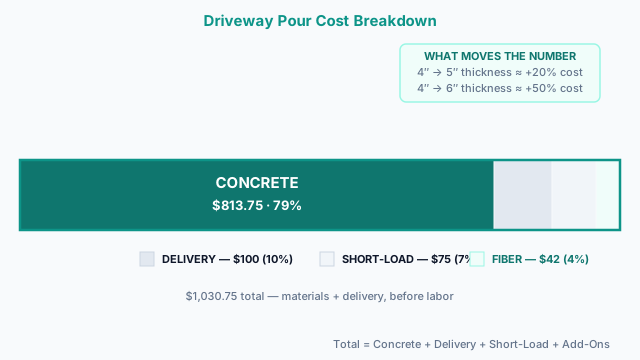
A homeowner replacing a single-car driveway measures the slab at 40 ft long × 10 ft wide, poured 4 inches thick. The local plant quoted $155/yd³, a $100 flat delivery fee, and a $75 short-load surcharge for orders below 7 yd³. They also want polypropylene fiber dosed at $8/yd³. Here is the full calculation walk-through:
- Step 1 — Gross area: 40 × 10 = 400 ft²
- Step 2 — Raw volume: 400 × (4 ÷ 12) ÷ 27 = 400 × 0.3333 ÷ 27 ≈ 4.94 yd³
- Step 3 — 5% waste allowance: 4.94 × 1.05 = 5.19 yd³
- Step 4 — Quarter-yard rounding: CEILING(5.19 ÷ 0.25) × 0.25 = 5.25 yd³ ordered
- Step 5 — Concrete cost: 5.25 × $155 = $813.75
- Step 6 — Delivery fee: $100.00
- Step 7 — Short-load fee: 5.25 yd³ is below the 7 yd³ threshold → $75.00 surcharge applies
- Step 8 — Fiber reinforcement: 5.25 × $8 = $42.00
- Project total (materials + delivery only): $813.75 + $100 + $75 + $42 = $1,030.75
Labor, forming, finishing, and sub-base preparation are not included and typically add $2–$5 per square foot for residential driveways — roughly $800–$2,000 on a 400 ft² slab.
Filling In Your Driveway Numbers
- 1Enter driveway length, width, and thickness (4" for cars, 5" for trucks/SUVs, 6" for RVs and heavy loads).
- 2Enter your supplier's price per yd³, delivery fee, and short-load threshold/fee, plus any add-ons (pump truck, fiber, after-hours surcharge).
- 3Click Calculate for the quarter-yard-rounded order quantity and a fully itemized cost breakdown.
The Math Behind Your Driveway Estimate
- 1) Driveway Area and Raw VolumeArea (ft²) = (Length × Width) + Extra Area
Volume (yd³) = Area × (Thickness_in ÷ 12) ÷ 27
Dividing thickness by 12 converts inches to feet; dividing by 27 converts cubic feet to cubic yards. - 2) Waste-Adjusted VolumeAdjusted Volume = Raw Volume × (1 + Waste% ÷ 100)
A 5% allowance is the minimum for a straight rectangular pour. Use 8–10% for irregular shapes or driveways with aprons and step-downs. - 3) Supplier Order Quantity (quarter-yard rounding)Order Qty = CEILING(Adjusted Volume ÷ 0.25) × 0.25
Ready-mix suppliers invoice in 0.25 yd³ increments. This formula replicates how your bill is actually calculated — not the raw geometric volume. - 4) Total Ready-Mix Project CostConcrete Cost = Order Qty × Price per yd³
Total = Concrete Cost + Delivery Fee + Short-Load Fee (if triggered) + Add-Ons
Short-load fee applies only when Order Qty is less than the Short-Load Threshold entered. - 5) Bagged Concrete CountBags (80 lb) ≈ CEILING(Adjusted Volume × 45)
Bags (60 lb) ≈ CEILING(Adjusted Volume × 60)
An 80 lb bag yields approximately 0.022 yd³ of mixed concrete; a 60 lb bag yields approximately 0.017 yd³.
Where Driveway Estimates Go Wrong
Ignoring the short-load surcharge
Most residential driveways at 4″ thickness require only 4–6 yd³ — right in the zone where many plants charge $50–$150 for orders below their 5–7 yd³ full-truck minimum. Skipping this line item leaves estimates 15–25% short of the actual invoice. Always ask your supplier for their threshold and fee before finalizing a budget.
Ordering the exact calculated volume
Concrete is perishable once batched and dispatched. Order exactly 4.94 yd³ and you may run short at the far end of the pour with no way to call for a partial load in time. Always apply at least a 5% waste allowance — 8–10% for L-shaped driveways, wide aprons, or sections with step-downs.
Specifying 4″ for heavy-vehicle driveways
A 4″ slab is designed for vehicles under roughly 5,000 lb. Pickup trucks, box trucks, and RVs routinely exceed this load. ACI 330R-14 recommends a minimum of 5″ for light commercial use and 6″ for vehicles over 10,000 lb GVW. Undersizing is the leading cause of premature driveway cracking and voids most contractor warranties.
Treating material cost as the full project budget
This calculator covers concrete material and delivery only. Sub-base preparation (4–6″ of compacted gravel), forming, demolition of an existing slab, finishing, and sealing are separate contractor line items. Combined, these typically add $2–$5/ft² — potentially doubling the material cost for a standard two-car driveway.
Not asking whether the short-load fee is flat or a rate bump
Some plants charge a flat surcharge below their threshold; others simply raise the per-yard price for the whole order instead of adding a line item. A flat $75 fee and a $15/yd³ rate bump land at nearly the same total on a 5 yd³ order, but they diverge fast as order size changes — so a quote that looks cheaper per yard can end up costing more once the short-load structure is applied. Ask which method your supplier uses before comparing two quotes on price-per-yard alone.
Which Driveway Tool Fits Your Job
Use the Concrete Driveway Cost Calculator when your primary question is “what will this pour cost?” and you need delivery logistics, supplier fee modeling, and optional add-on pricing. For volume-only estimation without any cost output, the concrete yards calculator is faster. If the slab you are pricing is interior or structural — a basement floor, warehouse slab, or industrial pad — rather than exterior driveway flatwork, the concrete slab cost calculator uses different cost driver assumptions (formwork, vapor barriers, structural reinforcement) that do not apply to driveways. Before pouring, run the gravel calculator to estimate the crushed stone or compacted aggregate sub-base your driveway requires — that material cost is entirely separate from the concrete estimate. For small repair patches under one cubic yard where you are deciding between bags and a truck, compare costs with the concrete bag calculator. If the driveway pour also includes the street-edge curb and gutter section rather than just the slab, the curb and gutter calculator prices that adjacent run separately. Where the reinforcement line item above is a welded mat rather than fiber, the wire mesh calculator sizes the sheet or roll count and adds its own material cost on top of the driveway pour.
How These Prices Are Benchmarked
Covers concrete mix design, subbase preparation, slab thickness selection by vehicle load class, joint spacing, and construction practices directly applicable to residential and commercial driveways. The load-class tables in this guide underpin the 4″, 5″, and 6″ thickness rows and minimum PSI values in the cost-driver table above.
Provides guidance on subbase requirements, concrete strength selection (minimum 4,000 PSI for exterior flatwork exposed to freeze-thaw cycling), finishing methods, and joint spacing for slabs including exterior driveways. The PSI minimums and air-entrainment requirements in the cost-driver table above derive from this guide.
Governs batching tolerances, maximum delivery times (drum revolution limits after water contact), and slump requirements at the point of discharge for ready-mix truck deliveries. Understanding this standard explains why suppliers charge short-load fees — partial loads increase fixed per-yard costs for batching, drum cleaning, and fuel, which ASTM C94 compliance doesn't eliminate.
Driveway longevity is critically dependent on sub-base compaction and surface drainage — even high-strength concrete will crack over an under-prepared sub-grade. Consult a licensed contractor or geotechnical engineer in freeze-thaw climates or on expansive-soil sites before finalizing your slab design.
Concrete Driveway Budget FAQ
What does the concrete driveway cost calculator estimate?
It estimates the total material and delivery cost for a concrete driveway pour. Inputs include driveway dimensions, slab thickness, your supplier's price per cubic yard, delivery fee, short-load threshold and surcharge, and optional add-ons like pump truck or fiber reinforcement. The output is a fully itemized cost breakdown — concrete material, delivery, short-load surcharge, add-ons, and project total — plus the order quantity rounded to the nearest quarter-yard as suppliers actually invoice it.
How does the calculator handle the short-load surcharge?
Enter your supplier's short-load threshold (the minimum order for a standard delivery, commonly 5–7 yd³) and the surcharge they apply when you fall below it. The calculator automatically adds that fee to your total if your waste-adjusted, quarter-yard-rounded order is less than the threshold. Most residential driveways poured at 4" thickness — typically 4 to 6 yd³ — trigger this surcharge, making it one of the most frequently missed line items in DIY cost estimates.
Why does the calculator round to the nearest quarter yard?
Ready-mix concrete suppliers invoice in 0.25 yd³ increments — they will not deliver 4.19 yd³, but they will deliver 4.25 yd³. The calculator replicates this billing practice by rounding your waste-adjusted volume up to the next quarter-yard using a CEILING function. This ensures your cost estimate matches what you will actually pay, and prevents accidentally under-ordering by working with the raw geometric volume.
What PSI concrete should I specify for a driveway?
ACI 302.1R-15 recommends a minimum of 4,000 PSI for exterior concrete flatwork exposed to normal weather. In freeze-thaw climates — USDA Hardiness Zones 5 through 7 and colder — specify 4,500–5,000 PSI with air entrainment. Entrained air bubbles give the concrete room to expand when water in the matrix freezes, preventing surface scaling and spalling. Your ready-mix plant will recommend the correct mix design based on your location.
How thick should a residential concrete driveway be?
The standard for passenger vehicles — sedans, crossovers, and compact SUVs — is 4 inches. Pickup trucks and full-size SUVs sit comfortably on 5 inches. If your driveway will see an RV, delivery truck, or any vehicle over 10,000 lb GVW, use 6 inches with fiber or rebar reinforcement. ACI 330R-14 provides the load-class tables that underpin these recommendations. Undersizing is the most common cause of driveway cracking within the first five years.
What is a short-load fee and how much does it cost?
A short-load fee is a surcharge applied when you order less concrete than the plant's minimum quantity for a standard delivery — often between 5 and 7 cubic yards. It covers the disproportionate fixed costs of running a partially loaded truck: batching setup, drum cleaning, driver time, and fuel. Typical charges range from $50 to $150 depending on the supplier and market. Some plants instead charge a higher per-yard rate below the threshold rather than a separate flat fee — ask your supplier which structure they use.
How much does ready-mix concrete cost per cubic yard?
Ready-mix concrete prices in 2025–2026 range from $120 to $210 per cubic yard across most US markets. High-demand coastal areas and dense urban markets often run $170–$260/yd³. Prices fluctuate with fuel costs, cement supply, and seasonal demand — late spring and summer are peak demand periods. Always call your nearest plant for a current quote rather than relying on national averages, which can be 20–30% off for your specific region.
Should I use ready-mix or bagged concrete for my driveway?
Ready-mix is the right choice for virtually all driveways. A standard single-car driveway measuring 40 × 10 ft at 4" thick requires about 5 to 5.5 cubic yards — over 220 bags of 80 lb mix. Manually mixing that volume is impractical for most homeowners, and hand-mixing produces inconsistent workability compared to a plant-batched design. Bagged concrete is economical only for patches, repairs, or very small pads under approximately 0.5 cubic yards.
Does the calculator include labor costs?
No. This calculator estimates concrete material and delivery costs only. Labor, forming, finishing, demolition and removal of an existing surface, sub-base preparation (typically 4–6" of compacted gravel — see the gravel calculator for that estimate), and decorative treatments are separate costs. For residential driveways in the US, combined labor and preparation typically adds $2–$5 per square foot on top of material costs, and substantially more for stamped or exposed-aggregate finishes.
When do I need a pump truck for a driveway pour?
A pump truck is needed when the ready-mix truck cannot position close enough to the pour zone for direct chute discharge — common on driveways with tight street access, gates, fences, or lengths over 60 feet that exceed chute reach. Pump truck cost varies widely: typically $400–$1,200 for a residential boom pump depending on size and market. Your concrete supplier or placing contractor will advise whether the site layout requires one once they see a sketch or photos.
How does fiber reinforcement affect driveway cost?
Polypropylene micro-fiber — the most common type for residential driveways — typically adds $6–$12 per cubic yard to the plant price. For a 5.25 yd³ order, that is roughly $31–$63 extra. Fiber reinforcement controls plastic shrinkage cracking — the hairline cracks that form during the curing window — but is not a structural substitute for rebar in driveways subject to heavy point loads. Many contractors specify fiber as a standard add-on for all exterior flatwork.
Which concrete finish is best for a residential driveway?
Broom finish is the standard and most cost-effective choice: it provides excellent wet-weather traction, costs nothing extra beyond concrete and labor, and lasts as long as the slab. Exposed aggregate is popular for its natural appearance and is reasonably slip-resistant. Stamped concrete increases cost by $8–$20 per square foot and requires periodic resealing to maintain appearance and protect the surface. In freeze-thaw climates, avoid smooth trowel finishes — they reduce traction on ice and are prone to surface delamination under cycling.
When should I use this vs. the concrete slab cost calculator?
Use the Concrete Driveway Cost Calculator for exterior flatwork driveways where the key cost drivers are ready-mix delivery logistics, supplier fees, and finish add-ons. Use the concrete slab cost calculator for interior or structural slabs — basement floors, warehouse slabs, industrial pads — where different assumptions apply: formwork systems, vapor barriers, elevated concrete strengths, and structural reinforcement schedules. The volume formulas are identical between the two, but the cost structures are meaningfully different.
Is this concrete driveway cost calculator free?
Yes, completely free with no account, registration, or paywall. You can run as many estimates as you need, adjust inputs, and switch between ready-mix and bagged pricing scenarios without any cost. The Print / Save feature is also included at no charge and produces a formatted PDF you can share with contractors for competing bids or keep in your project file.
Can I print or save my driveway cost estimate?
Yes. After clicking Calculate, a Print / Save button appears in the results panel. Clicking it opens a formatted print view containing your complete inputs and itemized cost breakdown. In your browser's print dialog, select "Save as PDF" to keep a digital copy. This is useful for presenting your preliminary estimate to multiple concrete contractors and ensuring you're comparing bids on identical scope and specifications.
Related Calculators
Concrete Slab Cost Calculator
Estimate cost of concrete for slabs, patios, and floors.
Slab Concrete Calculator
Estimate concrete for slabs, patios, and floors.
Gravel Driveway Calculator
Estimate driveway gravel in tons, yards, and total cost.
Gravel Cost Calculator
Estimate total project cost including delivery for gravel projects.
Concrete Patio Calculator
Estimate concrete volume, bags, and cost for slabs, patios, and floors.
Curb & Gutter Concrete Calculator
Calculate concrete volume for curb and gutter in yd³, ft³, and m³ with a gutter pan and curb body breakdown. Barrier, rollover, and mountable presets with AASHTO GDPS-4-M compliance check.