Ordering Concrete by the Cubic Yard
The cubic yard is the unit every ready-mix plant in the United States quotes, batches, and bills in — so almost every pour ends with the same question: how many yards do I order? The arithmetic looks trivial, but it hides the single most common estimating error on a job site: the unit mismatch. A slab is laid out in feet, but its thickness is called out in inches, and a cubic yard is 27 cubic feet — not 9, and not 3. Forget to convert that 4-inch thickness to 0.333 ft, or divide by 3 thinking “yards” means linear yards, and a 4-yard driveway turns into a 50-yard phantom order or a short load that leaves you scrambling mid-pour. Because concrete cannot be returned once it leaves the truck, getting the yardage right the first time is what separates a clean pour from a cold joint or a costly over-order. For the units behind every figure — cubic yards, cubic feet, and cubic meters — see our pillar guide to concrete volume conversions.
This calculator removes the conversion guesswork. You pick one shape — a rectangular slab or a circular pad — choose a single unit for every dimension, and enter length, width, and thickness (or diameter and thickness for a round pour). It computes volume with V = L × W × T or V = π × (D/2)² × T, applies an optional 0%, 5%, or 10% waste allowance, and returns the result in cubic yards (yd³) first, with cubic feet and cubic meters alongside. A dedicated ordering helper shows the base yardage plus +5% and +10% rows so you can round up to a load size before phoning the batch plant. For a worked slab example, see how to calculate concrete for a slab; to turn yards into tons, our guide on how much concrete weighs; and to convert a yardage into sacks, how many bags of concrete you need.
One unit selector governs every field, so you can't accidentally pair a length in feet with a thickness in inches — the mistake behind most twelve-fold over-orders. The tool always divides by exactly 27 to reach cubic yards, and the ordering-helper panel shows your base yardage next to +5% and +10% rows so you can round to a load size before calling the plant.
Worked Example: A Two-Car Driveway Pour
Say you are pouring a two-car driveway: 24 ft long × 20 ft wide × 4 in thick. The footprint is 24 × 20 = 480 ft². The trap is the thickness — it is in inches while the plan is in feet. Convert it: 4 in ÷ 12 = 0.333 ft. Now the volume is 480 × 0.333 = 160 ft³. Divide by 27 to reach the ordering unit: 160 ÷ 27 = 5.93 yd³. That is the raw geometric volume.
A driveway sub-base is rarely dead flat, so apply the 10% waste allowance: 5.93 × 1.10 = 6.52 yd³. Most plants sell in quarter-yard steps, so you would order 6.5 to 7 yd³. Compare that to what happens if you forget to convert the thickness and enter “4” with the unit still set to feet: 480 × 4 = 1,920 ft³ = 71 yd³ — a twelve-fold over-order that the single-unit lock and this worked example are designed to prevent.
For a round pour, the diameter trips people up instead. A 10 ft diameter, 4 in thick tank pad is π × (10/2)² × 0.333 = 3.14159 × 25 × 0.333 = 26.2 ft³ = 0.97 yd³ — round up with the +10% buffer to about 1.1 yd³. Halving the diameter to a radius is automatic in the calculator; the mistake to avoid is entering the radius in the diameter field, which would quarter your yardage.
Entering Your Concrete Yards Dimensions
- 1Choose Rectangle or Circular, pick one unit for every field, then enter length and width (or diameter) and thickness.
- 2Pick a waste allowance — 0% for raw volume, 5% as a safe minimum, 10% for uneven sub-base or pump-line loss.
- 3Press Calculate for cubic yards (with ft³ and m³ underneath) and the +5%/+10% ordering-helper rows.
The Concrete Yards Volume Formula
- 1) Rectangular / Slab VolumeVolume (ft³) = Length × Width × Thickness
All three dimensions are converted to feet from your chosen unit before multiplying. The result is a cubic-foot volume that is then converted to cubic yards. - 2) Circular / Round VolumeVolume (ft³) = π × (Diameter ÷ 2)² × Thickness
The diameter is halved to a radius, squared, and multiplied by π (3.14159) and the thickness — all in feet. Enter the full diameter; the tool does the halving. - 3) Cubic-Yard Conversion (the key step)yd³ = ft³ ÷ 27
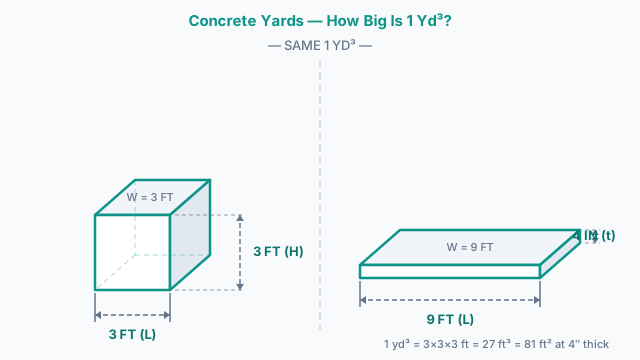
A cubic yard is 3 ft × 3 ft × 3 ft = 27 ft³. This is the conversion most hand calculations get wrong by dividing by 3 or 9 — the calculator always uses 27. - 4) Cubic-Meter Conversionm³ = ft³ × 0.0283168
Provided for metric documentation and international projects. 1 yd³ ≈ 0.7646 m³, and 1 m³ ≈ 1.308 yd³. - 5) Waste-Adjusted VolumeAdjusted Volume = Base Volume × (1 + Waste% ÷ 100)
Applied to the cubic-foot total before the yd³ and m³ conversions, so the cubic-yard figure you read already includes your chosen 0%, 5%, or 10% allowance. - 6) Ordering BuffersOrder yd³ = Result yd³ × 1.05 (or × 1.10)
The helper rows give a further round-up cushion on top of the waste allowance, useful when the sub-base is rough or the form may bulge slightly during placement.
Common Concrete Yardage Sizes at a Glance
Typical residential pours with their cubic-yard volume and a 10%-buffered order quantity. Use these as a sanity check against your calculator result before you call the plant. All assume the listed uniform thickness.
| Pour | Plan Size | Thickness | Volume (ft³) | Volume (yd³) | Order +10% (yd³) |
|---|---|---|---|---|---|
| Shed / storage slab | 8 × 10 ft | 4" | 26.7 | 0.99 | 1.09 |
| Patio | 10 × 10 ft | 4" | 33.3 | 1.23 | 1.36 |
| Sidewalk run | 3 × 40 ft | 4" | 40.0 | 1.48 | 1.63 |
| 1-car driveway | 12 × 24 ft | 4" | 96.0 | 3.56 | 3.91 |
| 2-car driveway | 20 × 24 ft | 4" | 160.0 | 5.93 | 6.52 |
| Garage floor | 24 × 24 ft | 5" | 240.0 | 8.89 | 9.78 |
| Round tank pad | 10 ft dia. | 4" | 26.2 | 0.97 | 1.07 |
Volumes computed as footprint × (thickness ÷ 12) ÷ 27, with the round pad using π × (D/2)². Figures are pre-rounded for reference; your project thickness, edge thickening, and sub-base condition will shift the exact order. For a thickened-edge slab use the monolithic slab calculator.
Ordering Mistakes That Leave You Short
- Dividing cubic feet by 3 or 9 instead of 27. A cubic yard is a 3-foot cube, so it holds 3 × 3 × 3 = 27 cubic feet, not 3 or 9. Dividing by the wrong number is the single most frequent yardage error — this tool always divides by 27.
- Mixing units within one pour. Entering a length in feet but a thickness in inches without converting inflates the volume roughly twelve-fold. Keep every field in the same unit, or switch the unit selector so the whole calculator matches your plan.
- Confusing “yards” with linear or square yards. Concrete is sold by the cubic yard (a volume), not the linear yard (a length) or square yard (an area). A “10-yard” order is 10 yd³ of material, enough for a 270 ft³ pour.
- Ordering the exact theoretical volume. Sub-grade dips, form deflection, spillage, and the concrete left in the pump line all consume material. Add at least the 5% waste allowance, and 10% on rough ground, or you risk a short load and a cold joint.
- Assuming volume scales with a single dimension. Doubling only the length of a slab doubles its volume — but doubling both length and width to make a driveway “twice as big” actually quadruples the footprint, and therefore the yardage. A 12 × 24 ft driveway (3.56 yd³ at 4 in) scaled to 24 × 48 ft isn't 7.1 yd³, it's 14.2 yd³ — a mental-math trap that catches people re-sizing a plan on the fly.
Pairing the Concrete Yards Calculator with Other Tools
Use this concrete yards calculator whenever your goal is the ordering number — total cubic yards for a slab or round pad — and you want the ÷27 conversion and waste buffer handled for you. If you need a like-for-like figure in cubic meters or are buying metric bags, switch to the concrete cubic meter calculator; to weigh the pour for transport or load checks, use the concrete weight calculator. For application-specific layouts, the slab concrete calculator, concrete pad calculator, and footing calculator carry presets tuned to those pours. If you are buying pre-mix by the sack instead of ready-mix, the concrete bag calculator and bags-per-yard calculator convert the same volume into bag counts. And when a single pour spans several shapes at once — a slab plus its footings, columns, or walls — the main concrete calculator on our homepage totals all of them in one tool.
Where These Figures Come From
The governing standard for concrete delivered by the cubic yard. It sets batching tolerance, the 90-minute / 300-revolution discharge limit, and acceptance testing at the truck — the practical reasons your ordered yardage should include a waste margin rather than the bare theoretical volume.
The ACI absolute-volume method that establishes how a cubic yard of concrete is proportioned and why yield is reported per cubic yard. It underpins the assumption that the placed volume this calculator returns maps directly to the unit a plant batches in.
The reference for the exact factors used here: 1 yd³ = 27 ft³, 1 ft³ = 0.0283168 m³, and 1 yd³ = 0.764555 m³. Using exact factors rather than rounded shortcuts keeps the cubic-yard, cubic-foot, and cubic-meter figures internally consistent.
Cubic-yard volume is an ordering quantity only; mix strength, reinforcement, joint layout, and sub-base preparation are separate design decisions — confirm final load size with your ready-mix supplier and any structural requirements with a licensed engineer before placing concrete.
Common Concrete Yardage Ordering Questions
How do I calculate concrete in cubic yards?
Multiply length × width × thickness in feet to get cubic feet, then divide by 27 to get cubic yards. For example, a 24 × 20 ft slab that is 4 in (0.333 ft) thick is 24 × 20 × 0.333 = 160 ft³, and 160 ÷ 27 = 5.93 yd³. Add a 5–10% waste allowance before ordering.
Why do I divide by 27 to get cubic yards?
A cubic yard is a cube measuring 3 feet on every side, so it contains 3 × 3 × 3 = 27 cubic feet. To convert a volume from cubic feet to cubic yards you divide by 27. Dividing by 3 or 9 — a common error — gives the wrong order quantity.
Do I have to enter all dimensions in the same unit?
Yes. The calculator uses one global unit selector, so whichever unit you pick — feet, inches, yards, meters, centimeters, or millimeters — applies to length, width, and thickness together. This prevents the classic mistake of pairing a length in feet with a thickness in inches.
My slab thickness is in inches but the length is in feet. What do I do?
Convert the thickness to feet by dividing by 12 (4 in ÷ 12 = 0.333 ft) and keep the unit on feet, or set the whole calculator to inches and enter every dimension in inches. Either approach keeps all fields consistent; mixing the two inflates the volume by roughly twelve times.
How many cubic feet are in a cubic yard of concrete?
Exactly 27 cubic feet. So 1 yd³ = 27 ft³, 2 yd³ = 54 ft³, and 5 yd³ = 135 ft³. The calculator uses this exact factor for the yd³ output and the reverse for any volume you already know in cubic feet.
How much is a cubic yard of concrete in cubic meters?
One cubic yard equals about 0.7646 cubic meters, and one cubic meter equals about 1.308 cubic yards. The calculator shows m³ alongside yd³ so metric drawings and US ready-mix orders stay reconciled without a separate conversion.
Is a 'yard' of concrete the same as a cubic yard?
Yes. In the ready-mix trade, ordering '5 yards' of concrete means 5 cubic yards of volume — never linear yards or square yards. Concrete is always sold by the cubic yard, so the result this calculator gives is exactly the number to tell your supplier.
Which waste percentage should I choose?
Use 0% only for a clean theoretical volume. Choose 5% as the standard ordering minimum for level, well-prepared sub-base, and 10% when the ground is uneven, the forms may bulge, or you are pumping and need to allow for line fill and spillage.
How do I calculate cubic yards for a round or circular pour?
Switch to Circular mode and enter the full diameter and the thickness. The tool computes π × (diameter ÷ 2)² × thickness in cubic feet, then divides by 27. A 10 ft diameter pad 4 in thick is about 26.2 ft³, or 0.97 yd³. Enter the diameter, not the radius.
What if my pour is an irregular or L-shape?
Break the area into rectangles and circles, calculate the cubic yards for each piece separately, and add the totals. Apply your waste allowance to the combined figure before ordering so the buffer covers the whole pour.
How many cubic yards do I need for a typical driveway?
A one-car driveway around 12 × 24 ft at 4 in thick needs about 3.6 yd³ (4 yd³ with a 10% buffer); a two-car driveway around 20 × 24 ft at 4 in needs about 5.9 yd³ (about 6.5 yd³ ordered). Thicker slabs or a 5 in pour raise these figures proportionally.
Does this calculator include rebar, mesh, or mix design?
No — it estimates concrete volume only. Reinforcement, control-joint spacing, compressive strength, and sub-base preparation follow your engineer's drawings and local code. Use the cubic-yard result purely to order the right amount of concrete.
Should I order ready-mix or bags for my cubic yardage?
Below roughly 1 yd³, bagged pre-mix can be practical; an 80 lb bag yields about 0.6 ft³, so a cubic yard takes about 45 bags. Above 1 yd³, ready-mix delivery is usually cheaper and more consistent. Convert your volume to bag counts with the dedicated bag calculator.
Why are the results hidden until I press Calculate?
The results panel is gated so it only appears once a valid thickness and footprint are entered, which avoids reading a yardage off a half-completed form. Press Calculate after filling the fields to reveal the cubic-yard, cubic-foot, and cubic-meter figures.
Can I print or save my cubic-yard estimate?
Yes. After pressing Calculate, click Print / Save to open a clean A4 summary listing the shape, units, dimensions, waste allowance, and the volume in yd³, ft³, and m³ with the ordering-buffer rows. Choose Save as PDF in your browser's print dialog to keep a copy for the purchase order or project file.
Related Calculators
Concrete Weight Calculator
Convert any concrete volume (yd³, ft³, m³) or pour dimensions to weight in lb, short tons, and kg — with normal-weight, lightweight, and bag-mix presets.
Concrete Cubic Meter Calculator
Metric-first concrete calculator — enter dimensions in m / cm / mm to get volume in m³, weight in kg, and bag counts for 20 / 25 / 40 kg pre-mix bags.
80 lb Bag Concrete Calculator
One 80 lb bag yields 0.60 cu ft — 45 bags per cubic yard. Convert any volume into bag counts, coverage and pallets for 40/50/60/80 lb bags.
Concrete Bag Calculator by Project
Turn slab, footing, post hole and sonotube dimensions into an exact bag count — five shape modes, imperial or metric, with +5%/+10% waste buffers.
Slab Concrete Calculator
Estimate concrete for slabs, patios, and floors.