Subtracting the Void: Tank and Trench Concrete Math
Tank and trench concrete estimating is inherently a subtraction problem — you are never pouring into a solid block of space. The critical failure mode unique to hollow structures is conflating the gross envelope with the net concrete shell. Add an 8-inch wall all around a 10 ft × 10 ft rectangular cistern and the outer footprint becomes 11.33 ft × 11.33 ft — a 28% larger plan area than the interior alone. That discrepancy multiplies through four walls, a base slab, and a cover slab simultaneously, and easily exceeds a full cubic yard of missed concrete on even a modest tank. Utility trenches carry their own trap: a trapezoidal cross-section from sloped-wall excavation uses a different area formula than a straight-wall rectangular trench, and confusing the two underestimates poured-concrete fill on every linear foot of the run. For the gross-minus-net volume formulas with worked examples, see our pillar guide on tank & trench concrete volume.
This calculator handles three distinct structure types from one interface: a utility trench (rectangular or trapezoidal cross-section), a rectangular cast-in-place tank (outer envelope minus inner void, with base slab, side walls, and optional cover slab computed separately), and a circular cast-in-place tank (annular wall volume plus flat base and cover slabs). Both tank modes display base slab, side walls, and cover slab volumes independently — useful when a pour is placed in separate operations — and the cover slab toggles off with one click if it will be precast and delivered separately. All three modes share a global unit selector (meters, centimeters, feet, or inches), a configurable waste allowance, and simultaneous output in m³, yd³, and ft³ — plus cubic-yard ordering helpers at +5% and +10% so you can call the ready-mix plant with a confirmed load size rather than a raw calculated volume. To move between cubic yards, feet, and meters, see our concrete volume conversions guide; for the base and cover slab math, our guide on how to calculate concrete for a slab; and for small hand-mixed pours, how many bags of concrete you need.
Worked Example: Rectangular Concrete Cistern
A contractor is pouring a cast-in-place rectangular cistern. Internal dimensions: 8 ft long × 6 ft wide × 5 ft tall. Wall thickness: 8 in (0.667 ft). Base slab thickness: 10 in (0.833 ft). Cover slab thickness: 6 in (0.500 ft). Waste allowance: 5%.
- Step 1 — Outer dimensions:Outer_L = 8 + 2 × 0.667 = 9.333 ft; Outer_W = 6 + 2 × 0.667 = 7.333 ft; Outer_H = 5 + 0.833 + 0.500 = 6.333 ft
- Step 2 — Outer envelope volume:9.333 × 7.333 × 6.333 = 433.6 ft³
- Step 3 — Inner void volume:8 × 6 × 5 = 240.0 ft³
- Step 4 — Net concrete:433.6 − 240.0 = 193.6 ft³
- Step 5 — Convert to yd³:193.6 ÷ 27 = 7.17 yd³
- Step 6 — Apply 5% waste:7.17 × 1.05 = 7.53 yd³ → order 7.75 yd³ (rounded to nearest 0.25 yd³ supplier increment)
Without the outer-minus-inner method — if someone had simply estimated 8 × 6 × 5 = 240 ft³ = 8.89 yd³ thinking "wall thickness doesn't matter much" — they would have over-ordered by 1.72 yd³ (roughly one quarter-yard delivery batch). The reverse error, entering outer dimensions as inner, would underorder by a similar margin and leave the pour critically short on two opposing wall faces.
How to Use the Tank / Trench Concrete Calculator
- 1Choose a Mode by clicking the Trench, Rectangular Tank, or Circular Tank tab at the top of the calculator. The input fields reconfigure instantly to match the selected geometry.
- 2Select your Unit System from the global dropdown — meters (m), centimeters (cm), feet (ft), or inches (in). All dimension fields use this unit; do not mix units.
- 3For Trench mode: choose Rectangular (single width) or Trapezoidal (top width + bottom width), then enter Length, Depth, and the required widths.
- 4For Rectangular Tank mode: enter the internal Length, Width, and Height of the tank cavity — the inside face of the walls. Then provide Wall Thickness, Base Slab Thickness, and Cover Slab Thickness.
- 5For Circular Tank mode: enter the Internal Diameter and Tank Height (inside face to inside face), then provide Wall Thickness, Base Slab Thickness, and Cover Slab Thickness.
- 6Toggle the Cover Slab checkbox on or off depending on whether the cover will be cast-in-place (include it) or precast and supplied separately (exclude it).
- 7Enter a Waste / Overage percentage. Use 5% for straightforward geometry and tight formwork; 8–10% for highly reinforced walls or difficult placement access.
- 8Click Calculate. The results panel shows per-component volumes (base, walls, cover) and project totals in m³, yd³, and ft³ — both net and with-waste.
- 9Use the +5% and +10% ordering helpers on the yd³ result to build in your final ordering buffer, then click Print / Save to export the summary for your records or your supplier.
The Tank & Trench Volume Formulas
- 1) Trench — Rectangular Cross-SectionV = Length × Width × Depth
Flat-bottomed trenches with vertical or near-vertical walls. Width is the single horizontal measurement at trench bottom. The same formula as a rectangular slab but oriented vertically. - 2) Trench — Trapezoidal Cross-SectionSection Area = Depth × (Top_Width + Bottom_Width) ÷ 2
V = Length × Section Area
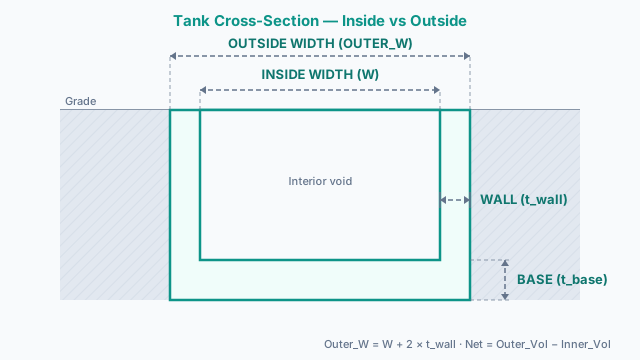
Sloped-wall utility trenches where the excavation widens toward the surface. Top_Width is the opening at grade; Bottom_Width is the narrower base. Used for pipe-bedding trenches in soft soils where vertical cuts cannot be maintained safely without shoring. - 3) Rectangular Tank — Outer-Minus-Inner ShellOuter_L = L + 2 × t_wall; Outer_W = W + 2 × t_wall; Outer_H = H + t_base + t_cover
Outer_Vol = Outer_L × Outer_W × Outer_H
Inner_Vol = L × W × H
Net Concrete = Outer_Vol − Inner_Vol
L, W, H are the inside (water-side) dimensions. Adding 2 × t_wall to each horizontal dimension accounts for both opposing walls. t_base and t_cover extend the height. The inner void is subtracted because it will hold fluid, not concrete. - 4) Circular Tank — Annular Wall + SlabsD_out = D_in + 2 × t_wall
Wall_Vol = π × t_wall × (D_in + t_wall) × H [annular ring × height]
Base_Vol = π × (D_out ÷ 2)² × t_base
Cover_Vol = π × (D_out ÷ 2)² × t_cover
Net Concrete = Wall_Vol + Base_Vol + Cover_Vol
The wall annulus uses the mean-diameter formula which is algebraically equivalent to the outer-minus-inner area method. Base and cover slabs are full circles computed from the outer diameter so they bear fully on the wall perimeter. - 5) Waste AllowanceFinal Volume = Net Volume × (1 + Waste% ÷ 100)
Applied last, after all geometric net volumes are summed. Covers form-face absorption, tie-hole grouting, minor honeycombing repair, and placement splash losses.
Tank & Trench Shape Variant Reference
The table below summarizes the three structure types, the geometric formula each uses, typical applications, and the wall thickness ranges most commonly specified for each. Use it to confirm you have selected the right mode before entering dimensions.
| Structure Type | Formula Basis | Typical Applications | Wall / Base Thickness |
|---|---|---|---|
| Rectangular Trench | L × W × D | Utility trench, pipe bedding, grade-beam form fill | N/A — trench is a void fill |
| Trapezoidal Trench | L × D × (TW + BW) ÷ 2 | Sloped-wall excavation in soft or unsupported soils | N/A — trench is a void fill |
| Rectangular Cast-in-Place Tank | Outer shell − Inner void | Cistern, septic tank, oil interceptor, detention vault | 6–10 in walls; 8–12 in base slab |
| Circular Cast-in-Place Tank | Annular wall + flat base + cover slab | Water storage tank, pump wet well, underground cistern | 6–12 in walls; 8–14 in base slab |
| Circular Tank (volume-check only) | Annular wall area × height | Precast manhole or catch basin concrete check | 4–8 in walls (precast standard) |
For buried tank applications, ACI 350-06 additionally requires a minimum w/c ratio ≤ 0.45 and crack-width control reinforcement — design parameters that are beyond the scope of this volume calculator but directly influence the final mix design your supplier batches.
Ordering Mistakes That Wreck a Tank or Trench Estimate
Entering outer dimensions instead of inner for tanks
This calculator treats your entered tank dimensions as internal (the water-holding cavity). If you measure from outside the formwork and enter those values, the wall-thickness math double-counts — the computed outer envelope is inflated by 2× the wall thickness on every side, and the net concrete volume is massively overstated. Always enter what you want the inside of the tank to be, then let the calculator grow the outer shell using your specified wall thickness.
Omitting the cover slab when it will be cast-in-place
Tank estimators commonly leave out the cover slab because it is poured as a separate operation weeks after the walls cure. That gap between operations does not make it a separate project — it is the same concrete order if the cover is cast-in-place. A 10 ft × 10 ft cistern cover at 6 inches adds over 0.18 yd³; on a tight-access site that is a separate short-load surcharge. Confirm the cover type with the structural engineer before toggling this field off.
Using the rectangular formula on a trapezoidal trench
A utility trench cut in sandy or loamy soil almost always has sloped walls — contractors use a 1H:1V or 1.5H:1V slope rather than risk a vertical-wall cave-in. Measuring the bottom width only and applying V = L × W × D underestimates fill volume by 15–30% depending on slope and depth. If your trench opening is wider at the top than at the base, switch to Trapezoidal mode and enter both widths.
Applying too low a waste factor for reinforced tank walls
A 5% waste allowance fits well-formed, lightly reinforced structures. Concrete tank walls carrying close-spaced rebar — #5 bars at 12-inch spacing in both directions, for example — see higher placement loss through rod displacement, consolidation with internal vibrators, and tie-wire displacement at form ties. Use 8% for ACI 350-compliant tank walls with crack-width-control reinforcement, and 10% if congestion is heavy enough that placement access is restricted to one direction.
Pairing the Tank / Trench Calculator with Other Tools
Use this calculator whenever your structure requires a hollow-shell subtraction — the defining feature of both cast-in-place tanks and concrete-lined trenches. For a standard foundation trench where concrete fills the full void without any hollow inner cavity, Trench mode handles it directly. If your project involves a concrete retaining wall above grade alongside the trench — such as a basement wall that rises from a footing trench — the wall concrete calculator handles the above-grade wall section independently, and you sum the two estimates. For deep drilled pier or caisson foundations, the geometry is a solid or minimally reinforced cylinder (not a hollow shell), so the pier & caisson concrete calculator is the correct tool — it also handles the bell frustum volume that this calculator does not model. When your main question is the overall pour volume in cubic yards without any hollow-structure adjustment, the concrete yards calculator is a faster top-level check. If the tank you are estimating sits on a large slab that will be poured separately from the walls, run the slab concrete calculator for that section and add the results to this calculator's wall and cover volumes. Not every trench needs poured concrete at all — where the void just needs to be backfilled rather than structurally lined, a self-compacting slurry from the flowable fill calculator or compacted granular fill sized with the crushed concrete calculator is often cheaper than a full concrete pour.
Where These Figures Come From
Governs structural design of concrete shells used in below-grade tanks and utility structures — specifically wall thickness minimums, shear transfer at the base-to-wall construction joint, and minimum concrete compressive strength (f'c ≥ 3,000 psi for most below-grade applications, higher in aggressive soil or groundwater conditions). Section 26.4 covers minimum concrete cover over reinforcement in buried structures.
The primary standard for concrete water-containment structures — cisterns, tanks, vaults, and lined trenches. Specifies watertight mix design requirements (maximum w/c ratio of 0.45 for normal exposure; 0.40 for aggressive chemical environments), crack-width control reinforcement detailing to limit service-load cracks to 0.010 in, and durability requirements for concrete in continuous contact with water or sewage. Volume calculations from this calculator feed directly into ACI 350 member sizing.
OSHA's excavation standard classifies soil into Type A, B, and C and sets maximum allowable vertical-cut depths (5 ft for Type A without shoring or sloping). Trenches deeper than 5 ft in any soil type require a competent person assessment. The trapezoidal trench mode in this calculator models the sloped-wall geometry that OSHA Subpart P requires for unshored trenches in Type B and C soils.
Fluid-retaining concrete structures require a watertight mix design (w/c ≤ 0.45 per ACI 350), appropriate crack-width-control reinforcement, and protective admixtures or coatings for chemical resistance — consult a licensed structural engineer before finalizing wall thickness and concrete mix design for any below-grade tank, cistern, or water-containment structure.
Common Tank & Trench Ordering Questions
What is the difference between Trench mode and Tank mode in this calculator?
Trench mode computes the volume of concrete that fills a complete void — an excavated channel where the entire cross-section is poured solid. Tank mode computes only the concrete shell surrounding an empty interior cavity, using outer-minus-inner subtraction for rectangular tanks and annular-wall plus slab formulas for circular tanks. Use Trench mode when every cubic foot of excavated space gets concrete; use Tank mode when the structure holds a fluid or void and only the walls, base, and cover are concrete.
Do I enter inside or outside dimensions for a tank?
Enter the inside (internal) dimensions — the width, length, and height of the cavity the tank will contain. The calculator adds the wall thickness to each dimension to derive the outer envelope, then subtracts the inner void to compute net concrete. If you enter outer dimensions by mistake, the computed outer envelope will be inflated by 2× the wall thickness on each side, producing a significantly overstated — and incorrect — concrete volume.
How does the trapezoidal trench formula differ from rectangular?
A rectangular trench has vertical walls and a uniform width from top to bottom; its cross-section is L × W. A trapezoidal trench has sloped walls that are wider at the top than at the base — the required geometry when OSHA prohibits vertical cuts in soft soils. The trapezoidal formula computes cross-section area as Depth × (Top_Width + Bottom_Width) ÷ 2, then multiplies by length. For a 4 ft deep trench with a 3 ft bottom width and 5 ft top width, the trapezoidal area is 4 × (5 + 3) ÷ 2 = 16 ft², vs. a rectangular area of only 12 ft² if you incorrectly enter only the bottom width.
What does the per-component volume breakdown show?
For rectangular and circular tank modes, the results panel displays the volume of the base slab, side walls, and cover slab independently rather than just a project total. This is useful when the tank is poured in multiple operations — the base slab first, walls in one or two lifts after the base cures, and the cover slab last. Each line tells you exactly how much to order for that specific pour without splitting the total manually.
What wall thickness should I specify for an underground concrete cistern?
Typical cast-in-place residential cistern walls are 6–8 inches thick for tanks up to about 10,000 gallons capacity and up to 8 ft deep. Tanks in soil with high lateral earth pressure or hydrostatic uplift, or those holding sewage (requiring ACI 350 compliance), typically step up to 8–10 inch walls with crack-width-control reinforcement. A structural engineer should size the walls for any tank deeper than 4 ft or with a capacity over 5,000 gallons — lateral earth pressure on buried walls increases quadratically with depth.
What concrete mix (PSI / MPa) is required for a water-containing tank?
ACI 350-06 requires a minimum compressive strength of 4,000 psi (27.6 MPa) for concrete in direct contact with water or wastewater, with a maximum water-to-cement ratio of 0.45 for normal exposure and 0.40 for aggressive chemical environments. The mix must also meet durability requirements for the specific exposure class. Your ready-mix plant will batch a specific design mix — specify the strength and w/c limit when you call, not just the PSI, because two mixes at 4,000 psi can have very different w/c ratios and durability performance.
How do I estimate concrete for a utility trench filled completely with concrete?
Use Trench mode with the Rectangular option if the trench has vertical walls. Enter the total trench length, the uniform width (inside of forms or excavation walls), and the depth (from grade or from the top of the concrete pour to the bottom). Add 5% waste for a well-formed trench in competent soil. If the walls are sloped — typical in sandy or cohesionless soils — switch to Trapezoidal mode and enter both the bottom width and the top width at grade level.
Why does this calculator subtract the inner void for tanks?
A tank is a hollow structure — only the shell (walls + base + cover) is concrete; the interior is empty space or stored fluid. If you computed the outer volume without subtracting the void, you would estimate as if the entire outer envelope were solid concrete. For a 10 ft × 10 ft × 8 ft exterior tank with 8-inch walls, the gross outer volume is 800 ft³, but the net concrete shell is roughly 200 ft³ — a 4× overestimate if the subtraction is skipped. The outer-minus-inner method ensures you order only the concrete that physically exists in the structure.
How much waste allowance should I use for a concrete tank vs. a trench?
Trenches: 5% for simple flat-bottomed, well-formed trenches in good soil; 8% for trapezoidal or poorly graded excavations. Tanks: 5% for lightly reinforced walls with accessible placement access; 8% for ACI 350-compliant tanks with crack-width-control reinforcement (which increases form tie density and reduces bucket access); 10% for any section where rebar spacing is under 8 inches clear in both directions. The higher figure on tanks accounts for tie-hole grouting, consolidation vibrator displacement, and the higher labor intensity of form-face placement.
Can I use this calculator for a septic tank or catch basin?
Yes, with caveats. For a cast-in-place concrete septic tank, use Rectangular Tank mode with the internal cavity dimensions and your specified wall and slab thicknesses. For a precast manhole or catch basin, Circular Tank mode gives a volume check useful for confirming the producer's reported concrete weight, but precast unit volumes are more accurately obtained from the manufacturer's shop drawings. Note that septic tank and catch basin design (sizing for influent flow rates, outlet baffle placement, access manhole location) is outside the scope of this volume calculator.
What is the minimum concrete cover over reinforcement in a water-retaining tank wall?
ACI 350-06 Section 7.7 requires a minimum cover of 2 inches for No. 5 bars and smaller in walls and slabs not exposed to weather, and 3 inches for bars in contact with soil or exposed to weather. For water-side faces of liquid-containment structures, 2 inches is the minimum, but many designers specify 2.5 to 3 inches on the water side to reduce crack width and improve long-term watertightness. Thicker cover is also required near construction joints where reinforcement continuity and waterproofing detail are most critical.
How do I handle a tank where the walls and base will be poured in separate operations?
Use the per-component volume breakdown in Tank mode. The base slab volume is shown separately from the wall volume and the cover slab volume. When scheduling the base pour, use the base slab line; for the wall lift pours, use the wall volume — split further if your lifts are under the full tank height. The cover slab volume is the third pour. Add each component's waste allowance independently, since placement difficulty and loss rates differ between a flat base slab (5% typical) and formed tank walls (8–10%).
When should I use the pier and caisson calculator instead of this one?
Use the pier and caisson calculator for drilled piers, bored piles, and belled caissons — cylindrical solid shafts that transfer load through weak soil to a bearing stratum. Those are solid elements (or minimally reinforced), not hollow shells, so the outer-minus-inner subtraction in this calculator does not apply. The pier/caisson calculator also handles the bell frustum volume at the base of belled caissons — a geometry this calculator does not model. Use this tank/trench calculator only when the structure is hollow (a tank) or is a fill operation in an open excavated trench.
How does the circular tank calculation handle the wall annulus vs. the base slab?
The wall volume uses an annular formula: π × t_wall × (D_in + t_wall) × H, which computes the ring of concrete between the inside face and the outside face of the cylindrical wall multiplied by the height. The base and cover slabs are computed as full circles based on the outer diameter — π × (D_out ÷ 2)² × slab_thickness — because the slab bears fully on the wall perimeter including the wall thickness. The two components are summed for total net concrete. Separating them lets you verify each independently against the structural drawing quantities.
How many 80 lb bags of concrete equal 1 cubic yard for small tank repairs?
An 80 lb bag of ready-mix concrete yields approximately 0.60 cubic feet when properly mixed, so 1 cubic yard (27 cubic feet) requires about 45 bags. A 60 lb bag yields roughly 0.45 cubic feet — about 60 bags per cubic yard. For tank repairs under 0.5 cubic yards (about 22–23 bags of 80 lb mix), bagged concrete is practical. Above that threshold, ordering a partial ready-mix truck is typically more economical and produces a more consistent mix — use the concrete bag calculator to compare costs at your specific bag price vs. your supplier's per-yard quote and short-load fee.
Related Calculators
Flowable Fill (CLSM) Calculator
Calculate CLSM volume in yd³, ft³, and m³ for utility trenches, abandoned tanks/vaults, and pipe or culvert fill — with overfill factor, weight at 100–125 pcf, and ACI 229R compliance check.
Footing Concrete Calculator
Continuous, isolated, and combined footings.
Wall Concrete Calculator
Vertical concrete wall volumes, single or multi-segment.
Slab Concrete Calculator
Estimate concrete for slabs, patios, and floors.
Concrete Yards Calculator
Convert and compute volume into cubic yards.