Getting Footing Concrete Volume Right the First Time
Accurate volume estimation for concrete footings is essential to establish a strong structural foundation without costly over-ordering. This calculator handles both continuous strip footings (rectangular) and isolated pier bases (circular) in one place. For the full set of strip, pad, and continuous-footing formulas with worked examples, see our pillar guide on concrete footing calculations. To buy by the sack, our guide to how many bags of concrete a footing needs gives counts; for the steel, see our rebar sizing & spacing reference; and for tied slabs, our guide on how to calculate concrete for a slab.
What sets this tool apart: it switches between rectangular/square and circular geometry in one place, accepts meters, centimeters, feet, or inches without manual conversion, and adds a waste allowance (typically 5–10%) so over-excavation and placement losses don't leave you short. Results display in m³, yd³, or ft³ behind a Calculate click, include a yd³ ordering helper at +5%/+10% for supplier rounding, and export to a printable summary for site approvals and purchase orders.
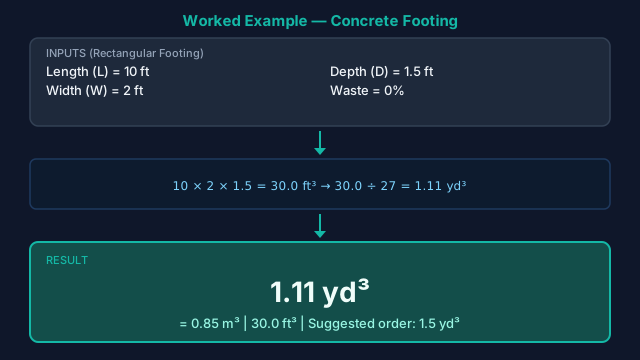
Worked Example: A 10 × 2 × 1.5 ft Strip Footing
Consider a continuous strip footing beneath a bearing wall: 10 ft long, 2 ft wide, and 1.5 ft deep — a common residential dimension for a footing under a block foundation wall. On the Rectangular tab, volume is Length × Width × Depth: 10 × 2 × 1.5 = 30 ft³. Converting to cubic yards, 30 ÷ 27 = 1.11 yd³ net. Footings commonly need a 10% waste allowance to cover over-excavation and trench irregularities: 1.11 × 1.10 = 1.22 yd³ with waste — the figure to phone in to the ready-mix plant.
For a round pier or deck-post footing, switch to the Circular tab. A 12-inch diameter pier poured 36 inches deep has a radius of 0.5 ft and a depth of 3 ft: π × 0.5² × 3 = 2.36 ft³ — small enough that bagged concrete makes sense, at roughly four 80 lb bags (0.6 ft³ yield each) rather than a ready-mix order.
Entering Your Footing Dimensions
- 1Select the Rectangular / Square or Circular tab.
- 2Choose your input unit (m, cm, ft, or in) and enter dimensions.
- 3Add a Waste Allowance (%)—5–10% is typical for footings.
- 4Click Calculate to reveal Net Volume, With Waste, and Waste Added.
- 5Set Show in to view m³, yd³, or ft³, and use the yd³ helper (+5% / +10%) for ordering.
- 6Use Print / Save Calculations to export a clean summary.
The Footing Volume Formula
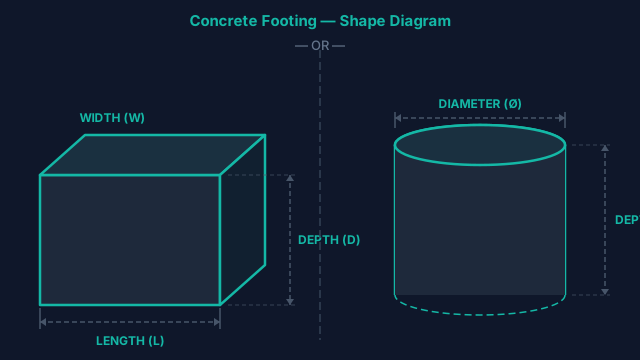
- 1) Rectangular / Square FootingVolume = Length × Width × Depth (Thickness)
Inputs are converted to meters internally before multiplication to keep units consistent. - 2) Circular FootingVolume = π × r² × Depth, where r = Diameter ÷ 2
- 3) Waste AllowanceAdjusted Volume = Raw Volume × (1 + Waste%)
Typical waste for footings is 5–10% depending on excavation, formwork, and placement method. - 4) Display Conversions1 m³ = 35.3147 ft³
1 m³ = 1.30795 yd³
yd³ = ft³ ÷ 27
Typical Footing Dimensions
Concrete footings come in a few standard configurations: strip / continuous footings run beneath load-bearing walls (enter the full wall length as L on the Rectangular tab); isolated / spread (pad) footings support a single column (L × W × D, multiplied by quantity for repeated pads); circular / pier footings serve deck posts and pier-and-beam systems (Circular tab, π × r² × D); combined footings merge two or more columns onto one slab where individual pads would overlap; stepped footings step down sloping grade, calculated as separate rectangular segments and summed; and pile caps transfer a column load onto a group of piles, sized as a rectangular prism.
For continuous strip footings, concrete scales with length. The table below shows the volume per linear foot for common width × depth combinations, plus the total for a 10-foot run, so you can sanity-check the calculator at a glance.
| Footing (Width × Depth) | Per Linear Foot (ft³) | Per 10 ft Run (yd³) |
|---|---|---|
| 12" × 6" | 0.50 | 0.19 |
| 16" × 8" | 0.89 | 0.33 |
| 18" × 8" | 1.00 | 0.37 |
| 20" × 10" | 1.39 | 0.51 |
| 24" × 12" | 2.00 | 0.74 |
Isolated pad footings are simpler: enter Length × Width × Depth directly on the Rectangular tab. For round deck or pier footings, switch to the Circular tab — a 12" diameter × 36" deep pier needs about 2.36 ft³ (≈ four 80 lb bags).
Why Footing Pours Come Up Under
- Skipping the waste allowance. Footings routinely need 5–10% added on top of the raw L × W × D or π × r² × D figure to cover over-excavation, trench irregularities, and placement losses — order the raw volume and the load can come up short before the pour is finished.
- Guessing at frost-line depth. Footings must bear on undisturbed soil and extend below the local frost line — often 12 to 48 inches depending on climate zone. Enter the depth your local building department requires, not a rounded guess, before locking in the volume.
- Running a circular pier footing through the Rectangular tab. Pier and deck-post footings are circular (π × r² × D), not L × W × D. A 12-inch diameter pier poured 36 inches deep needs about 2.36 ft³ — roughly four 80 lb bags — a figure the Rectangular tab cannot produce correctly.
- Forgetting to multiply isolated pads by quantity. A single pad-footing calculation covers one column. Repeated pads under multiple posts must be multiplied by the pad count, or the ready-mix order will only cover the first one.
Pairing the Footing Calculator with Other Tools
Use the Footing Concrete Calculator for shallow spread footings — continuous strip, isolated pad, and combined footings that bear near grade. For deck posts poured in cardboard tube forms, the Sonotube concrete calculator is purpose-built for that cylindrical geometry. Larger drilled shafts and belled caissons belong in the pier and caisson concrete calculator. When a monolithic pour includes both a slab and a thickened perimeter footing in one operation, the monolithic slab calculator handles both components together. For the slab that sits on top of the footing, the slab concrete calculator covers that pour. Rebar quantities for the footing are handled by the rebar calculator. If you are site-batching dry materials for the footing rather than ordering ready-mix, the nominal mix M5–M25 calculator converts this footing's volume into a per-grade cement, sand, and aggregate bag count.
Mix & Placement Standards
The primary U.S. structural concrete code, covering design and construction requirements for footings, foundations, columns, beams, and all reinforced concrete elements.
Guides selection of water-cement ratio, aggregate sizes, and mix proportions to achieve specified concrete strength for footing applications.
Covers requirements for ready-mixed concrete supplied by truck — the standard delivery method for footing pours on most construction projects.
Footing depth must extend below the local frost line per IRC R403.1.4 and soil bearing capacity must be confirmed by a licensed geotechnical or structural engineer before sizing footing dimensions and concrete volume.
Footing Concrete — Questions Before You Order
Can I calculate both rectangular and circular footings?
Yes. Use the tabs to switch between Rectangular/Square and Circular modes; each uses the appropriate geometric formula.
Which input units are supported?
Meters (m), centimeters (cm), feet (ft), and inches (in). You can display results in m³, yd³, or ft³.
How much waste should I add for footings?
5–10% is common to account for over-excavation, trench irregularities, and placement losses. Follow your project specifications.
What does the yards helper do?
It provides yd³ with +5% and +10% additions to quickly round orders for ready-mix deliveries.
Does this include rebar, cover, or mix design?
No. The calculator focuses on volume. Reinforcement and mix grade must follow your structural drawings and local codes.
How deep should a concrete footing be?
Footings must bear on undisturbed soil and extend below the local frost line — often 12 to 48 inches depending on your climate zone. Residential strip footings are commonly 8–12 inches thick and at least as wide as the wall plus the bearing required by your soil. Always confirm depth against your local building code (IRC/IBC).
How many bags of concrete do I need for a footing?
Divide the total volume by the bag yield: an 80 lb bag makes about 0.6 ft³, a 60 lb bag about 0.45 ft³, and a 40 lb bag about 0.30 ft³. For example, a 2.36 ft³ pier needs roughly four 80 lb bags. Beyond about 1 cubic yard (≈ 45 × 80 lb bags), ordering ready-mix is usually cheaper and faster.
How much concrete is needed for a deck footing?
Round deck footings are calculated with the Circular tab. A 12-inch diameter footing poured 36 inches deep takes about 2.36 ft³ (≈ 0.09 yd³, or four 80 lb bags). If you are using cardboard tube forms, our Sonotube concrete calculator is purpose-built for that job.
Related Calculators
Concrete Bag Calculator by Project
Turn slab, footing, post hole and sonotube dimensions into an exact bag count — five shape modes, imperial or metric, with +5%/+10% waste buffers.
Slab Concrete Calculator
Estimate concrete for slabs, patios, and floors.
Monolithic Slab Concrete Calculator (Slab + Thickened-Edge Footing)
Calculate concrete volume for a monolithic slab — slab body plus integral perimeter footing in a single pour. Garage, house foundation, and shed presets with ACI 318 and IRC R403 compliance checks.
Wall Concrete Calculator
Vertical concrete wall volumes, single or multi-segment.
Pier / Caisson Concrete Calculator
Cylindrical shafts and drilled piers by length.
Rebar Calculator
Estimate rebar bars, linear footage, weight, and cost for slabs, footings, and walls.