Planning the Pour for a Monolithic Slab Foundation
A monolithic slab combines the flat slab body and the integral perimeter footing into a single concrete pour. Because the thickened-edge beam and the slab are cast simultaneously, the volume calculation has two components: the rectangular slab body (length × width × slab thickness) and the perimeter footing extension that drops below the slab around the entire perimeter. Accurate estimation matters because the footing extension can add 15–30% to the volume of the slab body alone — underordering means a short load on pour day, while overordering wastes money. The slab-body portion uses the same method as our pillar guide on how to calculate concrete for a slab.
Three Project Presets
Garage, House Foundation, and Shed / ADU presets load typical monolithic slab dimensions instantly — every value remains editable.
Slab + Footing Computed Separately
The results panel shows slab body volume and perimeter footing extension volume as separate line items, then a combined total for ordering.
Every Order Format
Volume in yd³ / ft³ / m³, plus bag counts for all four US pre-mix bag sizes and an optional ready-mix cost estimate.
Three Automatic Code Checks
Warnings fire for slab thickness below 4 in (ACI 318 §7.3 / IRC R506), footing depth below 12 in (IRC R403.1.4), and invalid slab/footing geometry.
Print / Save PDF
One click exports a clean, print-ready summary of every input, the volume breakdown, bag counts, and cost.
Free, No Sign-Up
Runs entirely in your browser — no account, no email, no download.
This calculator accepts length and width in ft, in, yd, m, or cm; thickness and footing dimensions in in, ft, cm, or mm; and outputs volume in cubic yards, cubic feet, and cubic meters along with pre-mix bag counts for 40 / 50 / 60 / 80 lb bags. Because the thickened edge is really an integral footing, our reference on concrete footing calculations explains how that beam is sized; review how to reinforce a concrete slab for the rebar and mesh; and for hand-mixed pours, see how many concrete bags a slab needs.
From Dimensions to Delivery: a Monolithic Slab Example
Two real pours below show the same slab-plus-footing method at two scales — a full 2-car garage ordered by the yard, and a small shed foundation where the footing extension is proportionally larger.
Example 1 — 24×24 ft Garage Slab
- 1Start with a 2-car garage using the Garage preset: 24 ft × 24 ft slab, 4 in slab thickness, 12 in total footing depth, 12 in footing width.
- 2Slab body volume: 24 ft × 24 ft × (4 ÷ 12) ft = 192 ft³, or 192 ÷ 27 = 7.11 yd³.
- 3Perimeter footing extension: 2(24 + 24) ft × (12 ÷ 12) ft × [(12 − 4) ÷ 12] ft = 96 × 1 × 0.667 = 64 ft³, or 64 ÷ 27 = 2.37 yd³.
- 4Combine the two: Total volume = 192 + 64 = 256 ft³ = 9.48 yd³.
- 5Apply a 5% waste allowance: 256 ft³ × 1.05 ≈ 269 ft³, about 9.95 yd³ — most suppliers round this up to a 10 yd³ order.
- 6Result: a 24×24 ft monolithic garage slab needs roughly 9.5–10 yd³ of ready-mix, split as ~7.1 yd³ in the slab body and ~2.4 yd³ in the footing.
Example 2 — 10×12 ft Shed / ADU Slab
- 1Now scale down to a Shed / ADU preset: 10 ft × 12 ft slab, 4 in slab thickness, 12 in total footing depth, 12 in footing width.
- 2Slab body volume: 10 ft × 12 ft × (4 ÷ 12) ft = 40 ft³, or 40 ÷ 27 = 1.48 yd³.
- 3Perimeter footing extension: 2(10 + 12) ft × (12 ÷ 12) ft × [(12 − 4) ÷ 12] ft = 44 × 1 × 0.667 = 29.3 ft³, or 29.3 ÷ 27 = 1.09 yd³.
- 4Combine: Total = 40 + 29.3 = 69.3 ft³ ≈ 2.57 yd³ — matching the 2.6 yd³ shown in the size-reference table below.
- 5At this size, a bagged order is still workable: 69.3 ÷ 0.60 (80 lb bags) ≈ 116 bags — but most crews still call this in as a short ready-mix load rather than mixing that many bags by hand.
Entering Your Monolithic Slab Dimensions
- 1Select Quick or Advanced mode. Quick gives you volume and bag counts in seconds. Advanced mode adds a waste percentage and a ready-mix cost estimate field.
- 2Click your project type preset — Garage, House Foundation, or Shed / ADU. The preset fills typical length, width, slab thickness, footing depth, and footing width values. All fields are editable.
- 3In Step 2, adjust the Length and Width to match your actual slab plan area. Each field has its own unit selector (ft, in, yd, m, or cm).
- 4Set the Slab Thickness — the flat part of the slab body above the thickened edge. The ACI / IRC minimum for residential slabs is 4 inches. Enter the value in your preferred unit.
- 5In Step 3, enter the Total Footing Depth — the distance from the top of the slab to the bottom of the perimeter footing. This must be greater than the slab thickness. For most residential monolithic slabs this is 12 to 16 inches.
- 6Enter the Footing Width — the width of the thickened perimeter edge. Typical residential values are 12 to 16 inches.
- 7In Advanced mode, adjust the Waste Percentage. Use 5% for standard pours and up to 10% for large pours or sites with uneven subgrade.
- 8Optionally enter your ready-mix price per cubic yard in Advanced mode to add a cost estimate to the results.
- 9Press Calculate. The results panel shows the slab body and perimeter footing extension as separate volumes, then the combined total in yd³, ft³, and m³.
- 10Review the Volume Breakdown tile to verify the split between slab body and footing extension. The footing extension = 2(L + W) × footing width × (footing depth − slab thickness).
- 11Check the Bag Counts tile if you plan to use pre-mix bags. For pours above about 1.5 yd³, ready-mix delivery is more economical than bagged concrete.
- 12Click Print / Save to export a clean PDF summary of all inputs, volumes, bag counts, and cost. Select Save as PDF in your browser's Print dialog.
The Monolithic Slab Volume Formula
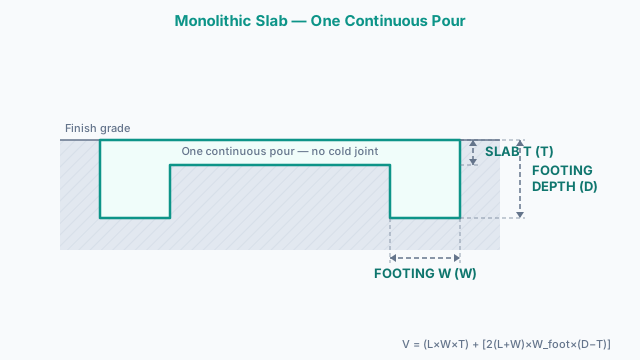
- 1) Slab Body VolumeV_slab (ft³) = L × W × T_slab
L and W are length and width in feet; T_slab is slab thickness in feet. This covers the entire plan area at the uniform slab depth. - 2) Perimeter Footing Extension VolumeV_foot (ft³) = 2(L + W) × W_foot × (D_foot − T_slab)
W_foot is footing width in feet; D_foot is total footing depth from top of slab to bottom of footing in feet; (D_foot − T_slab) is the depth the footing extends below the slab body. The factor 2(L + W) is the full perimeter length. - 3) Total VolumeV_total (ft³) = V_slab + V_foot
Convert to yd³ by dividing by 27; convert to m³ by multiplying by 0.028317. - 4) Waste-Adjusted VolumeV_order (ft³) = V_total × (1 + waste% / 100)
Bag counts are calculated on V_order. The standard waste allowance is 5–10% for monolithic slab pours. - 5) Pre-Mix Bag CountsBags = ⌈V_order (ft³) / yield per bag⌉ (ceiling, rounded up)
Bag yields: 40 lb = 0.30 ft³, 50 lb = 0.375 ft³, 60 lb = 0.45 ft³, 80 lb = 0.60 ft³ (Quikrete / Sakrete standard yields).
Typical Monolithic Slab Dimensions
All values assume normal-weight concrete (150 pcf), no waste added. Use the calculator above for your exact dimensions.
| Project | Slab Size | Slab T | Footing D | Footing W | Total (yd³) |
|---|---|---|---|---|---|
| Small Shed | 10 × 12 ft | 4 in | 12 in | 12 in | 2.6 yd³ |
| 1-Car Garage | 12 × 20 ft | 4 in | 12 in | 12 in | 4.5 yd³ |
| 2-Car Garage | 24 × 24 ft | 4 in | 12 in | 12 in | 9.5 yd³ |
| 3-Car Garage | 36 × 24 ft | 4 in | 12 in | 12 in | 13.6 yd³ |
| Small Home (990 sf) | 33 × 30 ft | 4 in | 16 in | 16 in | 18.4 yd³ |
| Medium Home (1120 sf) | 40 × 28 ft | 4 in | 16 in | 16 in | 20.5 yd³ |
Add 5–10% waste for a realistic order quantity. For pours above 1.5 yd³, ready-mix delivery is typically more economical than pre-mix bags.
Why Monolithic Slab Pours Come Up Short
- Skipping the waste allowance. The default 5–10% waste factor covers spills, uneven subgrade, and end-of-pour remainder. On a monolithic pour — where the footing trench adds its own variability — leaving this at zero is the fastest way to come up short a truck load.
- Guessing at footing depth instead of checking the frost line. IRC R403.1.4 requires footings to extend below the local frost line. The calculator's 12-inch default warning threshold suits mild climates only — cold-climate frost depths of 24–48 inches mean a much deeper, higher-volume footing.
- Ignoring the footing-vs-slab-thickness geometry rule. Total footing depth must be greater than slab thickness, or the footing extension formula produces an invalid (negative) volume. The calculator flags this before showing results — don't override it without rechecking your inputs.
- Ordering bags for a pour ready-mix should handle. Above roughly 1.5 yd³ combined slab-and-footing volume, ready-mix delivery is faster, cheaper per yard, and gives a more consistent mix than hand-mixing dozens of bags.
- Treating 4 inches as the slab thickness for every load. 4 in is the ACI 318 / IRC R506 practical minimum for residential slabs, but areas carrying vehicle traffic or heavy equipment may need 5–6 inches — check the load before locking in the preset thickness.
Pairing the Monolithic Slab Calculator with Other Tools
Use the Monolithic Slab calculator when the slab and its perimeter footing are poured in a single continuous operation. For a simple flat slab without a thickened edge, the slab concrete calculator is faster. When the footing is a separate pour made before the slab, calculate the two elements independently using the slab calculator and the footing concrete calculator, then add the volumes. For small equipment pads — AC units, generators, hot tubs — the concrete pad calculator provides presets. To budget material cost after volume is established, use the concrete slab cost calculator. For the pre-mix bag count on smaller pours, the concrete bag calculator converts your cubic yardage directly to 40/60/80 lb bag quantities.
Specs & References
This calculator enforces the §7.3 minimum slab thickness of 3.5 in (practical minimum 4 in) and references §7.6 for shrinkage and temperature steel requirements.
The IRC requires footings to extend below the frost line (R403.1.4). This calculator uses 12 inches as the default compliance threshold and recommends verifying local frost depth with the building department.
The primary ACI reference for slab-on-grade design, subgrade preparation, concrete placement, finishing, and curing practices applied to monolithic slabs.
R506.1 sets the 3.5-inch (practical 4-inch) minimum slab thickness for residential concrete floors on grade, referenced in this calculator's slab thickness compliance check.
Monolithic slab-on-grade designs integrate the footing and floor slab in a single pour; turndown depth must reach the local frost line and soil bearing capacity must be confirmed by a licensed geotechnical engineer before forming.
Ordering & Volume Questions
What is a monolithic slab?
A monolithic slab is a slab-on-grade foundation in which the flat slab body and the perimeter footing are cast together in a single pour. The perimeter has a thickened edge — typically 12 to 16 inches deep and 12 to 16 inches wide — that acts as both the beam and the footing. Because everything is poured at once, monolithic slabs are faster and less expensive than two-stage slab-plus-stem-wall foundations.
What is a monolithic slab calculator?
A monolithic slab calculator estimates the total concrete volume, bag counts, and optional material cost for a monolithic (thickened-edge) slab foundation. It splits the volume into two components: the flat slab body (length × width × slab thickness) and the perimeter footing extension (2 × (L + W) × footing width × extension depth), then combines them for a total order quantity.
How does the monolithic slab calculator work?
Enter your slab length, width, slab thickness, total footing depth, and footing width. The calculator converts everything to feet, computes slab body volume as L × W × T_slab and footing extension volume as 2(L + W) × W_foot × (D_foot − T_slab), then sums them. The waste-adjusted total is divided by each pre-mix bag's yield to produce bag counts. Volume also appears in cubic yards, cubic feet, and cubic meters.
What is a thickened-edge footing?
A thickened-edge footing is the deeper, wider concrete beam that runs around the perimeter of a monolithic slab. It extends further into the ground than the flat slab body, providing bearing capacity and frost resistance. The thickened edge typically ranges from 12 to 24 inches deep and 12 to 18 inches wide for residential construction.
What is the minimum slab thickness for a monolithic slab?
ACI 318-19 §7.3 and IRC R506 require a minimum slab-on-grade thickness of 3.5 inches, with 4 inches as the practical minimum for residential construction. Most monolithic slabs use 4 inches for the flat body. Areas subject to heavy loads — like vehicle traffic or heavy equipment — may require 5 to 6 inches.
How deep should the footing be in a monolithic slab?
IRC R403.1.4 requires footings to extend below the local frost line. In mild climates (frost depth 0–12 inches), a total footing depth of 12 inches is common. In cold climates (frost depth 24–48 inches), the footing may need to be considerably deeper. The calculator uses 12 inches as the default warning threshold — verify the frost line with your local building department.
How wide should the perimeter footing be?
Residential monolithic slab footings are typically 12 to 18 inches wide. IRC R403.1 requires the minimum footing width to be at least as wide as the wall it supports. For a standard 2×6 stud wall with sheathing, 12 inches of footing width is common; for heavier loads, 16 to 18 inches is used.
What is the formula for monolithic slab concrete volume?
Total Volume (ft³) = Slab Body + Perimeter Footing Extension = (L × W × T_slab) + [2(L + W) × W_foot × (D_foot − T_slab)], where all dimensions are in feet. L and W are length and width, T_slab is slab thickness, D_foot is total footing depth from the top of slab to the bottom of footing, and W_foot is the footing width. Convert to yd³ by dividing by 27.
How much concrete do I need for a 24×24 ft monolithic garage slab?
A 24 × 24 ft slab with 4-inch slab thickness, 12-inch total footing depth, and 12-inch footing width requires: Slab body = 24 × 24 × (4/12) = 192 ft³ = 7.11 yd³; Perimeter footing extension = 2(24+24) × (12/12) × (8/12) = 64 ft³ = 2.37 yd³; Total = 256 ft³ = 9.48 yd³. With a 5% waste factor, order about 9.95 yd³ — typically rounded to 10 yd³.
When should I use a monolithic slab instead of a stem-wall foundation?
Monolithic slabs are best suited for mild climates with shallow frost lines (under 12 inches), flat sites with stable soil, and structures that don't require a crawl space. Stem-wall foundations are better in cold climates (frost depth over 24 inches), sloped sites, or when a crawl space is needed for utilities. Check local code requirements — some jurisdictions restrict monolithic slabs for habitable spaces.
Do I need rebar in a monolithic slab?
Most residential monolithic slabs include #4 rebar at 18 inches on-center in both directions throughout the flat slab body, with additional #4 or #5 bars at the corners and around openings. The perimeter footing typically uses 2 to 4 horizontal #4 or #5 bars running continuously around the perimeter with vertical ties or stirrups. ACI 318 §7.6 specifies minimum shrinkage and temperature steel requirements.
What PSI concrete should I use for a monolithic slab?
IRC R506.2 and ACI 318 Table 19.3.3.1 specify a minimum compressive strength of 2,500 PSI (f′c = 17.2 MPa) for residential slabs on grade. Slabs exposed to freezing-and-thawing cycles or deicers require a minimum of 3,000 PSI per ACI 318 Table 19.3.3.1. Most ready-mix suppliers offer a standard 3,000 or 3,500 PSI mix for residential slabs.
What is the difference between a monolithic slab and a slab poured separately from its footing?
In a two-stage pour, the footing is cast first, cured, and then the slab is poured separately on top — creating a cold joint between the two elements. In a monolithic slab, both the footing and slab body are poured in a single continuous operation, eliminating the cold joint. Monolithic pours are faster and reduce labour cost but require more careful form setup before the pour begins.
How long does a monolithic slab take to cure?
Concrete reaches approximately 70% of its design strength in 7 days and full strength (28-day strength) at 28 days. Light foot traffic is possible after 24–48 hours. Frame construction should wait until 7 days minimum. ACI 308R recommends keeping the slab moist-cured (covered and damp) for at least 7 days, or using curing compound immediately after finishing.
Is the calculator free?
Yes — completely free with no sign-up, no account, and no download required. All calculations run locally in your browser and no data is sent to a server.
Can I print or save my estimate?
Yes. After pressing Calculate, click the Print / Save button to open a clean, print-optimised page listing all inputs, the slab body and footing extension volume breakdown, totals in yd³ / ft³ / m³, bag counts for all four bag sizes, and the cost estimate if you entered a price. Select Save as PDF in your browser's Print dialog to keep a digital copy.
Related Calculators
Slab Concrete Calculator
Estimate concrete for slabs, patios, and floors.
Footing Concrete Calculator
Continuous, isolated, and combined footings.
Concrete Slab Cost Calculator
Estimate cost of concrete for slabs, patios, and floors.
Rebar Calculator
Estimate rebar bars, linear footage, weight, and cost for slabs, footings, and walls.
Wall Concrete Calculator
Vertical concrete wall volumes, single or multi-segment.