Sizing Concrete for a Small Equipment Pad
An equipment pad is a small, flat concrete slab designed to support a specific piece of outdoor or mechanical equipment — an AC condenser, a garden shed, a hot tub, or a standby generator. Getting the concrete volume right matters: order too little and you face a short-load delivery charge or a second batch of bags; order too much and you pay for wasted material. This calculator takes the guesswork out by converting your pad dimensions into cubic yards, cubic feet, and bag counts for all four standard US pre-mix bag sizes. A pad is just a small slab on ground, so the underlying math is the same one covered in our guide on how to calculate concrete for a slab.
Four Equipment Presets
AC unit, shed, hot tub, and generator presets load typical dimensions instantly — every value stays editable.
Every Order Format
Volume in yd³ / ft³ / m³, plus bag counts for all four US bag sizes (40, 50, 60, 80 lb) and an optional cost estimate.
Waste & Reinforcement Guidance
Advanced mode adds a configurable waste percentage (default 5%) and flags the reinforcement type for your preset.
Automatic Code Check
A warning fires if entered thickness falls below the 4-inch residential minimum in ACI 318 / IRC R506.
Print / Save PDF
One click exports a clean, print-ready summary of every input, volume, bag count, and cost.
Free, No Sign-Up
Runs entirely in your browser — no account, no email, no download.
The calculator accepts length and width in feet, inches, yards, metres, or centimetres, and thickness in inches, feet, centimetres, or millimetres. Four one-click presets (AC Unit, Shed, Hot Tub, Generator) load typical industry dimensions so you can get a result in under a minute. To buy by the bag instead of ready-mix, our guide to how many concrete bags a slab needs shows the counts; and if the pad will carry a heavy load, read how to reinforce a concrete slab.
Worked Example: Sizing a Concrete Equipment Pad
Two real pours below show the same method at two scales — a small AC pad ordered by the bag, and a larger hot tub pad where ready-mix takes over.
Example 1 — 3×3 ft AC Unit Pad
- 1Start with a central AC unit needing a 3 ft × 3 ft pad at the standard 4 in thickness — the Central AC (2–3 ton) preset.
- 2Convert thickness to feet: 4 in ÷ 12 = 0.333 ft.
- 3Compute net volume: 3 ft × 3 ft × 0.333 ft = 3 ft³, or 3 ÷ 27 = 0.11 yd³.
- 4Apply the standard 5% waste allowance: 3 ft³ × 1.05 = 3.15 ft³ (about 0.12 yd³) — this is the quantity to actually order.
- 5Divide the waste-adjusted volume by each bag's yield: 3.15 ÷ 0.45 (60 lb bags) = 7 bags; 3.15 ÷ 0.60 (80 lb bags) = 5.25 → 6 bags. Always round up — you can't buy a partial bag.
- 6Result: a 3×3 ft, 4 in AC pad needs about 0.12 yd³ of concrete — 7 × 60 lb bags, or 6 × 80 lb bags.
Example 2 — 10×10 ft Hot Tub Pad
- 1Now compare a larger pour: a 10×10 ft hot tub pad at 6 in thickness — thicker than a standard pad because of the combined water and equipment load.
- 2Convert thickness to feet: 6 in ÷ 12 = 0.5 ft.
- 3Compute net volume: 10 ft × 10 ft × 0.5 ft = 50 ft³, or 50 ÷ 27 = 1.85 yd³.
- 4Apply the 5% waste allowance: 50 ft³ × 1.05 = 52.5 ft³, about 1.94 yd³ — the order quantity.
- 5Bag counts at net volume: 50 ÷ 0.45 = 112 × 60 lb bags, or 50 ÷ 0.60 = 84 × 80 lb bags.
- 6At just under 2 yd³, ready-mix delivery is more economical than hauling and mixing 84–112 bags — this is the size where the calculator's ready-mix cost field becomes the better path.
Entering Your Concrete Pad Dimensions
- 1Select Quick or Advanced mode. Quick gives you volume and bag counts in seconds. Advanced adds a waste percentage and a reinforcement recommendation for your chosen pad type.
- 2Click your equipment type preset — AC Unit, Shed, Hot Tub, or Generator. The calculator pre-fills typical length, width, and thickness values for that equipment. All values are editable.
- 3Adjust the Length and Width fields if your pad size differs from the preset. Each dimension has its own unit selector (ft / in / yd / m / cm).
- 4Set the Thickness. The standard minimum is 4 in for most residential equipment pads. Hot tubs typically need 6 in due to the combined water and equipment weight.
- 5Optionally enter your ready-mix price per cubic yard in Step 3 to add a material cost estimate to the results.
- 6In Advanced mode, adjust the waste percentage if needed. 5% is standard for small pads. Increase to 10% for pads with complex formwork or uneven subgrade.
- 7In Advanced mode, note the reinforcement recommendation in the box below the waste field. AC units and generators typically need only wire mesh; sheds and hot tubs benefit from rebar.
- 8Press Calculate. The results panel shows total volume (yd³ with and without waste), cubic feet, cubic meters, and bag counts for all four standard US bag sizes.
- 9Review the bag count section. Choose the bag size available at your local supplier — typically 60 lb or 80 lb bags work well for pads under 1 yd³.
- 10If you entered a ready-mix price, check the Cost Estimate section for net and waste-adjusted totals.
- 11Use the Print / Save button to export a clean PDF summary. In your browser's Print dialog choose 'Save as PDF'.
- 12Cross-check the cross-link at the bottom of the results if your pour is actually a large slab or a fence-post footing — those have dedicated calculators.
The Concrete Pad Volume Formula
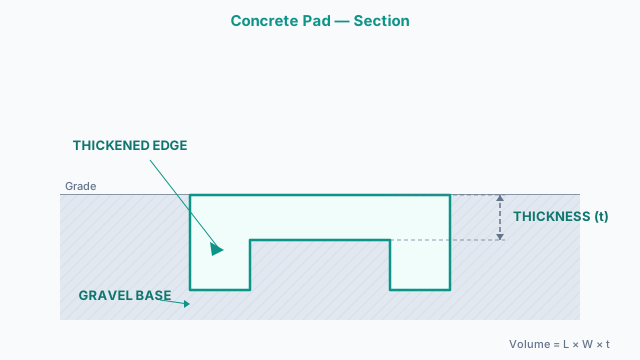
- 1) Net concrete volumeVolume (ft³) = Length (ft) × Width (ft) × Thickness (ft)
Volume (yd³) = Volume (ft³) ÷ 27
Volume (m³) = Volume (ft³) × 0.028317
All dimension inputs are converted to feet before multiplication. Thickness entered in inches is divided by 12 to convert to feet. - 2) Waste-adjusted volumeAdjusted Volume (ft³) = Net Volume × (1 + Waste% ÷ 100)
The default 5% waste factor covers minor spills, uneven subgrade surface, and form blowout. Bag counts are calculated on the waste-adjusted volume so your order already includes the overage. - 3) Pre-mix bag countBags = ⌈ Adjusted Volume (ft³) ÷ Yield per bag ⌉ (ceiling — round up)
Yields: 40 lb → 0.30 ft³ · 50 lb → 0.375 ft³ · 60 lb → 0.45 ft³ · 80 lb → 0.60 ft³
Bag yields sourced from manufacturer data (Quikrete, Sakrete). Always round up — you cannot use a partial bag of concrete. - 4) Ready-mix cost estimateCost = Waste-adjusted Volume (yd³) × Price per yd³
Concrete material cost only. Excludes labour, formwork, reinforcement, finishing, and delivery charges. Ready-mix concrete typically runs $130–$175 per yd³ in the US (varies significantly by region and season).
Common Concrete Pad Sizes at a Glance
| Equipment | Typical Pad Size | Thickness | Volume (yd³) | 60 lb Bags |
|---|---|---|---|---|
| Window AC Unit | 24 × 24 in | 4 in | 0.02 | 3 |
| Central AC (2–3 ton) | 3 × 3 ft | 4 in | 0.11 | 7 |
| Central AC (4–5 ton) | 3.5 × 3.5 ft | 4 in | 0.15 | 10 |
| Portable Generator | 3 × 4 ft | 4 in | 0.15 | 9 |
| Standby Generator | 5 × 4 ft | 4 in | 0.25 | 15 |
| Pool Equipment Pad | 4 × 4 ft | 4 in | 0.20 | 12 |
| Small Shed (8×8 ft) | 8 × 8 ft | 4 in | 0.79 | 48 |
| Medium Shed (12×8 ft) | 12 × 8 ft | 4 in | 1.19 | 72 |
| Large Shed (16×12 ft) | 16 × 12 ft | 4 in | 2.37 | 143 |
| Hot Tub / Spa | 10 × 10 ft | 6 in | 1.85 | 112 |
Volumes at net (no waste). Add 5–10% for a realistic order. Bag counts rounded up to whole bags. Ready-mix is recommended for volumes above 1.5 yd³.
Why Concrete Pad Pours Come Up Short
- Ignoring the waste allowance. The calculator's default 5% waste factor covers spills, uneven subgrade, and form blowout. Ordering exactly the net volume with nothing extra is the single most common reason a small pad pour comes up short by half a bag.
- Rounding bag counts down instead of up. Bag counts must be a ceiling, not a round-to-nearest value — 5.25 bags means you buy 6, not 5. A partial bag doesn't exist at the register or on the pad.
- Trusting the bare code minimum for every load. 4 in satisfies the ACI 318 / IRC R506 minimum for a light AC or generator pad, but a filled hot tub can add 90–125 psf of live load — that's why the hot tub preset defaults to 6 in instead.
- Sticking with bags past the ready-mix break-even point. Bags are practical and cheaper below about 0.5 yd³. Past roughly 1.5 yd³ — a large shed or hot tub pad — ready-mix delivery is faster, cheaper per yard, and gives a more consistent mix.
- Skipping the reinforcement check. Small AC and generator pads usually only need wire mesh or fiber; larger shed and hot tub pads benefit from #3–#4 rebar at 12 in on-center per ACI 318 §7.6 shrinkage-and-temperature steel requirements. Advanced mode flags which applies to your preset.
Pairing the Concrete Pad Calculator with Other Tools
The Concrete Pad Calculator is optimized for small equipment pads — AC units, generators, hot tubs, and sheds — with presets for each application. For a larger outdoor patio or pool deck, the concrete patio calculator covers rectangular and circular flatwork. When the pad needs a cost breakdown including labor, reinforcement, and sub-base, the concrete slab cost calculator provides the full itemized estimate. The broader slab concrete calculator handles any rectangular or circular slab without preset presets. When a pad requires a separate perimeter footing poured beforehand, the footing concrete calculator estimates that element. For the pre-mix bag count before your store run, the concrete bag calculator converts your cubic footage to 40/60/80 lb bag counts.
Where These Figures Come From
Section §7.3 governs minimum slab thickness for slabs on grade, and §7.6 specifies minimum shrinkage-and-temperature steel. The density constant used in this calculator (150 pcf / 2,400 kg/m³ for normal-weight concrete) is per ACI 318.
Sets the residential minimum at 3.5 in (practical 4 in) for slabs on grade. This calculator triggers a warning when pad thickness falls below 4 in.
Governs moist-curing practice for slabs on grade. Equipment pads should be kept moist and covered for a minimum of 7 days after placement to prevent plastic shrinkage cracking and achieve full design strength at 28 days.
The standard method for measuring fresh concrete unit weight. The 150 pcf normal-weight density used in this calculator is consistent with ASTM C138 test values for standard mix designs.
Equipment pad adequacy depends on allowable soil bearing pressure, anchor bolt edge distance, and dynamic load factors; consult a licensed structural engineer for any pad supporting HVAC, generators, or process equipment.
Common Concrete Pad Ordering Questions
What is a concrete pad calculator?
A concrete pad calculator estimates the concrete volume, bag counts, and optional material cost needed for a small equipment pad — such as an AC unit, shed, hot tub, or generator base. It multiplies pad length × width × thickness to get volume in cubic yards, then divides by the yield per pre-mix bag to give you the exact number of bags to buy.
How does the concrete pad calculator work?
The calculator converts your length, width, and thickness inputs to feet, then computes Volume (ft³) = Length(ft) × Width(ft) × Thickness(ft). It converts that to cubic yards (÷ 27) and cubic meters (× 0.02832), then divides the waste-adjusted ft³ by the yield of each bag size — 0.30 ft³ per 40 lb bag, 0.375 per 50 lb, 0.45 per 60 lb, and 0.60 per 80 lb — rounding up to whole bags.
How thick should a concrete pad be for an AC unit?
The standard thickness for a central air conditioner equipment pad is 4 inches (100 mm). This satisfies the IRC R506 residential slab minimum and is sufficient for the static load of most 2–5 ton units. Some HVAC contractors specify 3.5 in, but 4 in is the accepted minimum for a code-compliant residential pour.
How thick should a concrete pad be for a hot tub?
A concrete pad for a hot tub should be at least 6 inches (150 mm) thick. A filled 6-person hot tub can weigh 3,000–5,000 lb including water and occupants, creating a live load of approximately 90–125 psf on the pad surface. IRC R506 permits 4 in for general residential slabs, but the additional thickness and #4 rebar at 12″ on-center are recommended for this load.
How thick should a concrete pad be for a shed?
A concrete pad for a residential shed should be 4 inches (100 mm) thick. This matches the IRC R506 minimum for residential slabs and supports the dead weight of the shed structure plus stored contents. For larger sheds over 200 ft² or heavy storage applications, consider 4.5–6 inches with #3 rebar at 12″ on-center.
What is the difference between a concrete pad and a concrete slab?
A concrete pad is a small, discrete pour designed to support a specific piece of equipment — typically 2 ft × 2 ft to 16 ft × 12 ft in plan. A concrete slab is a large, continuous pour used for garages, driveways, patios, and room floors — typically 200–2,000+ ft². Both are rectangular concrete placements, but pads are equipment-specific with preset dimensions and presets, while slabs involve larger areas and sometimes saw-cut joints.
Do I need rebar in an equipment pad?
It depends on the load and size. Small AC pads and generator pads (under 16 ft²) typically use welded wire mesh (6×6 W1.4×W1.4) or polypropylene fiber, which is sufficient for the static equipment weight. Larger shed pads and hot tub pads benefit from #3 or #4 deformed rebar at 12″ on-center in both directions, per ACI 318 §7.6 minimum shrinkage and temperature steel requirements.
How many 60 lb bags of concrete fill 1 cubic yard?
A 60 lb pre-mix bag yields 0.45 cubic feet of concrete. Since 1 cubic yard = 27 cubic feet, you need 27 ÷ 0.45 = 60 × 60 lb bags per cubic yard. In practice, add 5–10% for waste, so budget 63–66 bags per yard.
Should I use ready-mix or bags for a concrete equipment pad?
For pads under 0.5 yd³ (about 13.5 ft³), pre-mix bags are practical and economical — you avoid minimum-order fees and short-load charges from ready-mix suppliers. For pads between 0.5 and 1.5 yd³, bags are still feasible but labour-intensive. Above 1.5 yd³ — such as a large shed or hot tub pad — ordering ready-mix is faster, cheaper per yard, and gives a more consistent mix.
How long does a concrete pad take to cure?
Concrete reaches approximately 70% of its design strength in 7 days and essentially full strength (28-day f'c) at 28 days. You can set light equipment (AC unit, generator) on the pad after 24–48 hours, but avoid heavy loads until 7-day cure. For hot tubs, wait the full 28 days before filling with water. Keep the pad moist and covered with plastic sheeting for the first 7 days to prevent shrinkage cracking (ACI 308R moist-curing guidance).
Is the calculator free?
Yes — completely free with no sign-up, no account, and no download required. All calculations run locally in your browser and no data is sent to a server.
Can I print or save my estimate?
Yes. After pressing Calculate, click the Print / Save button to open a clean, print-optimised page listing all inputs, volumes in yd³ / ft³ / m³, bag counts for all four bag sizes, and the cost estimate if you entered a price. Select 'Save as PDF' in your browser's Print dialog to keep a digital copy.
What standards govern concrete equipment pads?
The primary references are ACI 318-19 Building Code Requirements for Structural Concrete (§7.3 slab thickness minimums), IRC R506 (4-inch minimum for residential slabs on grade), ACI 308R Guide to External Curing of Concrete (moist curing practice), and ASTM C138 (unit weight verification). This calculator's density constants are sourced from ACI 318 (normal-weight: 150 pcf / 2,400 kg/m³).
Related Calculators
Slab Concrete Calculator
Estimate concrete for slabs, patios, and floors.
Concrete Patio Calculator
Estimate concrete volume, bags, and cost for slabs, patios, and floors.
Concrete Slab Cost Calculator
Estimate cost of concrete for slabs, patios, and floors.
Footing Concrete Calculator
Continuous, isolated, and combined footings.
Monolithic Slab Concrete Calculator (Slab + Thickened-Edge Footing)
Calculate concrete volume for a monolithic slab — slab body plus integral perimeter footing in a single pour. Garage, house foundation, and shed presets with ACI 318 and IRC R403 compliance checks.