How Much Concrete Is in an 80 lb Bag?
One 80 lb bag of standard pre-mixed concrete yields approximately 0.60 cubic feet (about 17 litres) of finished, placed concrete. That single number is the hinge every other figure on this page turns on: it is why 45 bags make a cubic yard, why one bag is 0.0222 cubic yards, and why one bag covers 1.80 square feet at 4 inches thick. Divide the bag weight by the yield and you get the implied compacted density — 80 ÷ 0.60 = 133.3 lb per cubic foot, which the site's shared calculation engine rounds to 133 lb/ft³ for every bag-mix computation it runs. Both figures are correct; 133.3 is the raw derivation and 133 is the constant the calculator actually uses.
Treat the word approximately as load-bearing. Manufacturers publish 0.60 cubic feet as a nominal yield for compacted, finished concrete — Quikrete states it in the YIELD section of the Concrete Mix No. 1101 data sheet, Sakrete publishes the same figure, and both products are supplied under ASTM C387, the standard specification for packaged dry combined materials. What the number does not include is spillage, an uneven subgrade, an over-excavated footing, or the mix you leave stuck in the mixer drum. That is why every bag count on this page is quoted alongside a 5–10% waste allowance, and why the calculator applies that allowance to the volume before it divides. Enter a volume in cubic yards or cubic feet and the tool answers all four standard sizes at once — 90 × 40 lb, 72 × 50 lb, 60 × 60 lb, or 45 × 80 lb per cubic yard. If you do not have a volume yet, the Concrete Bag Calculator derives one from project dimensions and belongs upstream of this page.
What This Volume-to-Bags Converter Does
All Four Sizes Answered Together
One volume entry returns the 40, 50, 60, and 80 lb counts side by side, so the bag-size decision happens at the desk with all four numbers visible — not in the aisle with one price tag in front of you.
Takes the Unit Your Volume Arrived In
A ready-mix quote comes in cubic yards; a slab takeoff comes in cubic feet. Both are accepted directly, with the 27 ft³-per-yard conversion handled internally so nothing is transcribed by hand.
Buffer Applied Before the Division
The waste allowance is added to the volume first, then converted. Buffering a finished bag count instead is the more common habit and it quietly under-orders, because the rounding has already happened.
Independent Ceiling on Every Size
Each size rounds up on its own remainder — a volume can land exactly on a whole number of 60 lb bags while the 80 lb column still carries a three-quarter-bag fraction that has to become a full bag.
Pallet Count per Bag Size
Each bag count is also expressed in standard retail pallets — 42 bags for 80 lb, 56 for 60 lb, 64 for 50 lb, 80 for 40 lb — which is the unit a supplier's yard and forklift actually think in.
Four-Way Volume Readout
Base cubic feet, buffered cubic feet, cubic yards, and cubic meters all appear together, so the same pour can be quoted to a bagged-goods clerk and a ready-mix dispatcher without re-deriving anything.
Ready-Mix Threshold Alert
Above 5 yd³ a standards note fires citing ACI 302.1R-15 on batch consistency for sequentially mixed bags — the point at which continuing to convert to bags stops being the right answer.
Job-Size Presets for Sanity Checks
Small (0.5 yd³), Medium (2 yd³), and Large (5 yd³) load instantly, which is the fastest way to see whether a quoted volume is plausible for the job in front of you before committing to it.
Per-Cubic-Yard Constants Stay On Screen
The quick-reference block keeps 45 / 60 / 72 / 90 bags per yard visible next to your result, so you can eyeball whether the calculated count is in the right neighbourhood.
80 lb Count as the Headline
The hero figure reports the 80 lb count because it is always the fewest bags for a given volume — the baseline every other size is a trade against.
No Geometry Required
There is no length, width, or thickness field anywhere in this tool. That is deliberate: it assumes the measuring argument is over and refuses to reopen it.
Printable Supplier Order Sheet
Print / Save produces a single page carrying the entered volume, the buffered volume, all four bag counts, all four pallet counts, and the reference table — enough for a supplier to fill the order without a phone call.
How Many 80 lb Bags Make a Cubic Yard?
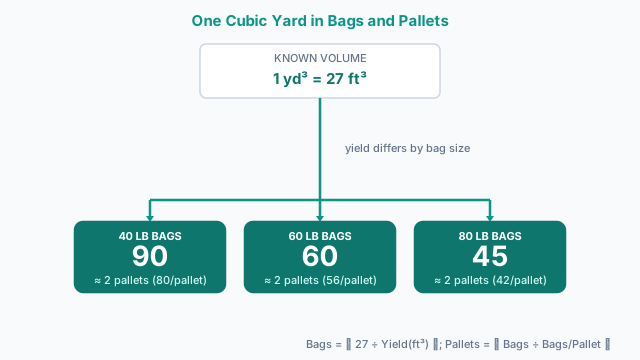
45 bags. A cubic yard is 27 cubic feet by definition, and one 80 lb bag yields approximately 0.60 cubic feet, so 27 ÷ 0.60 = 45. It divides evenly, which is unusual and worth noticing — the other three sizes also divide evenly, which is why the bags-per-yard numbers below are exact rather than rounded. Buy to that figure and you have bought exactly one yard of theoretical concrete with nothing left for the shovel, the wheelbarrow, or the low corner of the subgrade. Add the standard 5–10% allowance and a cubic yard of 80 lb bags becomes 48–50 bags to actually order.
How many 80 lb bags of concrete are in a yard?
45 bags (27 ÷ 0.60). That is 3,600 lb of dry mix and 1.07 standard pallets. With a +5% buffer, order 48 bags.
How many 60 lb bags of concrete are in a yard?
60 bags (27 ÷ 0.45). The 60 lb bag is the usual compromise — a third lighter to carry than the 80, but 15 more bags to open per yard. With a +5% buffer, order 63 bags.
How many 50 lb bags of concrete are in a yard?
72 bags (27 ÷ 0.375). The 50 lb size turns up in seasonal retail stock and in mixed-brand aisles, and it is the size most often mis-estimated because people reach for the 60 lb figure by habit. One 50 lb bag yields approximately 0.375 cubic feet, or 0.0139 cubic yards. With a +5% buffer, order 76 bags.
How many 40 lb bags of concrete are in a yard?
90 bags (27 ÷ 0.30) — exactly twice the 80 lb count, because the yield is exactly half. The 40 lb bag wins on handling in tight access and loses on everything else. With a +5% buffer, order 95 bags.
One consequence of these constants settles an argument that comes up on almost every bagged pour: the four sizes are exactly proportional. Every size yields 0.0075 ft³ of placed concrete per pound of dry mix, so a cubic yard is 3,600 lb of material whichever size you buy — 45 × 80 lb and 90 × 40 lb weigh the same. Switching sizes changes how many times you bend over, not how much concrete you get.
How Many Cubic Yards Is One 80 lb Bag?
One 80 lb bag is 0.0222 cubic yards — approximately 0.60 cubic feet divided by 27. Rounded the way most sources quote it, that is 0.022 yd³, or one forty-fifth of a yard. The reciprocal looks like a trivia question until you are on the phone with a ready-mix dispatcher, and then it is the only unit that matters.
Here is why. Ready-mix is quoted, batched, and invoiced in cubic yards, usually with a quarter-yard ordering increment and a short-load fee below some minimum. Bagged concrete is sold in bags. The two conversations use different units, so the moment you want to compare them you have to move in the bag-to-yard direction rather than the yard-to-bag direction you started with. A plan calling for 18 bags is 0.40 yd³ — well under the quarter-yard increment a plant will even take an order for. A stack of 60 bags left over from another job is 1.33 yd³, which is a real fraction of a truck and worth pricing before you buy more. Per-bag yardage for the other sizes: 60 lb → 0.0167 yd³, 50 lb → 0.0139 yd³, 40 lb → 0.0111 yd³. As always, whatever bag count you derive from a yardage figure still needs the 5–10% allowance added before you order.
How Much Area Does an 80 lb Bag Cover?
There is no single answer, and any page that gives you one has left out the only variable that matters. Coverage is yield divided by depth: approximately 0.60 cubic feet spread 2 inches deep covers 3.60 square feet; spread 8 inches deep it covers 0.90 square feet — a four-fold difference from the same bag. At the residential default of 4 inches, one 80 lb bag covers 1.80 square feet. Read the whole table rather than the one row you think applies.
| Thickness | Coverage per Bag (approximate) | Bags per 100 sq ft |
|---|---|---|
| 2 in. | 3.60 sq ft | 28 |
| 3 in. | 2.40 sq ft | 42 |
| 4 in. | 1.80 sq ft | 56 |
| 5 in. | 1.44 sq ft | 70 |
| 6 in. | 1.20 sq ft | 84 |
| 8 in. | 0.90 sq ft | 112 |
Coverage = approximately 0.60 ÷ (thickness in inches ÷ 12). The bags-per-100-sq-ft column is rounded up to the whole bag and is stated before the waste factor — add 5–10% to whichever row you use.
Two things fall straight out of this table. First, the 2 inch row is a floor, not an option: standard concrete mix is specified for a minimum 2 inch placement thickness, and anything thinner needs a sand mix or a topping mix instead — the coverage figure at 1 inch is arithmetically real and practically useless. Second, coverage scales inversely, so a 4 inch slab quoted at 56 bags per 100 sq ft becomes 84 bags per 100 sq ft the moment the spec moves to 6 inches for a driveway. Thickness changes are the single largest source of surprise on a bagged order, far ahead of yield variance between brands.
How to Use This Calculator
- 1Select an Estimate Mode. Quick mode converts your raw volume as entered. Advanced mode adds the waste-buffer step — use it for anything you are actually buying.
- 2Optional: click a job-size preset (Small 0.5 yd³, Medium 2 yd³, Large 5 yd³) to pre-fill the volume field, then override it with your own figure.
- 3Enter your concrete volume in the Volume field. Switch the unit selector to yd³ or ft³ to match the unit your volume arrived in — a ready-mix quote is yards, a slab takeoff is usually feet.
- 4In Advanced mode, choose a waste buffer: +0% for a theoretical check, +5% for a measured form on prepared subgrade, +10% for rough subgrade, complex forms, or hand mixing.
- 5Press Calculate. Results appear in the right panel; nothing is submitted anywhere and no sign-up is required.
- 6Read the Bags Needed tile. It reports the 40, 50, 60, and 80 lb counts simultaneously so you can compare sizes before committing to one.
- 7Check the volume readout underneath — base cubic feet, buffered cubic feet, cubic yards, and cubic meters — and confirm the buffered figure is the one the bag counts came from.
- 8Check the Pallets Needed tile if you are ordering in quantity; it converts each bag count into standard retail pallets for delivery and forklift planning.
- 9Cross-check against the quick reference block: 45 bags of 80 lb, 60 of 60 lb, 72 of 50 lb, or 90 of 40 lb per cubic yard. If your result is not close to your yardage times those numbers, the volume entry is wrong.
- 10If the large-pour warning appears above 5 yd³, price a short-load ready-mix truck before ordering. Past that point bags usually lose on both cost and batch consistency.
- 11Click Print / Save for a printable summary carrying your inputs, all four bag counts, pallets, and the reference table. Choose Save as PDF in the browser print dialog.
- 12Click Reset to clear every field and start over.
Formulas Used
- 1) Volume normalised to cubic feetVolume (ft³) = Volume (yd³) × 27
Worked: 2 yd³ × 27 = 54 ft³. Bag yields are published in cubic feet, so a cubic-yard input is converted first and a cubic-foot input skips this step. Every figure downstream inherits this one, which is why an error here scales through all four bag columns at once. - 2) Waste allowance applied to volumeAdjusted Volume (ft³) = Base Volume × (1 + Waste % ÷ 100)
Worked: 33.3 ft³ × 1.10 = 36.7 ft³. The order matters. Buffering the volume feeds a larger number into a ceiling function; buffering a finished bag count multiplies a figure that has already been rounded, and the two do not always agree. Use 5% for measured forms and 10% for rough conditions. - 3) Bag count, per size, rounded upBags = ⌈ Adjusted Volume (ft³) ÷ Yield per Bag (ft³) ⌉
Worked: ⌈ 36.7 ÷ 0.60 ⌉ = 62 bags of 80 lb. Nominal yields, all approximate: 40 lb → 0.30 ft³, 50 lb → 0.375 ft³, 60 lb → 0.45 ft³, 80 lb → 0.60 ft³. Four independent divisions, four independent ceilings — one size can land on a whole bag while another wastes most of one. - 4) Cubic yards per bag (the reciprocal)Yield (yd³) = Yield (ft³) ÷ 27
Worked: 0.60 ÷ 27 = 0.0222 yd³ per 80 lb bag. Multiply by a bag count to convert a stack of bags back into a truck quote: 60 bags × 0.0222 = 1.33 yd³. - 5) Coverage at a given thicknessCoverage (sq ft/bag) = Yield (ft³) ÷ (Thickness in. ÷ 12)
Worked: 0.60 ÷ (4 ÷ 12) = 1.80 sq ft per bag at 4 inches. Inverted for a known area: Bags = ⌈ Area (sq ft) ÷ Coverage ⌉, so 100 sq ft at 4 in. is ⌈ 100 ÷ 1.80 ⌉ = 56 bags before waste. - 6) Implied compacted densityDensity (lb/ft³) = Bag Weight ÷ Yield (ft³)
Worked: 80 ÷ 0.60 = 133.3 lb/ft³ unrounded; the shared engine constant used in every calculation on this site is 133 lb/ft³. Quote 133 when you are quoting the calculator and 133.3 only when you are showing this derivation.
Worked Examples
1 · The method, start to finish — a 36 sq ft walkway at 4 in.
A 12 ft × 3 ft walkway poured 4 inches thick. Convert every dimension to feet first — 4 inches is 0.333 ft, and forgetting that step is the most common way a bag count comes out twelve times too large. Volume is 12 × 3 × 0.333 = 12 ft³ (0.44 yd³). Divide by the 80 lb yield: 12 ÷ 0.60 = 20.0, rounded up to 20 bags. Now buffer it: at +10% the volume becomes 13.2 ft³ and the order becomes 22 bags. Cross-check against coverage — 36 sq ft ÷ 1.80 sq ft per bag = 20 bags before waste. The two routes agree, which is exactly what you want before spending money.
2 · How many 80 lb bags for a 10 × 10 slab?
10 ft × 10 ft × 4 in. = 33.3 ft³ (1.23 yd³). At approximately 0.60 ft³ per bag that is 56 bags, matching the 56-bags-per-100-sq-ft row in the coverage table. With a +10% allowance, order 62 bags. Worth pausing here: this is 1.23 yd³ and roughly 4,960 lb of material to carry, open, and mix by hand in a single continuous placement. It is the size of job where the bagged route starts to be a genuine decision rather than an obvious one.
3 · How many bags for an 8 in. sonotube, 4 ft deep?
A cylinder: π × (4 in. radius ÷ 12)² × 4 ft = 1.40 ft³. Divide by 0.60 and you get 2.33, rounded up to 3 bags per tube. Percentage waste is close to meaningless at this scale — 5% of 3 bags does not reach a whole bag. For piers, buffer by the bag instead: carry one spare per hole, because a tube left half-full while someone drives to the store is a cold joint in a structural element.
4 · Is one pallet of 42 bags the same as one cubic yard?
Close, but no — for the full pallet-to-yard breakdown, total weight, and truckload math, use the Concrete Pallet Calculator.
5 · How far will 43 bags of 80 lb concrete go?
43 × approximately 0.60 = 25.8 ft³. Spread at 4 inches, each bag covers 1.80 sq ft, so 43 × 1.80 = 77.4 square feet at 4 inches. Change the depth and that answer changes with it: the same 43 bags reach 51.6 sq ft at 6 inches and 154.8 sq ft at 2 inches. Treat these as pre-waste figures and plan the form 5–10% smaller than the arithmetic allows.
6 · How many yards of concrete is 60 bags of 80 lb?
60 × approximately 0.60 = 36 ft³ = 1.33 cubic yards. This is the conversion to run before calling a plant with leftover stock in the garage: 1.33 yd³ is a real fraction of a truck, and knowing it lets you order the difference rather than the whole pour. Going the other way, 1.33 yd³ with a +5% allowance would be 63 bags.
7 · How many 80 lb bags for 35 yards? — and why you should not
The arithmetic first, because the question deserves a real answer: 35 yd³ × 27 = 945 ft³, divided by approximately 0.60 ft³ per bag = 1,575 bags. With a +5% allowance it is 1,654 bags. That is 37 full pallets plus 21 loose bags — 38 pallet positions and 126,000 lb (63 tons) of material to unload, store, open, and mix.
Do not do this. 35 cubic yards is a ready-mix pour — three to four truckloads, batched to a specified mix design, placed continuously, with the plant carrying the batching tolerance instead of you. Mixing 1,575 bags by hand or in a portable mixer means cold joints between batches, uncontrolled water content bag to bag, and a placement window measured in days rather than hours. ACI 302.1R-15 is explicit that batch-to-batch consistency degrades on sequentially mixed work of this size. Use the 35 yd³ figure as your input when you call the supplier — that is the number the dispatcher needs, and it is what this calculator is for once the answer stops being “buy bags”.
80 lb vs 60 lb vs 50 lb vs 40 lb Bags
The four sizes deliver identical concrete at identical total weight per cubic yard. The choice is a handling and logistics decision, not a materials one.
| Bag Size | Yield per Bag (approximate) | Yield in yd³ | Bags per yd³ | Coverage at 4 in. | Bags per Pallet | Dry Mix per yd³ |
|---|---|---|---|---|---|---|
| 40 lb | 0.30 ft³ | 0.0111 yd³ | 90 | 0.90 sq ft | 80 | 3,600 lb |
| 50 lb | 0.375 ft³ | 0.0139 yd³ | 72 | 1.13 sq ft | 64 | 3,600 lb |
| 60 lb | 0.45 ft³ | 0.0167 yd³ | 60 | 1.35 sq ft | 56 | 3,600 lb |
| 80 lb | 0.60 ft³ | 0.0222 yd³ | 45 | 1.80 sq ft | 42 | 3,600 lb |
Yields are nominal manufacturer figures held in the site's shared engine constants and are approximate. Pallet counts are standard retail quantities — confirm with your supplier before scheduling a delivery.
When the 80 lb bag wins
- Fewest units to move: 45 per yard against 90 for the 40 lb — half the lifts and half the bags to slit, empty, and dispose of.
- Fastest mixing cycle for a given volume, which matters when the whole pour has to stay ahead of initial set.
- Lowest packaging overhead per cubic yard, and usually the lowest cost per cubic yard for the same product line.
- Best fit for a powered mixer, where drum capacity and not back strength is the limit.
When a smaller bag wins
- An 80 lb bag is a genuine two-hand lift; 60 or 50 lb is the realistic choice for solo work, stairs, or a long carry from the truck.
- Small, scattered pours — a few post holes, a mower pad — where a whole 80 lb bag would be wasted on the last hole.
- Hand mixing in a tub or wheelbarrow, where a smaller batch is easier to bring to an even consistency.
- Constrained access: 40 lb bags at 80 per pallet break down into loads a single person can carry through a gate or down a basement stair.
On cost, the useful frame is cost per cubic yard rather than cost per bag. Because a yard is 3,600 lb of dry mix at any size, whichever size carries the lowest price per pound within a product line wins — in practice that is normally the 80 lb bag, and the gap widens at pallet quantity. Bag pricing moves with the market and by region, so check current bag pricing before treating any published per-yard figure as settled.
Four Mistakes Specific to Converting a Volume Into Bags
- Converting the supplier's quoted yardage instead of your own volume. A ready-mix quote has already been rounded up to the plant's ordering increment — often a quarter yard, sometimes a one-yard minimum. Feed that number in here and you buy bags for concrete the truck was padding, not concrete your forms will hold. Convert the volume you measured, and treat the quote as a price comparison only.
- Quoting a coverage figure without its thickness. “A bag covers 1.80 square feet” is true at 4 inches and wrong everywhere else — the same bag covers 3.60 sq ft at 2 inches and 0.90 sq ft at 8. A driveway spec that moves from 4 to 6 inches adds 28 bags per 100 square feet. Carry the depth with the number, always.
- Leaving Quick mode's zero buffer on a real order. Quick mode converts the raw volume with no allowance at all, which is correct for checking a number and wrong for buying material. Switch to Advanced and apply +5% for a measured form or +10% for rough subgrade before you write the order down — not afterwards in your head, where it usually gets forgotten.
- Treating the four counts as interchangeable at the register. They deliver identical concrete at identical total weight, so the only real difference is labour: 90 × 40 lb bags per yard is twice the lifting cycles of 45 × 80 lb, and twice the bags to open, empty, and dispose of. Choose the size by who is carrying and how the mixer is fed, then order that column — don't default to whatever is stacked nearest the door.
This Calculator vs. the Concrete Bag Calculator
The two bag tools on this site are not variations on each other — they sit at different points in the same job. The dividing question is simply whether you already know your volume. If you do, the geometry step is behind you and everything left is procurement. If you don't, dividing anything is premature.
Use this calculator when…
- A ready-mix supplier quoted you a cubic-yard figure and you want to price the bagged route against it.
- Blueprints, a bid schedule, or an engineer's takeoff already state the volume.
- Another calculator on this site returned a volume and you need it in bags.
- You are comparing bag sizes, coverage at depth, pallet counts, or delivery logistics rather than shapes.
Use the Concrete Bag Calculator when…
- You have physical dimensions — slab length, width and thickness; hole diameter and depth — and no volume yet.
- The pour is a specific shape: slab, footing, post hole, or sonotube.
- You want one bag size costed for one project rather than four sizes compared.
- You need the volume itself as an output, not just the bag count.
In practice the two chain together: derive the volume with the Concrete Bag Calculator or a shape-specific tool, then bring the number here to compare sizes, coverage and pallets before ordering. For the upstream volume step, the slab calculator handles flatwork, the footing calculator covers strip and pad footings, the sonotube calculator handles tube-form piers, and the post hole calculator covers fence and deck posts. If the volume turns out to be large enough that bags stop making sense, the concrete yards calculator is the right tool for talking to a ready-mix plant. For field notes on how bagged and ready-mix pours actually go wrong on site, see our write-up on mixing and placing bagged concrete.
Standards & References
The governing standard for packaged concrete mix, and the reason the approximately 0.60 ft³ yield holds across compliant brands rather than being one manufacturer's number. It sets the material proportioning and strength requirements behind every figure this calculator divides by.
The primary published source for the yield figures on this page. Its YIELD section gives approximately 0.60 ft³ for the 80 lb bag and 0.45 ft³ for the 60 lb bag, along with the 2 in. minimum placement thickness the calculator warns about and the 4,000 psi average 28-day compressive strength.
A second, independent manufacturer publishing the same per-bag yields under the same ASTM C387 specification. Two unrelated sources agreeing is the reason these constants are treated as class figures rather than as a single brand's claim.
The reference specification architects and engineers incorporate into project documents. It governs placement, consolidation and finishing tolerances — the practical reason a real order carries a 5–10% allowance over the theoretical volume rather than matching it exactly.
The basis for the large-pour alert in the results panel: past roughly 5 yd³, batch-to-batch consistency on sequentially mixed bagged concrete degrades far enough that ready-mix delivery is the better quality decision, not just the cheaper one.
Yield-variance risk note for this conversion: every count on this page divides by a nominal yield, and nominal yield is the one input a volume-to-bags conversion cannot verify for you. Specialty lines — fast-setting, high-early-strength, fiber-reinforced, crack-resistant — depart from the standard figures by roughly ±5%, and damp aggregate carries water weight that shifts placed volume again once you dose to slump. Read the yield printed on the bag you are actually buying, and if it differs from the table above, re-run the conversion against that number rather than the class average. Standards are cited for reference; consult a licensed engineer for project-specific design requirements.
Frequently Asked Questions
How many 80 lb bags of concrete are in a cubic yard?
45 bags. A cubic yard is 27 cubic feet and one 80 lb bag yields approximately 0.60 cubic feet, so 27 ÷ 0.60 = 45. That is the theoretical figure with nothing left over — add a 5–10% waste allowance and the realistic order is 48–50 bags. For the other sizes: 60 × 60 lb bags, 72 × 50 lb bags, or 90 × 40 lb bags per cubic yard.
How many cubic feet is an 80 lb bag of concrete?
Approximately 0.60 cubic feet (about 17 litres) of finished, placed concrete. That is the compacted volume the mix produces once water is added, not the volume of dry material in the sack. Dividing bag weight by yield gives the implied compacted density: 80 ÷ 0.60 = 133.3 lb/ft³ unrounded, which this site's shared calculation engine rounds to 133 lb/ft³ for every bag-mix computation.
How many cubic yards is one 80 lb bag?
0.0222 cubic yards, usually quoted as 0.022 yd³. It is simply the cubic-foot yield divided by 27: approximately 0.60 ÷ 27 = 0.0222. One bag is one forty-fifth of a cubic yard, which is the conversion you need when comparing a bag count against a ready-mix quote, since plants batch and invoice in yards.
How much area does one 80 lb bag cover at 4 inches?
1.80 square feet at 4 inches thick, which works out to 56 bags per 100 square feet before waste. Coverage is yield divided by depth, so it changes with thickness: 3.60 sq ft at 2 in., 2.40 sq ft at 3 in., 1.80 sq ft at 4 in., 1.44 sq ft at 5 in., 1.20 sq ft at 6 in., and 0.90 sq ft at 8 in. Never use a coverage figure without stating the thickness it assumes.
How many 80 lb bags do I need for a 10×10 slab?
A 10 ft × 10 ft slab poured 4 inches thick is 33.3 cubic feet, or 1.23 cubic yards, which needs 56 bags of 80 lb concrete. With a 10% waste allowance, order 62 bags. That is roughly 4,960 lb of material to carry, open and mix in one continuous placement, so it is the size of job where pricing a short-load ready-mix truck is worth the phone call.
Is the 0.60 cu ft yield officially published?
Yes. QUIKRETE publishes it in the YIELD section of the Concrete Mix No. 1101 product data sheet, and Sakrete publishes the same figure for its equivalent product. Both are supplied under ASTM C387, the standard specification for packaged, dry, combined materials for concrete, which is why two unrelated manufacturers agree. The figure is explicitly a nominal, approximate yield for compacted concrete.
Why do I get a different bag count than the store calculator?
Almost always one of three things. First, where the waste allowance is applied — buffering the volume before dividing gives a different answer from buffering an already-rounded bag count. Second, the rounding rule: this calculator rounds up to a whole bag on every size independently. Third, the assumed yield — specialty and fast-setting mixes depart from the standard 0.60 cubic feet by roughly ±5%, and a store tool tied to one product line will use that product's number.
How much waste should I add to my bag count?
Use 5% when the volume came from a precisely measured form on prepared subgrade, and 10% when the volume is an estimate, the subgrade is irregular or over-excavated, or you are hand mixing. Apply the allowance to the volume before dividing by bag yield, not to the finished count. On very small pours such as post holes, percentages are meaningless — carry one spare bag per hole instead.
How many 80 lb bags equal a full pallet?
A standard retail pallet holds 42 bags of 80 lb concrete mix. See the Concrete Pallet Calculator for the full breakdown by bag size, weight, and cubic yard equivalents.
full pallet quantities →How much water does an 80 lb bag need?
Approximately 6 pints (3 quarts, or 0.75 US gallons) to start, with a working range of 6–9 pints per bag. Slump, not a fixed volume, is the real target — mix to a 2–3 inch slump and stop. Excess water reduces compressive strength, so add the last pint gradually rather than pouring the full range in at once.
water needed per bag →How much does an 80 lb bag cost?
Bag pricing moves with the market and varies significantly by region and retailer, so check current local pricing rather than relying on any published figure. What does not change is the structure: a cubic yard is 45 bags at 80 lb, pallet quantities carry a bulk price break at 42 bags, and every size delivers the same 3,600 lb of dry mix per cubic yard — so the size with the lowest price per pound wins on cost per yard.
current bag pricing →At what project size should I switch to ready-mix?
Under about half a cubic yard, roughly 22 bags of 80 lb, bags almost always win. Above one cubic yard — 45 bags and 3,600 lb of material — the decision turns on labour rather than material price. This calculator flags a ready-mix comparison above 5 cubic yards, where ACI 302.1R-15 notes that batch-to-batch consistency degrades on sequentially mixed work. The 0.5 to 1 yard band is a genuine judgement call about how many hands you have.
Can I use 80 lb bags for a slab under 2 inches thick?
No. Standard concrete mix is specified for a minimum placement thickness of 2 inches, because the aggregate size in the mix will not consolidate properly in a thinner section. Below 2 inches, use a sand mix or a concrete topping mix formulated for thin applications. The coverage arithmetic will happily give you a figure for a 1 inch pour, but the resulting slab will not perform.
How much does an 80 lb bag weigh when mixed?
Roughly 86 to 89 pounds. The bag contributes its 80 lb of dry material, and the 6 to 9 pints of mixing water add about 6.3 to 9.4 lb, since a US pint of water weighs about 1.04 lb. Note that this is why the 133.3 lb/ft³ figure derived from bag weight and yield is a bookkeeping density rather than the wet unit weight of the placed concrete, which sits nearer 145 lb/ft³.
Do all brands yield the same 0.60 cu ft?
Standard concrete mixes supplied under ASTM C387 land on approximately 0.60 cubic feet per 80 lb bag across the major brands, which is why the figure can be used as a class constant. Specialty products are a different matter: fast-setting, high-early-strength, fiber-reinforced and crack-resistant lines can vary by roughly ±5%, and aggregate moisture shifts placed volume again. Read the yield printed on the bag you are buying and re-run the numbers if it differs.
Related Calculators
Concrete Bag Calculator by Project
Turn slab, footing, post hole and sonotube dimensions into an exact bag count — five shape modes, imperial or metric, with +5%/+10% waste buffers.
Concrete Pallet Calculator
A pallet holds 42 bags of 80 lb concrete — 3,360 lb and 0.93 cubic yards, 3 bags short of a full yard. Calculate pallets, weight, and delivery needs for any bag size or project.
Concrete Mix Water Calculator
An 80 lb bag of concrete needs about 6 pints (3 quarts) of water, with a 6–9 pint working range. Calculate exact water for any number of bags across 40/50/60/80 lb sizes.
Concrete Yards Calculator
Convert and compute volume into cubic yards.
Concrete Weight Calculator
Convert any concrete volume (yd³, ft³, m³) or pour dimensions to weight in lb, short tons, and kg — with normal-weight, lightweight, and bag-mix presets.
Concrete Cubic Meter Calculator
Metric-first concrete calculator — enter dimensions in m / cm / mm to get volume in m³, weight in kg, and bag counts for 20 / 25 / 40 kg pre-mix bags.