How Concrete Weight Is Derived from Volume and Density
The Concrete Weight Calculator converts any concrete volume — entered directly as cubic yards, cubic feet, or cubic meters, or derived from pour dimensions — into weight in pounds, short tons, kilograms, and metric tons. Whether you are planning a structural dead-load check, estimating a haul-away truck requirement, or simply double-checking a ready-mix order, having the exact weight up front prevents costly overloads and engineering surprises. For the density references behind these numbers, see our pillar guide on how much concrete weighs; to move between cubic units, our concrete volume conversions guide; and for bagged-mix yield, our bag coverage and yield reference.
The calculator accepts three concrete types — normal weight (150 pcf), lightweight ACI 213R concrete (110 pcf), and pre-mix bag concrete (133 pcf) — all drawn from the shared density table in the site engine so every calculator on this site uses the same spec-locked constants. Outputs include bag counts for 40 / 50 / 60 / 80 lb bags alongside the weight figures, making it equally useful whether you are ordering ready-mix by the yard or using bagged concrete for a small project. You can enter a volume you already know (yd³, ft³, or m³), or let the calculator derive it from raw dimensions with an independent unit selector on each field.
What This Concrete Weight Model Assumes
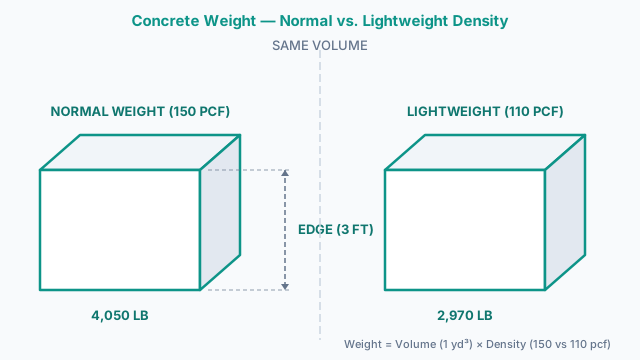
- Density constants are spec-locked, shared site-wide. The three concrete types — normal weight (150 pcf / 4,050 lb·yd⁻³), lightweight ACI 213R (110 pcf), and pre-mix bag concrete (133 pcf) — draw from a single density table used across every calculator on this site, so a value entered here matches the same constant used elsewhere.
- Metric conversions route through kg/m³, not through pcf. When the input unit is m³, the engine uses the kgPerM3 constant (2,400 for normal weight) directly, then derives pounds from kg × 2.20462 — avoiding compounded rounding that would occur converting pcf → kg/m³ → kg for every calculation.
- “Lightweight” refers to structural density, not material cost. ACI 213R lightweight mixes (110 pcf) use manufactured lightweight aggregate that typically costs more per yard than normal-weight ready-mix, even though the finished structure weighs less. The model assumes you are choosing lightweight for a dead-load reason, not a cost one.
- Large pours trigger a QC note, not an automatic design check. A pour volume over 20 yd³ surfaces a note referencing the mix-design review and QC testing ACI 318 §26.4 expects at that scale — informational only, since actual mix-design review requires supplier and engineer sign-off outside this calculator's scope.
How the Concrete Weight Total Is Built
- 1) Volume from dimensionsVolume (ft³) = Length (ft) × Width (ft) × Depth (ft)
Each input is converted to feet before multiplication using standard conversion factors (1 in = 1/12 ft, 1 yd = 3 ft, 1 m = 3.28084 ft, 1 cm = 1/30.48 ft). - 2) Weight from volume — normal weight concreteWeight (lb) = Volume (yd³) × 4,050 lb·yd⁻³
or Weight (lb) = Volume (ft³) × 150 lb·ft⁻³
4,050 lb·yd⁻³ is the spec-locked lbPerYd3 constant from the shared density table — equivalent to 150 pcf × 27 ft³/yd³. Used for normal-weight ready-mix and structural concrete (ACI 318). - 3) Weight from volume — metric pathWeight (kg) = Volume (m³) × 2,400 kg·m⁻³
When the input unit is m³, the engine routes through the kgPerM3 constant (2,400 for normal weight) to preserve the spec-exact value. Pounds are then derived from kg × 2.20462 rather than from pcf to avoid compounding rounding errors. - 4) Weight unit conversionsShort tons (US) = lb ÷ 2,000 | kg = lb × 0.453592 | metric tons = kg ÷ 1,000
The 0.453592 factor is the exact NIST pound-to-kilogram conversion. - 5) Volume unit conversionsft³ = yd³ × 27 | m³ = yd³ × 0.764555 | ft³ = m³ × 35.3147
All three volume representations are derived from a single authoritative value to avoid independent rounding of each. - 6) Pre-mix bag countsBags = ⌈ Volume (ft³) ÷ bag yield (ft³) ⌉
Bag yields: 40 lb → 0.30 ft³, 50 lb → 0.375 ft³, 60 lb → 0.45 ft³, 80 lb → 0.60 ft³. Always rounded up (Math.ceil) — you cannot buy a fraction of a bag.
Running the Concrete Weight Calculator
- 1Enter a known volume directly, or switch to dimensions and enter length × width × thickness — each field takes its own unit.
- 2Select the concrete type: Normal Weight for standard ready-mix, Lightweight for ACI 213R mixes, or Bag Mix for bagged pre-mix.
- 3Press Calculate for weight in pounds, tons, kilograms, and metric tons, plus bag counts if you're buying bagged concrete.
Concrete Weight Design Values — All Types, All Unit Systems
The table below shows the weight of concrete for the three most common mix types at each standard volume quantity. Use it for quick sanity-checks without running the full calculator.
| Volume | Normal Wt (150 pcf) | Lightweight (110 pcf) | Bag Mix (133 pcf) |
|---|---|---|---|
| 1 ft³ | 150 lb / 0.075 tons | 110 lb / 0.055 tons | 133 lb / 0.067 tons |
| 1 yd³ | 4,050 lb / 2.03 tons | 2,970 lb / 1.49 tons | 3,591 lb / 1.80 tons |
| 1 m³ | 2,400 kg / 2.40 t | 1,762 kg / 1.76 t | 2,130 kg / 2.13 t |
| 5 yd³ | 20,250 lb / 10.1 tons | 14,850 lb / 7.4 tons | 17,955 lb / 9.0 tons |
| 10 yd³ | 40,500 lb / 20.3 tons | 29,700 lb / 14.9 tons | 35,910 lb / 18.0 tons |
| 20 yd³ | 81,000 lb / 40.5 tons | 59,400 lb / 29.7 tons | 71,820 lb / 35.9 tons |
| 1 bag (80 lb) | 80 lb (0.60 ft³ yield) | n/a | 80 lb (0.60 ft³ yield) |
| 1 bag (60 lb) | 60 lb (0.45 ft³ yield) | n/a | 60 lb (0.45 ft³ yield) |
Short ton = 2,000 lb (US). Metric ton (t) = 1,000 kg. Bag-mix densities based on manufacturer-stated yields (80 lb bag → 0.60 ft³). For any concrete shape by volume, use this calculator. For a specific slab dead-load check, use the Concrete Slab Weight Calculator.
Worked Analysis: 24 × 30 ft Slab at 5 Inches
A 24 ft × 30 ft slab poured 5 inches thick covers 720 sq ft × (5 ÷ 12) ft = 300 ft³, or 300 ÷ 27 ≈ 11.1 yd³. At the standard 150 pcf normal-weight density, that's 300 × 150 = 45,000 lb — 22.5 short tons. A single ready-mix truck typically caps out around 8–9 yd³ before hitting gross-vehicle-weight limits, so this pour needs a second truck or a split delivery — worth knowing before the first load shows up. At 11.1 yd³, this pour also crosses into the >20 yd³ QC-review zone only if scaled up roughly 2×; below that threshold, no formal mix-design review is triggered.
Limits of This Concrete Weight Estimate
A mistake that costs money: assuming "lightweight" means cheaper. ACI 213R lightweight mixes (110 pcf) use manufactured lightweight aggregate that usually costs more per yard than normal-weight ready-mix, even though the finished structure weighs less. Specify lightweight only when the dead-load savings are structurally necessary — for an ordinary slab-on-grade, normal weight is both cheaper and the correct default.
Concrete density varies 5–10% between normal-weight, lightweight, and heavyweight mixes; confirm unit weight with ASTM C138 field testing or certified mill reports before relying on weight estimates for structural dead-load calculations. When the primary goal is the ordering quantity in cubic yards, the concrete yards calculator is the faster path. For metric projects where dimensions are in m / cm / mm, the concrete cubic meter calculator returns volume in m³ alongside kg weight. For application-specific volume estimation, use the slab concrete calculator or the footing concrete calculator, then feed that volume here for the weight result. Pre-mix bag counts are best handled by the concrete bag calculator.
Governing Codes & Standards
Defines the normal-weight concrete unit weight of 150 pcf (2,400 kg·m⁻³) used as the primary density constant in this calculator. ACI 318 §26.4 also specifies quality-control and mix-design documentation requirements for larger structural pours — the basis for this calculator's 20 yd³ compliance flag.
The authoritative guide for structural lightweight concrete (SLWC). The lightweight density preset in this calculator (110 pcf / 1,762 kg·m⁻³) is drawn from the equilibrium density range covered by ACI 213R — appropriate for SLWC used in weight-sensitive applications such as long-span decks and high-rise slabs.
ASTM C138 is the field method used to measure the actual unit weight of fresh concrete. The density values used in this calculator (150, 110, 133 pcf) are design-time reference constants; actual delivered concrete should be verified against C138 test results from the pour to confirm mix compliance and confirm bag-mix yield assumptions.
Engineering & Design Questions
How much does concrete weigh per cubic foot?
Standard normal-weight concrete weighs 150 pounds per cubic foot (pcf). This is the industry-wide reference value per ACI 318 and is the most common figure used for dead-load calculations. Lightweight concrete (ACI 213R) comes in at approximately 110 pcf, while pre-mixed bag concrete averages around 133 pcf based on typical 80 lb bag yields.
How much does 1 cubic yard of concrete weigh?
One cubic yard of normal-weight concrete weighs approximately 4,050 pounds (just over 2 short tons). Because 1 yd³ = 27 ft³, and concrete weighs 150 lb/ft³, the math is 27 × 150 = 4,050 lb. Ready-mix trucks typically carry 8–10 cubic yards, so a full truckload weighs roughly 32,000–40,500 lb of concrete alone before factoring in the truck tare weight.
How much does 1 cubic meter of concrete weigh?
One cubic meter of normal-weight concrete weighs 2,400 kilograms (2.4 metric tons), per the ACI 318 standard density. Lightweight concrete is approximately 1,762 kg/m³. These are the constants used in this calculator's metric path — entered directly rather than converted from pcf to preserve the spec-exact value.
What is a concrete weight calculator?
A concrete weight calculator is a tool that converts a volume of concrete — expressed in cubic yards, cubic feet, or cubic meters — into a total weight in pounds, tons, or kilograms. It uses the known density (unit weight) of the concrete mix to perform the multiplication. This page's calculator also accepts pour dimensions and derives the volume itself.
How does a concrete weight calculator work?
It multiplies volume by density: Weight = Volume × Density. For normal-weight concrete that is Weight (lb) = Volume (ft³) × 150. If you enter dimensions, the calculator first computes volume (L × W × D, all converted to the same unit), then multiplies by the density constant for the selected concrete type. Unit conversions between lb, kg, tons, and metric tons are applied afterward.
What is the difference between this calculator and the Concrete Slab Weight Calculator?
This general Concrete Weight Calculator accepts any volume in yd³, ft³, or m³ — or raw dimensions for any shape. The Concrete Slab Weight Calculator is dimension-in, weight-out specifically for rectangular slabs, and also shows weight per square foot as a dead load value. Use this calculator when you already know your volume or have a non-slab shape; use the slab calculator when you want dead load in lb/ft².
Does concrete weight include rebar or reinforcement?
No — this calculator estimates the weight of the concrete mix only. Rebar adds approximately 0.5–1.5% of the concrete weight for typical residential slabs (roughly 3–5 lb per linear foot for #4 bar). If you need to include rebar weight, estimate it separately using a rebar weight chart and add it to the concrete weight result. Reinforced concrete is sometimes modeled at 156 pcf (150 pcf concrete + ~6 pcf rebar allowance) for structural dead-load purposes.
How much does 20 yards of concrete weigh?
Twenty cubic yards of normal-weight concrete weighs 20 × 4,050 = 81,000 pounds, or 40.5 short tons. That is approximately the payload limit of two fully loaded ready-mix trucks. At that pour volume, ACI 302.1R recommends a formal pre-pour mix design review and independent QC testing per ACI 318 §26.4.
What is the dry unit weight of concrete?
Dry unit weight refers to the density of hardened concrete after free water has evaporated from the mix. For normal-weight concrete, the dry unit weight is typically 145–150 pcf, slightly less than fresh concrete (which retains mix water). For structural calculations, 150 pcf is the standard design value unless a project-specific mix design specifies otherwise.
How much does concrete weigh per square foot?
Weight per square foot depends on slab thickness. A 4-inch normal-weight slab weighs 150 × (4/12) = 50 lb/ft². A 6-inch slab: 75 lb/ft². An 8-inch slab: 100 lb/ft². These are the self-weight dead load values commonly used in structural floor-load calculations. Use the Concrete Slab Weight Calculator for a full dimension-based dead-load check.
Why does the bag-mix preset use 133 pcf instead of 150 pcf?
Pre-mixed bag concrete typically yields slightly less than normal ready-mix because it includes fine aggregate and may have a different water-cement ratio. The 133 pcf value is derived from the standard 80 lb bag yield of 0.60 ft³: 80 lb ÷ 0.60 ft³ = 133 lb/ft³. This matches the air-entrained, pre-blended nature of products like Quikrete 80 lb. If your specific product has a different yield, use the volume-input mode with your own measurement.
Is the calculator free?
Yes — completely free with no sign-up required. Enter your values and get results instantly. All calculations run in your browser; no data is sent to any server.
Can I print or save my estimate?
Yes. After calculating, press the Print / Save button in the results panel. This opens a clean, print-optimized HTML page showing your inputs, volume, weight in all units, and bag counts. In your browser's Print dialog, choose 'Save as PDF' to keep a digital copy for your project file or permit application.
What volume of concrete does a cubic yard equal?
1 cubic yard = 27 cubic feet = 0.7646 cubic meters. Conversely, 1 cubic meter = 1.308 cubic yards = 35.315 cubic feet, and 1 cubic foot = 0.0370 cubic yards = 0.02832 cubic meters. This calculator displays your result in all three simultaneously so you never need to convert manually.
How many bags of concrete fill a cubic yard?
For 80 lb bags (0.60 ft³ yield): 27 ft³ ÷ 0.60 = 45 bags per yard. For 60 lb bags (0.45 ft³): 60 bags. For 50 lb bags (0.375 ft³): 72 bags. For 40 lb bags (0.30 ft³): 90 bags. The calculator's bag-count section shows these numbers automatically — no manual calculation needed.
Related Calculators
Concrete Yards Calculator
Convert and compute volume into cubic yards.
Concrete Slab Weight Calculator
Estimate weight of concrete for slabs, patios, and floors.
Concrete Cubic Meter Calculator
Metric-first concrete calculator — enter dimensions in m / cm / mm to get volume in m³, weight in kg, and bag counts for 20 / 25 / 40 kg pre-mix bags.
Concrete Bag Calculator by Project
Turn slab, footing, post hole and sonotube dimensions into an exact bag count — five shape modes, imperial or metric, with +5%/+10% waste buffers.
Crushed Concrete Estimator Calculator
Calculate crushed concrete volume, tons, coverage, and total cost with compaction adjustments.