Bagged Concrete vs Ready-Mix: When to Stop Counting Bags
November 4, 2025
Written by Shakeel Alvi · Technically reviewed by Muhammad Qasim, PEC Reg. No. 63430 · Last reviewed: 2026-08-02
Table of Contents
No headings found.
Bagged or Ready-Mix? Where the Crossover Sits
Quick answer: use bags under about ½ cubic yard, order ready-mix past about 1 cubic yard, and treat the gap between as a judgment call that turns on your mixer, your crew, and how long the pour can stay open. The material is not what decides it — a bag mixed correctly reaches the same compressive strength as truck concrete of the same rating. Labor is. One cubic yard of bagged mix is roughly 3,600 lb lifted twice, two to three hours at the drum, and a water ratio you have to reproduce on every single batch.
This guide is the field side of that decision: where the crossover actually lands for your project type, what the lifting really looks like, how to control water so the mix hits its rating, and the things that quietly cost you concrete on site. For the bag arithmetic itself — yields, bags per cubic yard, coverage at a given thickness — the 80 lb Bag Concrete Calculator carries the full derivation and the coverage tables.
| Factor | Bagged Concrete | Ready-Mix (Truck) |
|---|---|---|
| Best volume range | Under ~½ yd³ | Over ~1 yd³ |
| Typical cost | $4.50–$7 per bag | $120–$170 per yd³ + delivery |
| Cost per cubic yard | $315–$405 (material only) | $120–$170 + fees |
| Labor | You mix every bag | Poured from the chute |
| Setup time | None — buy and go | Scheduled delivery window |
| Consistency | Batch-to-batch variation | Plant-controlled, uniform |
| Short-load fees | None | Common under 3–4 yd³ |
Rule of thumb:
- Under ½ cubic yard (≈ 23 of the 80 lb bags, or 30 of the 60 lb) — use bags. A truck isn't worth the delivery minimum.
- ½ to 1 cubic yard — a judgment call. Weigh bag cost, your time, and whether you have a mixer.
- Over 1 cubic yard (45+ of the 80 lb bags) — order ready-mix. Hand-mixing a full yard is 45+ bags of lifting, and ready-mix is cheaper per yard once you pass the truck's minimum.
Picture what 45 bags actually is: 3,600 lb — nearly two tons of material, lifted once onto the cart and again into the mixer, plus hours at the drum holding a consistent water ratio across every batch. A truck delivers 8–10 yards in a single pour with no mixing at all.
Field tip: Many suppliers offer "short-load" or trailer-mounted ready-mix for 1–3 yd³ jobs that fall between bags and a full truck. Ask for it before you buy 60 bags for a pour you'll struggle to finish before it sets.
Working from dimensions rather than a volume figure? Run them below to see which side of the line your pour lands on.
Select a project type, enter dimensions, pick a bag size, and get an exact bag count with +5%/+10% waste buffers.
What a Yard Actually Looks Like on the Ground
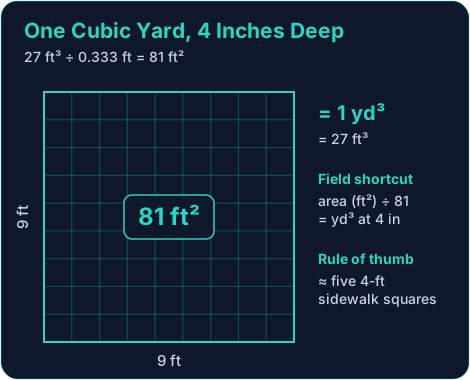
The crossover only means something once you can picture the volume. A cubic yard spread at the most common slab thickness — 4 inches — covers 81 ft²: a 9 ft × 9 ft slab, about five 4-foot sidewalk squares.
That gives you a field shortcut that skips bag math entirely: square footage ÷ 81 = cubic yards at 4 inches. A 200 ft² patio is 200 ÷ 81 = 2.5 yd³ — well past the crossover, and a truck job before you have counted a single bag.
The bag equivalent of that square, and the counts at every other thickness, are derived in full on the 80 lb Bag Concrete Calculator.
Where the Bag Job Stops Being a Bag Job
Most pours start with a footprint, not a cubic-yard figure — you have a 10×10 patio, not "1.23 yd³." This table is the labor version of the crossover rule: find your slab size, read the count, and decide whether you want to lift that many bags in one day.
Waste note: The counts below are exact geometry — no waste is baked in. Add 5–10% on top for spillage, subgrade unevenness, and mixing loss. The volume columns are stated at 4″; a 5″ pour needs ×1.25 the concrete and a 6″ pour ×1.5, which is why the bag columns climb with thickness.
| Slab Size (ft) | Volume @4″ (ft³) | Volume @4″ (yd³) | 80 lb bags @4″ | 80 lb bags @5″ | 80 lb bags @6″ |
|---|---|---|---|---|---|
| 4 × 4 | 5.33 | 0.20 | 9 | 12 | 14 |
| 4 × 6 | 8.00 | 0.30 | 14 | 17 | 20 |
| 5 × 5 | 8.33 | 0.31 | 14 | 18 | 21 |
| 6 × 6 | 12.00 | 0.44 | 20 | 25 | 30 |
| 6 × 8 | 16.00 | 0.59 | 27 | 34 | 40 |
| 6 × 10 | 20.00 | 0.74 | 34 | 42 | 50 |
| 8 × 8 | 21.33 | 0.79 | 36 | 45 | 54 |
| 8 × 10 | 26.67 | 0.99 | 45 | 56 | 67 |
| 10 × 10 | 33.33 | 1.23 | 56 | 70 | 84 |
| 10 × 12 | 40.00 | 1.48 | 67 | 84 | 100 |
| 12 × 12 | 48.00 | 1.78 | 80 | 100 | 120 |
| 12 × 16 | 64.00 | 2.37 | 107 | 134 | 160 |
Reading it: anything at or past the 8×10 / 45-bag line is roughly a cubic yard and a full day of lifting for one person — the point where pricing a truck is worth the phone call. Below the 6×8 line you are in comfortable bag territory, and a solo afternoon finishes it. The bag counts themselves come out of the yield arithmetic published on the 80 lb Bag Concrete Calculator.
Bag Counts by Project Type
Slabs are the easy case — a rectangle with a thickness. Other projects shape the concrete differently, and the geometry is what changes, not the decision rule. Here is the field quick answer for each common job, with the full worked guide behind it. All counts use 80 lb bags before waste.
Footings
Footings are long, narrow trenches, so the volume climbs faster than people expect. A 20 ft run, 12 in wide × 12 in deep, holds 20 ft³ — about 34 bags of 80 lb mix. Footings routinely run past the point where bags make sense, so work the volume out before you buy anything. Full examples are in footing bags of concrete.
Fence Posts
A post hole is a cylinder minus the post that sits in it. A 4×4 post in a 10 in-wide hole, 2 ft deep leaves about 0.9 ft³ of concrete to place — roughly 2 bags per post once you subtract the post itself. Multiply by your post count and you will know quickly whether you are buying by the bag or by the pallet. See fence post bags of concrete for hole-size charts.
Sonotubes & Round Columns
Round forms use the cylinder formula, π × radius² × height. A 12 in-diameter sonotube, 4 ft tall holds 3.14 ft³ — close to 6 bags. Diameter drives this fast because the radius is squared: going from a 12 in to an 18 in tube more than doubles the concrete. Per-tube counts are in sonotube bags of concrete.
Retaining Walls
Most segmental retaining walls use bagged concrete only for the footing or the core fill, not the wall itself. A typical poured footing runs about 1–2 bags per linear foot depending on width and depth; wall height and design drive everything above it. See retaining wall bags of concrete.
Steps, Stairs & Odd Shapes
There is no single formula for an L-shaped patio or a run of steps — split the shape into rectangles and cylinders, work out each volume separately, then add them before dividing by bag yield. Doing it the other way round (rounding each piece up to whole bags, then summing) over-orders by a bag or two on every section.
Shape-driven counts like these are what the Concrete Bag Calculator by Project is built for — it takes the dimensions directly and handles the displacement subtraction for posts.
A pallet of 80 lb bags (42 of them) yields just under one cubic yard — see the Concrete Pallet Calculator for the full breakdown by bag size, pallet weight, and truckload planning.
Is Bagged Concrete as Strong as Ready-Mix?
Yes — bag for bag, mixed correctly, bagged concrete reaches the same compressive strength as ready-mix of the same rating. A 4000 psi bag mix and 4000 psi truck concrete cure to the same strength.
The real difference is consistency and control. Ready-mix is batched by weight at a plant, so water content and aggregate ratios are precise across the whole pour. With bags, your strength depends on not over-watering (the #1 mistake) and mixing each batch the same way. Add too much water for easier mixing and you can drop a 4000 psi mix well below its rating. So bagged can match ready-mix — but only if you respect the water ratio on every batch.
Choosing the Right Bag: Strength by Project
Bag count is only half the decision — match the mix strength to the job. Strength is measured in psi (U.S.) or MPa (metric).
| Project Type | Common Mix Strength | Typical Ratio (C:S:A) | Description |
|---|---|---|---|
| Footpaths, patios | 3000 psi (≈ 20 MPa) | 1 : 2 : 4 | General-purpose mix for moderate loads |
| Driveways, foundations | 4000 psi (≈ 25 MPa) | 1 : 1.5 : 3 | Structural mix, suitable for load-bearing |
| Columns, beams, slabs | 5000 psi (≈ 30 MPa) | 1 : 1 : 2 | High-strength, dense structural concrete |
| Fence posts / quick jobs | 2500–3000 psi (≈ 17–20 MPa) | Fast-setting or post mix | For anchoring poles or small pours |
Pro Tip: The higher the cement ratio, the stronger and denser the concrete — but the smaller the yield per bag. That's why bag choice directly influences your total count.
Match Bag Size to Your Labor Setup
The right bag isn't just about strength — it's also about how you'll mix and move it.
| Bag Size | Best For | Advantages | Limitations |
|---|---|---|---|
| 40 lb | Small DIY jobs | Easy to lift and mix | Higher bag count |
| 50 lb | Light slabs, steps | Manageable, decent yield | Slightly slower for large pours |
| 60 lb | Patios, walkways | Good balance of weight vs yield | Moderate handling effort |
| 80 lb | Driveways, foundations | Fewer bags, cost efficient | Heavy — needs 2-person or mixer setup |
| 20 kg (metric) | General projects | Standard in UK, AU, CA | Slightly lower yield than 50 lb bags |
For most pours the 80 lb bag is the efficient default — it yields the most concrete per unit, so you carry, open, and empty the fewest. Drop to 40 or 50 lb only when the weight itself is the constraint: tight access, overhead work, a small repair, or a solo day. Working alone or above shoulder height, two 40 lb bags genuinely beat one 80 lb bag for your back, and the yield is identical. For crew jobs or mechanical mixers, 80 lb bags cut handling time and packaging waste.
Mix Type (Not Just Bag Weight)
Concrete mixes come in several variants, each designed for specific site conditions. Mix type affects curing time and finish quality.
1. General Purpose Mix
- Typically 3000 psi (≈ 20 MPa) strength.
- Balanced cement ratio for general slabs, steps, and pathways.
- Workable and easy to finish.
2. High-Strength Mix
- 4000–5000 psi (≈ 25–35 MPa).
- More cement per bag = lower yield but greater durability.
- Ideal for foundations, driveways, and structural work.
3. Fast-Setting Mix
- Sets within 20–40 minutes.
- Great for fence posts or small anchors where speed matters.
- Usually available in 50 or 60 lb bags. See the Fence Post Concrete Calculator for post counts.
4. Crack-Resistant Mix
- Contains synthetic fibers to control shrinkage.
- Reduces surface cracking in large thin slabs.
5. Mortar or Mason Mix
- No coarse aggregate — used for brick, block, or plastering.
- Not suitable for slabs or heavy loads.
Field Tip: Always check the bag label for its intended use and compressive strength. A 60 lb "Fast Set" bag behaves differently from a 60 lb "High-Strength" mix even though they weigh the same.
Worked Comparison — Garage Slab
Let's compare two approaches for a garage slab measuring 12 ft × 16 ft × 5 in thick.
Volume: 12 × 16 × 0.416 = 79.9 ft³ = 2.96 yd³
| Parameter | 80 lb High-Strength | 60 lb General Mix |
|---|---|---|
| Yield (ft³/bag) | 0.60 | 0.45 |
| Bags before waste | 133 | 178 |
| Bags + 8% contingency | 144 | 192 |
| Typical Strength | 4000 psi | 3000 psi |
| Cost per Bag ($) | 7.00 | 6.00 |
| Total Cost | $1,008 | $1,152 |
| Handling | Heavy, fewer bags | Easier, more lifting cycles |
Notice the total: at ~3 cubic yards and 144+ bags, this slab is well past the point where ready-mix wins. A truck would deliver the same 3 yd³ for roughly $400–$500 plus delivery — a fraction of the bagged cost, with none of the mixing. This is exactly the "over 1 cubic yard → call the plant" rule in action.
Quick Reference — Choosing the Right Bag
| Job Type | Recommended Bag Type | Mix Strength | Bag Weight | Mix Feature |
|---|---|---|---|---|
| Fence posts / mailboxes | Fast-setting | 2500–3000 psi | 50–60 lb | Sets quickly, no slump finish |
| Patio or sidewalk | General Purpose | 3000 psi | 60 lb | Smooth finish, good workability |
| Driveway slab | High-Strength | 4000 psi | 80 lb | Dense, durable finish |
| Structural footing / beam | High-Strength | 4000–5000 psi | 80 lb | Load-bearing |
| Small repairs | Rapid-Set or Crack-Resistant | 2500–4000 psi | 40–50 lb | Thin sections, quick cure |
| Metric region (UK, AU, CA) | Standard 20 kg | 20–25 MPa | 20 kg | Equivalent to 45–50 lb mix |
Mixing, Handling & Safety on Site
Moving and mixing concrete is labor-intensive, and it is where a bagged pour is won or lost. For consistent results:
- Lift smart — bend knees, keep the bag close to your body, and avoid twisting.
- Start low on water — an 80 lb bag takes about 6 pints (3 quarts / 0.75 gal / 2.8 L) to start, inside a working range of 6–9 pints (3–4.5 qt / 2.8–4.3 L). Add it gradually to prevent segregation. The range exists because the real target is slump, not a fixed volume: aim for a 2–3 in. slump and stop adding water when you hit it.
- Avoid overwatering — too much water weakens concrete, increases shrinkage, and reduces strength (this is what makes a bag mix come up short of its psi rating). Landing at the top of the water range instead of the bottom is a strength decision, not a convenience one.
- Use a wheelbarrow or drum mixer for batches above 60 lb.
- Wear gloves and a mask — cement dust is alkaline and irritates skin and lungs.
On large pours, coordinate a team: one mixing, one pouring, one finishing. Consistency in timing and texture gives professional results — and it is the single largest difference between a bagged pour and a truck pour, where the plant guarantees it for you.
Pro Tips from the Field
- Don't mix brands mid-project. Slight changes in mix design or additive content can cause uneven finish and color variation.
- Control curing. Cover the slab with plastic or mist water regularly for 5–7 days to prevent rapid moisture loss.
- Batch planning matters. Pre-stage enough bags for each section to avoid delays mid-pour.
- Store bags off damp ground; moisture ruins cement before mixing.
- Watch the weather. Avoid pouring in direct hot sun or freezing conditions.
- Check bag age. Cement-based mixes lose reactivity over time — avoid bags stored more than 3–4 months.
- Count before you buy with the 80 lb Bag Concrete Calculator so you don't make a second trip mid-pour.
What Bagged Concrete Costs per Cubic Yard
Cost is the other half of the crossover decision, and it runs the opposite way to convenience: the more concrete you need, the worse bags look. Bag counts per yard come from the yields published on the 80 lb Bag Concrete Calculator; the prices below are typical US retail.
| Bag Size | Bags per Yard | Price per Bag ($) | Total Material Cost ($/yd³) |
|---|---|---|---|
| 40 lb | 90 | 4.50 | 405 |
| 50 lb | 72 | 5.00 | 360 |
| 60 lb | 60 | 6.00 | 360 |
| 80 lb | 45 | 7.00 | 315 |
While 80 lb bags are the most cost-effective per cubic yard, they're also the most physically demanding — and every row above is still pricier per yard than ready-mix delivery, before you count your own day of labor. Use bags for small pours and convenience, never to save money on a large one.
Comparing by area instead. For small slabs it is often easier to put both options on a per-square-foot footing. Divide the price of one bag by its coverage at your thickness: a 60 lb bag at $5.50 covering 1.35 ft² at 4 inches works out to $4.07 per ft², while an 80 lb bag at $7.00 covering 1.8 ft² comes to $3.89 per ft² — the per-area version of why the bigger bag is cheaper by volume. Ready-mix is quoted per cubic yard, so converting one side or the other is the only way to compare them honestly. For slab cost specifically, the Concrete Slab Cost Calculator compares material and labor.
Real-World Project Quick Reference
Pre-calculated bag counts for typical small concrete jobs. Volume is the placed concrete volume; bag counts use 80 lb bags with 5% waste already included, rounded up to the whole bag.
| Project | Typical Dimensions | Volume | 80 lb Bags (+5% waste) | Full Guide |
|---|---|---|---|---|
| 4×4 fence post hole | 10 in dia × 24 in deep, net of post | 0.92 ft³ per hole | 2 per hole | Fence posts |
| Deck pier | 12 in dia × 36 in deep | 2.36 ft³ per pier | 5 per pier | Sonotubes |
| Sonotube column | 12 in dia × 4 ft tall | 3.14 ft³ per tube | 6 per tube | Sonotubes |
| Small landing pad | 3×3 ft × 4 in | 3.00 ft³ | 6 total | Slabs |
| AC / shed pad | 4×4 ft × 4 in | 5.33 ft³ | 10 total | Slabs |
| Footing run | 10 ft × 12 in × 12 in | 10.0 ft³ | 18 total | Footings |
| Retaining-wall footing | 12 in wide × 8 in deep, per linear ft | 0.67 ft³ per ft | 2 per ft | Retaining walls |
| Shed floor | 8×12 ft × 4 in | 32.0 ft³ | 56 total | Slabs |
| Small patio | 10×10 ft × 4 in | 33.3 ft³ | 59 total | Slabs |
| Driveway apron | 12×12 ft × 5 in | 60.0 ft³ | 105 total | Slabs |
Note the fence-post row is the volume left after the post displaces its share of the hole — a 10 in hole 2 ft deep is 1.09 ft³ gross, but a 4×4 post takes about 0.17 ft³ of that. Skip the subtraction and you buy roughly one extra bag for every six posts.
Read down the right-hand column and the crossover shows up as a pattern: everything above the shed floor is a comfortable bag job, and everything at or below it is a day you should have priced a truck for.
Why the Printed Yield Isn't What You Get on Site
Published bag yields assume ideal placement. On the ground, real conditions move the number — which is why an estimate that is exactly right on paper still runs short:
- Moisture and temperature. Hot, dry weather accelerates evaporation and can force thicker pours to finish properly; cooler climates reduce shrinkage loss.
- Overdigging and rough subgrade. Uneven ground or over-excavated trenches take more concrete than planned. Level and compact the base before calculating volumes.
- Mix consistency. Adding extra water for easier finishing makes the mix less dense and can drop yield 2–4%.
- Vibration and consolidation. Proper consolidation removes voids and raises strength, but slightly lowers yield as air pockets are eliminated — a well-compacted pour appears to "shrink," which is normal.
- Reinforcement and additives. Rebar and fiber barely affect yield, but air-entraining admixtures (for freeze-thaw resistance) change density slightly.
This is why experienced crews order 5–10% more than the theoretical count. Use 10% on small DIY pours and rough subgrades, 5% on large, well-prepared sites.
The asymmetry is what makes the buffer non-negotiable: over-ordering costs you a few unopened bags you can return or keep. Under-ordering means stopping mid-pour for a hardware run while the placed concrete stiffens — and restarting against a partly set edge gives you a cold joint, a permanent plane of weakness through the slab. The two outcomes are not equivalent, so the cushion is not really a cost decision.
Cement vs. Concrete: Two Different Bags, Two Different Questions
Half the confusion on the shelf comes from two products that sit side by side. They are not the same, and "how many bags" has a different answer for each.
- A bag of concrete mix — QUIKRETE, SAKRETE, the 80 lb sack — is finished concrete in powder form: portland cement already blended with sand and gravel. Add water and it becomes concrete. This is what every count in this guide refers to, and the question is one of volume: how many bags fill your cubic feet.
- A sack of portland cement — the classic 94 lb bag — is only the binder. Portland cement makes up just 10–15% of a concrete mix by volume; the rest is aggregate and water (American Cement Association / PCA). On its own it makes no structural concrete. You buy it to batch concrete from scratch with your own sand and stone, and the question is one of proportion: how much cement per yard of finished concrete.
Concrete is "a paste made of cement and water … mixed with aggregates," and the cement "binds the aggregates into a rock-like mass" (American Cement Association). Cement is the ingredient; concrete is the result.
What "5-Sack," "6-Sack," and "7-Sack" Mean
When a ready-mix plant or a spec sheet calls a mix "six-sack," it is stating cement content, not a brand or a strength grade. One sack of portland cement is 94 lb — the weight of roughly one cubic foot of cement, which is why the industry counts cement in sacks. So the sack number is simply cement per cubic yard of concrete:
| Mix Name | Portland Cement per yd³ |
|---|---|
| 5-sack | 5 × 94 = 470 lb |
| 6-sack | 6 × 94 = 564 lb |
| 7-sack | 7 × 94 = 658 lb |
More sacks means more cement paste per yard — but cement content is not the same as strength. Compressive strength is governed by the water-to-cement ratio, not the sack count directly. For non-air-entrained concrete, ACI 211.1 puts roughly 0.68 w/c at 3,000 psi, 0.57 at 4,000 psi, and 0.48 at 5,000 psi (28-day strength). A higher sack count is what lets a batcher hit a low water-cement ratio while keeping the mix workable — which is why richer, higher-sack mixes reach higher strengths — but add extra water and even a 7-sack mix drops below its rating. That is why state DOTs specify structural concrete by both a minimum cement content and a maximum water-cement ratio; concrete specified at 3,600 psi or higher is formally designated "compressive strength" concrete (Caltrans Standard Specifications §90).
Why the two questions diverge: a bag of concrete mix already holds its cement, sand, and stone in fixed proportion, so counting bags is pure volume arithmetic. A sack of cement is one ingredient of a recipe, so "how many sacks" only means something once you also fix the sand, the aggregate, and the water — the from-scratch batching covered next. (Metric regions batch by the 50 kg cement bag rather than the US 94 lb sack; the method below works in 50 kg bags.)
Estimating from Formwork: The Dry-Volume (1.54) Method
Everything above assumes you are buying pre-mixed bags. If you are batching cement, sand, and aggregate yourself from a mix ratio, the arithmetic is different — dry ingredients occupy more space than the wet concrete they produce, and skipping that correction under-orders the job badly.
Step 1 — Measure the wet volume of your formwork
Start with the internal volume of your forms — the concrete you will actually place.
| Structure Type | Volume Formula |
|---|---|
| Slab or floor | Length × Width × Thickness |
| Continuous footing or grade beam | Length × Width × Height |
| Column or rectangular pier | Length × Width × Height |
| Circular column or sonotube | π × (Radius)² × Height |
| Stepped footing | Calculate each section separately and sum |
Work in feet for US bag yields (ft³). Convert thickness from inches to feet first: 4 in = 0.333 ft, 6 in = 0.500 ft. Example — a slab 12 ft × 10 ft × 0.5 ft thick: wet volume = 12 × 10 × 0.5 = 60 ft³.
Step 2 — Convert wet volume to dry volume (the 1.54 factor)
Concrete is placed wet, but cement, sand, and aggregate are measured and sold dry. Because dry ingredients hold air voids between particles, they occupy more space than the wet concrete they produce. The standard conversion used in estimation handbooks is 1.54:
Dry Volume = Wet Volume × 1.54
One cubic metre of wet concrete needs roughly 1.54 cubic metres of dry ingredients. Skipping this factor under-orders from-scratch materials by about 35–40%. (Pre-mixed bags already build this into their published yield, which is why bag counts need no 1.54 factor.)
Step 3 — Manual batching: cement bags from a mix ratio
Use this when you are buying Portland cement, sand, and aggregate separately and batching to a specified ratio. The output is the number of 50 kg cement bags.
| Mix Type | Ratio (C : S : A) | Sum of Parts | Approx. Strength | Typical Use |
|---|---|---|---|---|
| M5 | 1 : 5 : 10 | 16 | ~5 MPa / 725 psi | Non-structural levelling, blinding |
| M10 | 1 : 3 : 6 | 10 | ~10 MPa / 1,450 psi | Lean fills, garden paths |
| M15 | 1 : 2 : 4 | 7 | ~15 MPa / 2,175 psi | Plain concrete slabs, footings |
| M20 | 1 : 1.5 : 3 | 5.5 | ~20 MPa / 2,900 psi | Reinforced slabs, beams |
| M25 | 1 : 1 : 2 | 4 | ~25 MPa / 3,625 psi | Structural columns, load-bearing elements |
Cement-bag formula (50 kg bags):
Bags = (Wet Volume × 1.54 × Cement Part) ÷ (0.0347 × Sum of Mix Parts)
where 0.0347 m³ is the volume of one 50 kg cement bag. Example — an M20 slab with wet volume 1.70 m³ (the 60 ft³ slab above), sum of parts 5.5, cement part 1:
Bags = (1.70 × 1.54 × 1) ÷ (0.0347 × 5.5) = 2.62 ÷ 0.19085 = 13.7 → 14 bags of 50 kg cement.
Unit Conversions Reference
Mixed-unit inputs are the single most common source of estimating error on site. Keep this table handy.
| Conversion | Value |
|---|---|
| 1 yd³ | = 27 ft³ |
| 1 m³ | = 35.3147 ft³ |
| 1 ft³ | = 0.0283 m³ |
| 1 bag cement (50 kg) | = 0.0347 m³ |
| Dry Volume | = Wet Volume × 1.54 |
Choose one system — all imperial or all metric — at the start of each calculation. One cubic yard is not three cubic feet; it is twenty-seven. Converting units mid-calculation and losing track of which value is in which unit is where most field errors actually originate.
Common Mistakes
1. Using the standard yield for specialty bags. Fast-setting and high-strength 80 lb bags often yield 0.55 ft³ or less — not the standard 0.60 ft³. At 0.55 ft³ a cubic yard takes 49 bags, so applying the standard rate leaves you short by about 4 bags per yard.
2. Forgetting the 1.54 dry-volume factor when manual-batching. Without it, a from-scratch cement count is short by 35–40%. It is a volume-accounting correction, not a safety margin — and it does not apply to pre-mixed bags.
3. Skipping the waste buffer. Subgrade roughness, over-excavation, and mixing losses consistently consume 5–10% more concrete than a clean geometry calculation predicts. Rounding up and adding 5% is standard practice, not over-ordering.
4. Switching bag sizes mid-pour. Mixing 60 lb and 80 lb bags mid-project breaks your counting rhythm and leaves you unsure how much volume you have placed. Pick one bag size per pour.
5. Buying bags for a truck-sized job. The most expensive mistake on this list is not an arithmetic error — it is committing to 100+ bags because the count looked manageable on paper, then discovering at bag 40 that the first section has already set.
Frequently Asked Questions
Bag-count questions — how many bags make a cubic yard, how much one bag covers at a given thickness — are answered in full on the 80 lb Bag Concrete Calculator. The questions below are the ones that come up on site.
At what point should I order ready-mix instead of bags? When you need more than about one cubic yard (45+ of the 80 lb bags). Below ½ yard, bags win; over a yard, ready-mix is cheaper and far less work. Between the two, decide on your mixer, your crew, and how long the pour can stay open.
Is bagged concrete as strong as ready-mix? Yes, at the same psi rating — provided you don't over-water it. Ready-mix simply guarantees that consistency across the whole pour.
Can I hand-mix, or do I need a mixer? Hand-mixing in a tub or wheelbarrow is realistic up to about 10–15 of the 80 lb bags. Past that, a drum mixer is not a convenience — it is what keeps the water ratio and the timing consistent from the first batch to the last, which is what the strength actually depends on.
How many bags of concrete are on a pallet? Typically 42 of the 80 lb bags per standard pallet — see the Concrete Pallet Calculator for the full breakdown by bag size, weight, and yard equivalents.
How many bags of concrete do I need for a 10×10 slab? A 10 ft × 10 ft slab at 4 inches holds 33.3 ft³, which is 56 bags of 80 lb mix before waste — add 10% and order about 62. That's 1.23 cubic yards, right at the ready-mix crossover, so price a truck before you commit to mixing.
How many bags of concrete do I need per fence post? Usually 2 bags of 80 lb per hole. A 4×4 post in a 10 in-wide hole dug 2 ft deep leaves about 0.9 ft³ of concrete once you subtract the post itself — 1.5 bags of geometry, rounded up. Wider or deeper holes for gate and corner posts need more.
Should I buy 40 lb or 80 lb bags? Buy 80 lb for slabs and footings — fewest bags, least opening, lowest cost per cubic yard. Buy 40 lb when weight is the real constraint: tight access, overhead work, working alone, or a small repair. Two 40 lb bags yield exactly what one 80 lb bag does, so the choice costs you nothing in volume.
How do I calculate bags for an odd or L-shaped pour? Split the shape into rectangles and cylinders, work out each volume separately, and add the volumes before dividing by bag yield. Rectangles are length × width × thickness; round forms are π × radius² × height. Rounding each piece up to whole bags first and then summing over-orders on every section.
Related Guides
For project-specific bag counts and deeper estimation guidance:
- How Many Bags of Concrete for a Slab
- Footing Bags of Concrete
- Fence Post Bags of Concrete
- Sonotube Bags of Concrete
- Retaining Wall Bags of Concrete
- Choosing the Right Concrete Mix Bag
- Concrete Bags Reference Hub
- Bag counts, coverage and pallets: 80 lb Bag Concrete Calculator
- Counts straight from slab, footing or post dimensions: Concrete Bag Calculator by Project
Conclusion
The decision is simpler than the arithmetic around it. Under half a yard, buy bags. Past one yard, call the plant. In between, ask what you actually have: a mixer, a second pair of hands, and a window long enough to finish before the first section sets.
Everything else follows from that. Match the bag's strength and weight to the job, start low on water and let slump tell you when to stop, order 5–10% over, and never let an easy-looking count on paper talk you into a two-ton day.
Related guides
- Slab Pouring Made Simple: How Many Concrete Bags You’ll Need
From 4-inch patios to garage floors — bag counts with examples.
- Concrete Bag Mix Ratios & Strength: What's Inside the Bag and the PSI It Yields
What's actually blended inside a bag of pre-mix, how that ratio sets the cured PSI, and why an 80 lb bag covers less than you'd expect. Bag-specific — not nominal M-grade design.
- How to Calculate Cement Bags in Concrete (with Examples)
Learn the exact steps and formulas to convert concrete volume into precise cement bag counts, with worked examples.
Need a quick result? Try the related calculator.