What a Crushed Concrete Order Actually Depends On
Crushed concrete — formally recycled concrete aggregate (RCA) — is produced by pulverizing demolished slabs, foundations, and curb sections and grading the fragments to a specified particle size. Unlike virgin quarried stone, RCA carries residual cement paste from its previous life, which lowers its bulk density to roughly 95–115 lb/ft³ (versus 110–130 lb/ft³ for crushed limestone or granite) and raises its water-absorption rate. That density gap is why a standard gravel calculator will overestimate the tonnage you actually need — and why this calculator defaults to RCA-specific density profiles instead. If your project uses virgin crushed stone, decomposed granite, or pea gravel, use the Gravel Calculator which applies the higher quarried-aggregate densities. For coverage, depth, and tonnage methodology that applies to RCA too, see our pillar guide on the gravel coverage, depth & tonnage calculation.
Enter your project shape — rectangle, circle, triangle, trapezoid, a known area, a known volume, or a reverse-coverage mode that starts from tons already on site — along with depth and a compaction/waste percentage. Pick a density profile (Standard Crushed Concrete, Compact Recycled Concrete, Light Recycled Aggregate, or a custom lb/ft³ from a supplier weigh ticket), and the calculator returns net and adjusted volume in cubic yards and cubic meters, net and adjusted weight in US tons, a truckload count, and a total delivered-cost estimate. Once your RCA base is in and you are ready to pour, switch to the Concrete Slab Calculator to size the fresh-concrete volume above it. To convert between cubic yards, feet, and meters, see our concrete volume conversions guide; for tonnage weight, our reference on how much concrete weighs; and to budget the job, our overview of how much concrete costs.
RCA Grade & Density Reference
Loose bulk density and typical applications by RCA grade. The calculator's own Density Profile selector offers three representative points across this range — Standard (105 lb/ft³), Compact (115 lb/ft³), and Light (95 lb/ft³) — plus a Custom option for a supplier-specific value.
| RCA Grade | Nominal Size | Loose Density | Typical Applications |
|---|---|---|---|
| #4 RCA | ¾"–1½" | 100–104 lb/ft³ | Structural backfill, base course, road base |
| #57 RCA | ¾" nominal | 103–108 lb/ft³ | Driveway base, parking pads, pipe bedding |
| #67 RCA | ½"–¾" | 105–110 lb/ft³ | Drainage layers, trench fill, landscaping base |
| Crushed Fines | <⅜" | 110–120 lb/ft³ | Compacted platform fill, stable foot-traffic surfaces |
| RCA Sub-base | 1½"–3" | 95–103 lb/ft³ | Road sub-base, heavy-haul base, large-area fills |
Density ranges are for typical US RCA. Actual bulk density varies with pulverization degree, moisture content, and original concrete mix design. Confirm with a supplier weigh ticket for high-value or structural orders.
How to Run the Crushed Concrete Takeoff
- 1Select an Input Method: Rectangle, Circle, Triangle, or Trapezoid area; a Known Area if you already have the square footage; a Known Volume if you already have cubic yards; or Reverse Coverage (from Tons) to find how far a fixed tonnage will spread.
- 2For a shape or Known Area mode, pick a Dimension Unit (inches, feet, yards, centimeters, or meters) and enter the required dimensions — length and width for a rectangle, radius for a circle, base and height for a triangle, or top base, bottom base, and height for a trapezoid.
- 3Enter the Depth / Thickness and its own unit (in, ft, cm, or m). Typical values: 2–4 in. for walkways, 4–6 in. for patios and shed pads, 6–8 in. for driveway bases, 10–12 in. for road sub-base. Depth is skipped in Known Volume mode.
- 4For Reverse Coverage, enter the Material Weight in tons already on site along with the target depth — the calculator works backward to the square footage that quantity will cover.
- 5Choose a Density Profile: Standard Crushed Concrete (105 lb/ft³), Compact Recycled Concrete (115 lb/ft³), or Light Recycled Aggregate (95 lb/ft³). Select Custom Density and enter your own lb/ft³ if your supplier provides a measured value from a weigh ticket.
- 6Set the Compaction / Waste percentage. Use 5–10% for lightly tamped walkways, 10–15% for mechanically rolled driveway bases under traffic, and up to 20% for soft or clay sub-grades.
- 7Enter your Truck Capacity in tons (default 15, typical 15–20 for a tri-axle) so the results show an exact truckload count for scheduling.
- 8Optionally enter a Material Price and choose whether it is priced Per Ton or Per Cubic Yard, then add a flat Delivery Fee — the calculator totals material cost plus delivery into one number.
- 9Click Calculate. The results panel shows the recommended order in tons, plus tiles for volume (net and adjusted, in yards and cubic meters), weight (net and adjusted tons), coverage area, truckloads, and total cost.
- 10Click Print / Save to export a formatted estimate — share it with your supplier to confirm the order before the delivery truck is dispatched.
How the Crushed Concrete Tonnage Is Calculated
- 1) Area by ShapeRectangle: Length × Width · Circle: π × Radius² · Triangle: (Base × Height) ÷ 2 · Trapezoid: ((Top Base + Bottom Base) ÷ 2) × Height
All dimensions convert to feet first. Known Area mode skips this step and uses your entered square footage directly. - 2) Net Volume (ft³, yd³, m³)Net Volume (ft³) = Area (ft²) × Depth (ft)
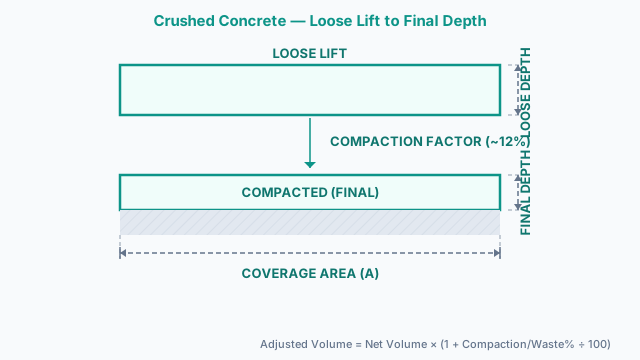
Cubic yards = Net Volume ÷ 27. Cubic meters = Net Volume × 0.0283168. Known Volume mode enters cubic yards directly and multiplies by 27 to get ft³. - 3) Adjusted Volume (with Compaction / Waste)Adjusted Volume = Net Volume × (1 + Compaction/Waste % ÷ 100)
A 12% factor means you order 1.12× the geometric volume to account for in-place settling under a roller or plate compactor. - 4) Weight in US TonsNet Tons = (Net Volume (ft³) × Density (lb/ft³)) ÷ 2,000 · Adjusted Tons = Net Tons × (1 + Compaction/Waste % ÷ 100)
Order to the Adjusted Tons figure, not the net weight, so the compaction allowance is priced in. - 5) TruckloadsTruckloads = ⌈ Adjusted Tons ÷ Truck Capacity (tons) ⌉
Rounds up to the next whole load. A standard tri-axle carries 15–20 tons; limits vary by state and road weight class. - 6) Total Delivered CostCost = (Adjusted Tons × Price per Ton) + Delivery Fee — or (Adjusted Yards × Price per Yard) + Delivery Fee if priced by volume
Cost per square foot = Total Cost ÷ Area, shown alongside the total when a price is entered. - 7) Reverse Coverage (from a Known Tonnage)Volume (ft³) = (Tons × 2,000) ÷ Density · Coverage Area (ft²) = Volume (ft³) ÷ Depth (ft)
Useful when a delivery is already on site and you need to know how far it will spread at your target depth.
Worked Takeoff: 20 × 12 ft Driveway Base
Suppose you are building a 20 ft × 12 ft driveway base at a 6 in. compacted depth using the Standard Crushed Concrete density profile (105 lb/ft³) at $12/ton with a $75 flat delivery fee.
Step 1 — Area and net volume: 20 × 12 = 240 ft², and 240 × 0.5 ft depth = 120 ft³, which converts to 120 ÷ 27 = 4.44 yd³.
Step 2 — Net weight: At the Standard density (105 lb/ft³), net weight = 120 × 105 ÷ 2,000 = 6.30 US tons.
Step 3 — Apply a 12% compaction/waste factor: 4.44 × 1.12 = 4.97 yd³ to order; 6.30 × 1.12 = 7.06 tons to order.
Step 4 — Total delivered cost: 7.06 × $12 = $84.72 material + $75 delivery = $159.72 total (≈ $0.67 per sq ft over the 240 ft² area).
Step 5 — Truckload check: ⌈7.06 ÷ 15⌉ = 1 truckload on a 15-ton tri-axle. If you expect a soft or clay sub-grade, raise the compaction/waste entry to 17%: 6.30 × 1.17 = 7.37 tons ordered, still one truckload.
Quantity Mistakes That Inflate a Crushed Concrete Order
1. Using virgin-aggregate density for RCA
Crushed limestone or granite runs 110–130 lb/ft³; RCA is lighter at 95–115 lb/ft³ because the residual cement paste is more porous. Plugging gravel density into an RCA order overstates your ton estimate by 5–15%, leading to over-budgeting and potentially paying for material you don't need.
2. Ordering the exact geometric volume with no compaction/waste factor
RCA's angular fragments interlock and seat under roller or plate-compactor passes, reducing the layer thickness by 10–20%. A 6 in. loose layer typically compacts to roughly 5 in. Leaving the compaction/waste field at 0% means a second — often expensive — top-up delivery to reach final grade.
3. Confusing US short tons with metric tonnes
Some regional suppliers and many online references quote metric tonnes (1 t = 2,205 lb); the US short ton is 2,000 lb. Mixing units inflates your order quantity by approximately 10%. Always confirm the unit your supplier uses before dividing material cost by price per ton.
4. Specifying high-fines RCA in drainage applications
Crushed concrete fines (particles <⅜ in.) self-compact and seal surface voids, blocking water percolation. For French drains, pipe bedding, or permeable driveway bases, specify #4 or #57 RCA with <5% fines per ASTM C33 — not crusher run or recycled-fines blends that will impede drainage.
Choosing Between the Crushed Concrete Calculator and Related Tools
Use this calculator when your fill material is recycled concrete aggregate — crushed demolished slabs, curbs, or foundation rubble graded to a specified size. Its RCA-specific density profiles (95–115 lb/ft³) are essential for an accurate ton estimate. If your project uses virgin crushed stone — crushed limestone, granite chip, or pea gravel — switch to the Gravel Calculator, which applies the higher 110–130 lb/ft³ density of quarried aggregate. For a side-by-side cost comparison between RCA and virgin stone at a custom price, the Gravel Cost Calculator lets you enter any material price and density. If you have a supplier quote in tons and only need it converted to yards without a full project area, the Gravel Tons to Yards Calculator handles the density math without requiring dimensions. Finally, once the RCA base is compacted and you are ready to estimate the new-concrete pour above it, the Concrete Slab Calculator takes over for the fresh-concrete volume. And where the void needs to self-level into tight or irregular spaces rather than accept a compacted granular fill — utility trenches, abandoned tanks, pipe bedding — the Flowable Fill Calculator sizes a self-compacting CLSM slurry instead.
ASTM Material Specs
Sets gradation, fines content (≤3% passing #200 sieve for structural use), Los Angeles abrasion limits, and water-absorption thresholds. RCA used as aggregate in new concrete mixes must be evaluated against these requirements; for base-course-only use, C33 limits are typically not enforced.
Defines the size numbers (#4, #57, #67, etc.) referenced when ordering RCA for driveway bases, sub-base layers, and drainage applications. Ensures consistent gradation expectations across different suppliers and regions.
Governs granular base material quality in highway construction. RCA sub-base layers are frequently approved under state DOT specifications that reference AASHTO M147 gradation classes A through F for the relevant application.
Standards cited for reference. RCA quality varies significantly by source material and pulverization method — always request a material data sheet and gradation sieve analysis from your supplier before placing a structural order.
Crushed Concrete Takeoff FAQ
What is crushed concrete (RCA) and where does it come from?
Recycled concrete aggregate (RCA) is produced by crushing and grading concrete debris from demolished buildings, roads, sidewalks, and bridge decks. The resulting material — fragments of original aggregate bonded with residual cement paste — is screened into standard size grades (#57, #67, sub-base, etc.) and sold as a lower-cost alternative to quarried stone for base-course and fill applications.
What density should I use for crushed concrete calculations?
Loose RCA typically weighs 95–115 lb/ft³ (approximately 1.3–1.55 tons per cubic yard), which is 10–20% lighter than virgin crushed limestone or granite (110–130 lb/ft³). The calculator's three density profiles — Standard (105), Compact (115), and Light (95) — span this range; use Custom Density and your supplier's weigh ticket for large or structural orders where per-ton cost is significant.
How do I calculate cubic yards of crushed concrete needed?
Multiply your project area in square feet by the depth in feet to get cubic feet, then divide by 27 to convert to cubic yards. For a 20 × 12 ft pad at 6 in. (0.5 ft): 20 × 12 × 0.5 = 120 ft³ ÷ 27 = 4.44 yd³ net. Add a 10–15% compaction/waste percentage, giving you approximately 4.88–5.10 yd³ to order.
How many tons of crushed concrete do I need for a driveway?
For a typical 20 × 40 ft residential driveway at a 6 in. base depth: net volume = 20 × 40 × 0.5 = 400 ft³ = 14.81 yd³. At 105 lb/ft³: 400 × 105 ÷ 2,000 = 21.0 tons net. Add a 12% compaction/waste factor and you need approximately 23.5 tons — typically 1–2 tri-axle deliveries depending on state road-weight limits.
What is the difference between crushed concrete and crushed gravel?
Crushed concrete is a recycled product made from demolished concrete structures; its fragments contain old cement paste bonded to the original aggregate. Crushed gravel is quarried virgin stone broken to a specified size with no cement content. RCA is generally lighter (95–115 lb/ft³), has higher water absorption (up to 5–8% vs. 0.5–2% for limestone), and costs 30–60% less while performing comparably as a compacted base material.
What compaction/waste percentage should I add when ordering RCA?
Most residential base projects use a 10–15% compaction/waste percentage. Enter 10% for lightly loaded patio or shed bases tamped by hand. Use 15% for mechanically rolled driveway bases under repeated vehicle traffic. Increase to 20% if the sub-grade is soft clay or poorly drained fill, where RCA tends to punch through more aggressively on initial compaction passes.
Is crushed concrete #57 the same as #57 crushed stone?
Not exactly. Both follow the ASTM D448 size-57 gradation (predominantly ¾" to ½" particles), but #57 crushed stone is virgin quarried limestone or granite while #57 RCA is recycled concrete screened to the same gradation. The size class is identical; the density, absorption rate, and material source differ. For structural applications, confirm your local DOT or engineer allows RCA in place of virgin stone before substituting.
How many square feet does 1 ton of crushed concrete cover?
Coverage depends on installation depth and RCA density. At 105 lb/ft³: 1 ton = 2,000 lb ÷ 105 = 19.05 ft³. At a 4 in. (0.33 ft) depth: 19.05 ÷ 0.33 ≈ 58 ft². At 2 in. (0.167 ft) depth: 19.05 ÷ 0.167 ≈ 114 ft². Enter your specific weight and depth in Reverse Coverage (from Tons) mode and the calculator runs this conversion for you.
Can crushed concrete be used for a driveway base?
Yes — RCA is one of the most common driveway base materials in North America, particularly where demolished concrete is locally available. It typically costs 30–60% less than quarried crushed stone and performs comparably when properly compacted to 95–98% Proctor density (ASTM D1557). Most state DOTs and local building departments allow RCA as base course material; verify with your local authority before using it beneath a new concrete slab.
What is the environmental benefit of using recycled concrete aggregate?
Using RCA diverts demolition concrete from landfills — an estimated 140 million tons of concrete debris is generated annually in the US. RCA eliminates the quarrying, primary crushing, and long-haul transport energy required for virgin aggregate, reducing the embodied carbon of a typical base-course installation by 25–40%. Many LEED and sustainable-site scoring systems award materials credits for specifying RCA.
Is crushed concrete sold by the ton or cubic yard?
Both units are common and vary by region and supplier. West Coast and Midwest suppliers often quote by the ton (weight-based, easy to verify on truck scales); East Coast and Northeast suppliers sometimes quote by the cubic yard. Toggle the pricing mode between Per Ton and Per Cubic Yard so you can match whichever unit your supplier uses without a manual conversion.
How many truckloads do I need for my RCA project?
Divide your total adjusted-ton order by the truck's payload capacity, rounding up to the next whole load. A standard tri-axle dump truck legally carries 15–20 tons per load in most US states (limits vary by state and road weight class). For a 23-ton driveway order on a 15-ton truck: ⌈23 ÷ 15⌉ = 2 deliveries. On a 20-ton truck that same order ships in one load, saving one delivery fee — the calculator computes this automatically once you enter your Truck Capacity.
What does ASTM C33 say about using RCA as aggregate in new concrete?
ASTM C33/C33M sets maximum fines content (passing #200 sieve ≤ 3% for structural concrete), Los Angeles abrasion loss limits (≤ 40–50%), and water-absorption thresholds. RCA exceeds virgin aggregate on absorption (up to 5–8% vs. 0.5–2% for limestone), so direct substitution in new concrete mixes requires pre-soaking RCA or adjusting the water-to-cement ratio. For base-course use only, C33 aggregate requirements are generally not enforced by local codes.
Is this crushed concrete calculator free to use?
Yes, completely free with no registration, subscription, or usage limit. The calculator runs entirely in your browser — no project data is transmitted to any server. All estimates are yours to use for planning, ordering, and sharing with contractors or suppliers at no cost.
Can I print or save my crushed concrete estimate?
Yes. After clicking Calculate, use the Print / Save button in the results panel. This opens a clean, formatted print view showing your inputs, order quantity in yards and tons, truckload count, and cost breakdown. In your browser's Print dialog, choose 'Save as PDF' to create a shareable digital estimate you can email to your supplier or attach to a project file.
Related Calculators
Gravel Calculator
Calculate gravel volume, tons, cubic yards, and estimated cost.
Gravel Tons to Yards Calculator
Convert between gravel tons and cubic yards.
Gravel Cost Calculator
Estimate total project cost including delivery for gravel projects.
Flowable Fill (CLSM) Calculator
Calculate CLSM volume in yd³, ft³, and m³ for utility trenches, abandoned tanks/vaults, and pipe or culvert fill — with overfill factor, weight at 100–125 pcf, and ACI 229R compliance check.
Gravel Driveway Calculator
Estimate driveway gravel in tons, yards, and total cost.