How to Estimate the Total Cost of a Concrete Slab
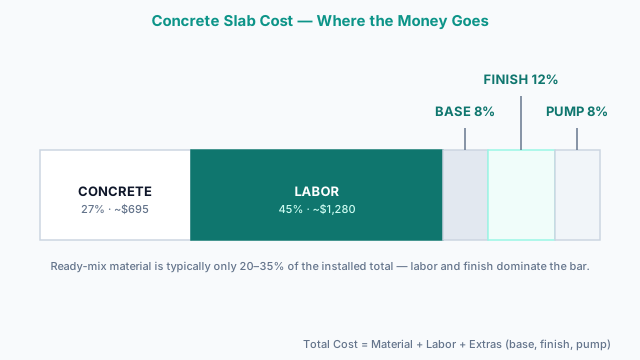
Pricing a concrete slab is far more nuanced than computing its volume. The same 400 ft² patio slab can run anywhere from $2,400 to over $8,000 installed — a 3× swing driven almost entirely by finish type, reinforcement method, sub-base preparation, and local labor rates, not by the cost of the concrete itself. Ready-mix material typically represents only 20–35% of the final invoice on a professionally installed slab; finish and labor account for 40–60%, and site-prep extras for the rest. Homeowners who price only the concrete and then receive a contractor quote are routinely caught off guard by a gap that can exceed $3,000 on a standard driveway. For typical 2026 price ranges by slab size, thickness, and finish, see our pillar guide on how much a concrete slab costs.
This calculator builds a full cost estimate from your slab dimensions. It computes concrete volume from length, width, and thickness, applies a waste allowance, and prices the material as either ready-mix ($/yd³) or bagged concrete ($/bag). On top of that it adds labor at a per-square-foot rate you set, then layers in optional line items — rebar or wire mesh, vapor barrier, compacted sub-base, and form rental — to produce a total project cost in dollars and a cost per square foot. To get the volume only (for a separate ordering estimate), use the slab concrete calculator. For wider context, our overview of how much concrete costs covers material and labor across project types, our guide to how to calculate concrete for a slab explains the volume input, and how to reinforce a concrete slab details the rebar line item.
The results panel breaks material, labor, and each add-on (rebar, vapor barrier, sub-base, forms) into the same line-item format a contractor's invoice uses, so you can check a quote line by line instead of comparing two lump sums. It also runs a ready-mix-vs-bagged comparison at your entered volume — bagging rarely wins past about 1.5 yd³.
Concrete Slab Cost Drivers, Line by Line
Use the table below to build a realistic line-by-line budget before entering numbers into the calculator. Every row represents a cost driver — a choice or requirement that adds a predictable increment to the per-square-foot total. The ranges reflect 2024–25 US averages for professional installation; DIY labor removes the labor column entirely.
| Cost Driver | Specification | Cost Impact ($/sq ft) | Notes |
|---|---|---|---|
| Concrete material (3,000 psi) | Ready-mix, standard residential | $1.80–$3.00 | Based on $130–$180/yd³ at 4 in thick; higher PSI adds $0.30–$0.55/sq ft |
| Labor — plain broom finish | Float, broom, edge | $2.50–$5.00 | Baseline labor rate; varies by region and crew experience |
| Labor — brushed / textured | Textured broom or salt finish | $5.00–$8.00 | Additional passes and edging detail; popular for patios |
| Labor — exposed aggregate | Pressure-wash before set | $6.00–$10.00 | Requires skilled timing; slip-resistant, durable finish |
| Labor — stamped concrete | Colored + pattern stamping | $10.00–$18.00 | Most labor-intensive finish; seasonal limitations in cold climates |
| 6×6 W1.4 welded wire mesh | 10-gauge wire panels | $0.25–$0.50 | Basic crack control; most common for patios and walkways |
| #3 rebar @ 18 in O.C. | 3/8 in bars, two-way grid | $0.75–$1.25 | Standard for driveways and light commercial slabs |
| #4 rebar @ 12–16 in O.C. | 1/2 in bars, two-way grid | $1.25–$2.00 | Garage floors, commercial; required for heavy vehicles |
| 6 mil polyethylene vapor barrier | Under-slab moisture control | $0.10–$0.20 | Required for interior slabs; recommended for garage floors |
| Sub-base: 4 in compacted gravel | Crushed stone or bank-run | $0.50–$1.50 | Often included in contractor price; ask if itemized separately |
| Fiber mesh admixture | 1.5 lb/yd³ polypropylene fiber | $3–$6/yd³ concrete | Replaces wire mesh in many residential specs; reduces plastic shrinkage cracking |
| Concrete strength upgrade to 4,000 psi | vs. standard 3,000 psi mix | +$8–$15/yd³ | Garage floor and driveway standard; increases material cost ~$0.12–$0.22/sq ft at 4 in |
Prices are 2024–25 US national averages for professionally installed work. Local market conditions, site access, and project scale can shift any line item by ±30%. Always obtain at least two contractor quotes and confirm which line items are included before signing a contract.
Real Ready-Mix Prices, By Metro (Sourced & Dated)
Instead of a single unattributed "national average," here is our first-party price survey: published supplier rate sheets, one direct written plant quote, and BLS regional price-trend data, metro by metro. Every row links to its source and shows the date it was collected or published.
| 4000 PSI ($/yd³) | Dated | ||||
|---|---|---|---|---|---|
| Chicago IL | Midwest | $162–$170 | $173–$182 | HomeBlue Aggregator (attributed) | 2025-03-05 |
| Columbus OH | Midwest | $128–$134 | $137–$144 | HomeBlue Aggregator (attributed) | 2025-03-05 |
| Kansas City MO | Midwest | $145–$153 | $155–$163 | HomeBlue Aggregator (attributed) | 2025-03-05 |
| Minneapolis MN | Midwest | $155–$163 | $166–$174 | HomeBlue Aggregator (attributed) | 2025-03-05 |
| Boston MA | Northeast | $173–$181 | $185–$194 | HomeBlue Aggregator (attributed) | 2025-03-05 |
| Philadelphia PA | Northeast | $163–$172 | $175–$184 | HomeBlue Aggregator (attributed) | 2025-03-05 |
| Atlanta GA | South | $135–$142 | $144–$152 | HomeBlue Aggregator (attributed) | 2025-03-05 |
| Augusta GA | South | $174 | $182 | American Concrete (Augusta) Primary supplier | 2026-04-01 |
| Charlotte NC | South | $129–$135 | $138–$145 | HomeBlue Aggregator (attributed) | 2025-03-05 |
| Dallas TX | South | $126–$132 | $135–$141 | HomeBlue Aggregator (attributed) | 2025-03-05 |
| Houston TX | South | $136 | $143 | LS Ready Mix, LLC Primary supplier | 2026-07-13 |
| Houston TX | South | $130–$145 | — | Buck's Ready Mix Primary supplier | 2025-06-29 |
| Nashville TN | South | $128–$134 | $136–$143 | HomeBlue Aggregator (attributed) | 2025-03-05 |
| Tampa FL | South | $125–$131 | $133–$140 | HomeBlue Aggregator (attributed) | 2025-03-05 |
| Denver CO | West | $142–$149 | $152–$159 | HomeBlue Aggregator (attributed) | 2025-03-05 |
| Las Vegas NV | West | $143–$150 | $153–$161 | HomeBlue Aggregator (attributed) | 2025-03-05 |
| Phoenix AZ | West | $134–$141 | $143–$151 | HomeBlue Aggregator (attributed) | 2025-03-05 |
| Portland OR | West | $149–$157 | $160–$168 | HomeBlue Aggregator (attributed) | 2025-03-05 |
| Salt Lake City UT | West | $131–$137 | $140–$147 | HomeBlue Aggregator (attributed) | 2025-03-05 |
| Seattle WA | West | $166–$174 | $177–$186 | HomeBlue Aggregator (attributed) | 2025-03-05 |
Compiled 2026-07 from publicly listed supplier prices, one direct written supplier quote, and BLS regional producer-price data. Every figure carries a source link and collection date. Prices move — confirm with your local plant before ordering. Compiled 2026-07-14. Full dataset with every source URL: download the CSV.
BLS Producer Price Index for Ready-Mix Concrete Manufacturing, 2026-05, via the FRED database. An index of price change, not a $/yd³ figure — national and regional series use different base periods and are not directly comparable to each other.
Sample Estimate: A 16 × 20 ft Concrete Patio Slab
Consider a rectangular patio that is 16 ft long, 20 ft wide, and 4 in thick — a footprint of 320 sq ft. Start with concrete volume: 16 × 20 × (4 ÷ 12) ÷ 27 = 3.95 yd³. Add 10% waste: 3.95 × 1.10 = 4.34 yd³. At a local ready-mix price of $160/yd³, that is $695 in concrete material. Labor for a plain broom finish at $4.00/sq ft adds 320 × $4.00 = $1,280. Reinforcement with 6×6 welded wire mesh at $0.40/sq ft adds $128; a vapor barrier is not needed for an open patio, so skip that line. Sub-base prep at $1.00/sq ft adds $320. Total: $695 + $1,280 + $128 + $320 = $2,423, or $7.57/sq ft. Now suppose the homeowner upgrades to stamped concrete at $13.00/sq ft labor instead of broom finish: labor alone jumps to $4,160, and the total becomes $5,303 — more than double. That 3× labor swing from broom to stamped is why finish choice dominates the budget far more than concrete price does. To estimate only the volume for your concrete order, use the slab concrete calculator.
Costing Your Project with the Concrete Slab Cost Calculator
- 1Enter slab length, width, and thickness, then set a waste percentage (10% is a safe default).
- 2Choose ready-mix or bagged supply and enter your local price, then add a labor rate matched to your finish (broom, exposed aggregate, or stamped) and any reinforcement, vapor barrier, or sub-base line items.
- 3Click Calculate for the full line-item breakdown, total project cost, and cost per square foot.
How the Concrete Slab Cost Total Is Built
- 1) Concrete VolumeVolume (yd³) = Length (ft) × Width (ft) × [Thickness (in) ÷ 12] ÷ 27
Standard slab-on-grade volume formula. Thickness must be converted from inches to feet (÷ 12) before dividing by 27 to reach cubic yards. This is the base volume before waste. - 2) Waste-Adjusted VolumeAdjusted Volume (yd³) = Base Volume × (1 + Waste% ÷ 100)
Applied to the volume before pricing. The waste allowance compensates for sub-grade undulation, form spread, and end-of-pour remainder — not accounting for it is the leading cause of short pours. - 3) Ready-Mix Material CostMaterial Cost ($) = Adjusted Volume (yd³) × Price per yd³ ($)
Ready-mix is sold and billed by the cubic yard. Our sourced regional price survey above shows 3,000 psi ready-mix running roughly $125–$135/yd³ in Southern metros up to $165–$180/yd³ in Northeast and West Coast metros, each figure dated and linked to its source rather than a blended national guess. Minimum load fees ($150–$300) may apply for orders under 3–4 yd³. - 4) Bagged Material CostBag Count = ⌈ Adjusted Volume (ft³) ÷ Bag Yield (ft³) ⌉
Bagged Material Cost ($) = Bag Count × Price per Bag ($)
80 lb bag yield ≈ 0.60 ft³; 60 lb ≈ 0.45 ft³. Bag count is rounded up. Bagging is economical only for orders under roughly 1.5 yd³ (~67 eighty-pound bags); above that threshold, ready-mix delivery costs less and saves significant labor. - 5) Labor CostLabor Cost ($) = Slab Area (sq ft) × Labor Rate ($/sq ft)
Labor rate varies by finish complexity. Plain broom finish: $2.50–$5.00/sq ft. Brushed/textured: $5–$8. Exposed aggregate: $6–$10. Stamped/colored: $10–$18. Labor typically represents 40–55% of total installed cost on a professionally finished slab. - 6) Add-On ExtrasExtras ($) = (Rebar $/sq ft + Vapor Barrier $/sq ft + Sub-Base $/sq ft + Other) × Slab Area (sq ft)
Each extra is priced per square foot of slab area. These line items frequently catch first-time buyers off guard — sub-base prep and reinforcement together can add $1.50–$3.50/sq ft to a project that was quoted only on concrete and labor. - 7) Total Project Cost and $/sq ftTotal Cost ($) = Material Cost + Labor Cost + Extras
Cost per sq ft ($/sq ft) = Total Cost ÷ Slab Area (sq ft)
The per-square-foot figure is the universal benchmark for comparing slab bids. Fully installed residential slabs currently run $6–$12/sq ft for plain finish and $12–$25/sq ft for premium decorative finishes in most US markets.
Budgeting Mistakes That Inflate a Concrete Slab Quote
- Pricing concrete only and forgetting labor. Labor typically represents 40–60% of the total installed cost of a concrete slab. Homeowners who calculate concrete material cost and use that figure as the project budget routinely end up $2,000–$5,000 short. Always include a labor line before comparing against a contractor bid.
- Underestimating the finish upgrade premium. Upgrading from a plain broom finish to stamped concrete adds $8–$14/sq ft in labor alone. On a 400 sq ft driveway, that is a $3,200–$5,600 swing in labor costs — more than the entire concrete material cost for most residential slabs. Price the finish before committing to a design.
- Using national averages instead of local quotes. Ready-mix concrete costs $130/yd³ in some rural Midwest markets and $195/yd³ in coastal metros. On a 7 yd³ driveway, that $65/yd³ spread is a $455 difference in material alone. Call two local suppliers for pricing before building your estimate.
- Omitting sub-base, vapor barrier, and form rental from the budget. These three line items together add $1.00–$2.00/sq ft on a typical residential slab. On a 24×24 ft garage floor (576 sq ft), that is $576–$1,152 that shows up in the contractor invoice but was absent from the initial estimate. Ask explicitly whether sub-base prep and forming are included in any quote you receive.
- Forgetting demolition and haul-away when replacing an existing slab. Breaking out and hauling away an old slab runs $2–$6/sq ft depending on thickness, rebar content, and disposal fees at the local landfill — a line item this calculator doesn't model because it assumes a clear site. On a 400 sq ft driveway replacement, that's $800–$2,400 on top of the new-pour estimate, and it's the single most common reason a "replace my driveway" quote comes in higher than a "new driveway" quote of the same size.
Which Concrete Slab Tool Fits Your Job
Use this calculator when your goal is a dollar estimate — what will it cost to pour this slab? If you need only the concrete volume for ordering purposes (cubic yards or bags), the slab concrete calculator is the right starting point; it focuses on geometry and ordering quantities rather than cost. If your project is a driveway specifically, the concrete driveway cost calculator applies driveway-specific thickness and reinforcement defaults. To understand the structural side of your slab — whether it can carry a load — use the concrete slab load capacity calculator. To find out how much the finished slab weighs for structural dead-load calculations, the concrete slab weight calculator handles that. For the concrete bag count specifically (when going the bagged route), see the concrete bag calculator.
Pricing Sources & Cost Standards
Defines the finishing methods (broom, float, trowel, stamped) that determine the labor cost tier for a slab. The guide's specifications for surface flatness, curing, and jointing are what justify the premium for higher-skill finishes.
Governs concrete mix design — the water-cement ratio, aggregate size, and admixture dosage that determine what a ready-mix plant charges per cubic yard. Understanding the mix spec is essential to comparing apples-to-apples when collecting material quotes.
Sets the batching, delivery, and acceptance requirements for the ready-mix that forms the material cost line in this calculator. The standard's 90-minute / 300-revolution discharge limit means ordering slightly more than the calculated volume — and getting it to the site on time — directly affects whether you pay for an additional truck load.
Cost estimates exclude premium finishes requiring specialty contractors, vapor-barrier requirements mandated by local building codes, and structural reinforcement specified by a licensed engineer; confirm slab thickness, finish spec, and reinforcement requirements with your contractor before signing any agreement.
Cost & Pricing Questions
What is the average cost of a concrete slab per square foot?
In the US (2024–25), a professionally installed concrete slab with a plain broom finish runs $6–$12 per square foot, including material, labor, and basic site prep. Premium decorative finishes drive the range higher: exposed aggregate typically falls at $12–$18/sq ft and stamped concrete at $15–$25/sq ft. The per-square-foot cost drops significantly on larger slabs as setup and mobilization costs are spread across more area.
How much does a 20×20 concrete slab cost?
A 20×20 ft slab (400 sq ft) at 4 in thick requires roughly 5 yd³ of concrete (including 10% waste). At $160/yd³ ready-mix, that is $800 in material. A broom-finish labor rate of $4.50/sq ft adds $1,800. Sub-base prep ($1.00/sq ft) and wire mesh ($0.40/sq ft) add another $560. Total estimate: approximately $3,160, or $7.90/sq ft. Stamped concrete on the same slab would run $12–$20/sq ft installed, for a total of $4,800–$8,000.
Is it cheaper to use ready-mix or bagged concrete for a slab?
Ready-mix is almost always cheaper for slabs requiring more than 1.5 cubic yards. At that volume you would need roughly 67 eighty-pound bags at $7 each — $469 in bagged material — compared to $225–$270 for 1.5 yd³ of ready-mix. Beyond the material cost difference, bagging 1.5 yd³ requires 4–6 hours of labor per person to mix and place; a ready-mix truck delivers it ready to pour in a fraction of the time. Most concrete professionals recommend ready-mix for any slab over 50–60 sq ft at 4 in thick.
How much does labor cost for pouring a concrete slab?
Labor cost for a concrete slab depends almost entirely on the finish type. A standard broom or float finish runs $2.50–$5.00 per square foot in most markets. A brushed or light-texture finish adds roughly $2–$3/sq ft over that baseline. Exposed aggregate — where the contractor pressure-washes the surface before the paste sets to expose the stone — typically costs $6–$10/sq ft total. Stamped concrete with integral color is the most labor-intensive option and runs $10–$18/sq ft in labor alone, not counting the color and release agents.
How much does stamped concrete cost compared to plain broom finish?
The labor difference between a plain broom finish and stamped concrete is typically $8–$14 per square foot. On a 400 sq ft patio, that is a $3,200–$5,600 swing in labor costs alone. When you include color hardener ($0.50–$1.50/sq ft), release agent ($0.20–$0.40/sq ft), and sealer ($0.75–$1.50/sq ft), stamped concrete adds $9–$17/sq ft over a plain broom finish. Stamped concrete also requires periodic resealing every 2–3 years, adding to the long-term cost of ownership.
How much does rebar add to the cost of a concrete slab?
Reinforcement cost depends on the type. A single layer of 6×6 W1.4 welded wire mesh (the minimum for crack control on a residential patio) adds roughly $0.25–$0.50 per square foot. #3 rebar (3/8 in diameter) placed at 18 in on center in two directions — standard for driveways — adds $0.75–$1.25/sq ft. #4 rebar (1/2 in) at 12–16 in on center for a garage floor or commercial slab adds $1.25–$2.00/sq ft. On a 576 sq ft (24×24 ft) garage floor, the difference between wire mesh and #4 rebar is roughly $700–$900.
What is included in the per-square-foot cost of a concrete slab?
A fully installed per-square-foot price from a professional contractor typically includes: concrete material (including waste), delivery, pump or chute placement, forming, finishing (the stated finish type), control joint cutting, and basic curing. It may or may not include sub-base prep (excavation, gravel, and compaction), vapor barrier, reinforcement (rebar or mesh), or permitting. Always ask your contractor for a written line-item quote to understand which of these are included before comparing bids.
What is the cost difference between 3,000 psi and 4,000 psi concrete?
Upgrading from a standard 3,000 psi mix to a 4,000 psi mix typically adds $8–$15 per cubic yard at the ready-mix plant. On a 6 yd³ garage floor pour, that is a $48–$90 increase in material cost — modest compared to total project cost. The upgrade is worth it for garage floors and driveways: 4,000 psi concrete has better resistance to freeze-thaw cycling, deicing salt damage, and vehicle loading. Most professional contractors automatically spec 4,000 psi for driveways and garage floors without charging extra.
How much does sub-base preparation add to the cost of a concrete slab?
Sub-base preparation — typically a 4-in layer of compacted crushed stone or bank-run gravel placed and compacted before the concrete is poured — adds roughly $0.50–$1.50 per square foot of slab area. On a 400 sq ft patio that is $200–$600. This cost is frequently missing from homeowner estimates because some contractors include it in a lump-sum quote without itemizing it. A proper sub-base is not optional: without it, slabs on expansive or poorly draining soils will settle and crack within a few years.
How much does a concrete driveway slab cost vs. a patio?
Driveways typically cost 20–35% more than patios of the same size because driveways require thicker concrete (5–6 in vs. 4 in for a patio), heavier reinforcement (typically #3 or #4 rebar rather than wire mesh), and higher-strength concrete (4,000 psi vs. 3,000 psi). A 20×40 ft (800 sq ft) two-car driveway at 5 in with #3 rebar and broom finish commonly runs $8–$14/sq ft installed, or $6,400–$11,200 total. For a driveway-specific estimate, the concrete driveway cost calculator applies the correct default thickness and reinforcement.
Why is there such a wide cost range for concrete slabs?
Three factors explain most of the range: (1) Finish type — labor for stamped concrete can cost 4–5× more than plain broom finish; (2) Regional labor rates — installed slab costs in the Pacific Northwest or Northeast can run 40–60% above rates in the rural Southeast or Midwest; (3) Site conditions — poor soil, tight access, steep grades, or permit requirements add costs that do not show up in a generic estimate. The calculator helps you isolate which of these factors drives your specific project by letting you enter local prices for every line item.
Should I get multiple quotes for a concrete slab?
Yes — at minimum three quotes from licensed concrete contractors. Bid spreads of 30–50% on residential slab work are common, and a single low bid from an unlicensed contractor is a common source of problems. When comparing quotes, verify that each one specifies the same slab thickness, concrete PSI, reinforcement type, finish, and whether sub-base preparation and disposal of spoils are included. Use the cost breakdown from this calculator as a line-item checklist to identify what each bid does and does not cover.
What time of year is cheapest to pour a concrete slab?
In most US climates, late summer and early fall (August–October) offer the best combination of stable pricing and optimal curing conditions. Spring is typically the busiest season for concrete contractors, which can drive labor rates up by 10–20% in competitive markets. Avoid mid-winter pours in freeze-thaw climates: cold-weather concrete requires heated forms, insulated blankets, or accelerating admixtures that add $1–$3/yd³ to material cost and complicate scheduling. The concrete itself costs roughly the same year-round — the seasonal variation is primarily in labor availability and cold-weather protection costs.
How does this slab cost calculator differ from the slab volume calculator?
The slab concrete calculator computes how much concrete you need — volume in cubic yards for ordering. This slab cost calculator starts with that same volume calculation but layers on ready-mix or bagged material pricing, a labor rate matched to your finish type, and optional line items (reinforcement, vapor barrier, sub-base, forms) to produce a complete dollar estimate. Use the volume calculator when you are calling the ready-mix plant for a price; use this cost calculator when you are building a project budget or benchmarking a contractor quote.
Does the concrete slab cost estimate include form removal and cleanup?
It depends on how you enter the labor rate. Most professional contractors bundle forming, placing, finishing, stripping forms, and basic cleanup into a single per-square-foot labor rate — so if you use a full-service contractor rate ($3.50–$5/sq ft for broom finish), form removal is implicitly included. If you are estimating for a contractor who bills forms and cleanup separately, enter only the placing-and-finishing labor rate here and add a separate line item for forms. The extras field can accommodate any additional cost items not covered by the standard inputs.
Related Calculators
Slab Concrete Calculator
Estimate concrete for slabs, patios, and floors.
Concrete Slab Weight Calculator
Estimate weight of concrete for slabs, patios, and floors.
Concrete Driveway Cost Calculator
Estimate cost of concrete for driveways.
Concrete Patio Calculator
Estimate concrete volume, bags, and cost for slabs, patios, and floors.
Concrete Pad Calculator (AC, Shed, Hot Tub, Generator)
Estimate concrete volume, bag counts, and cost for small equipment pads — AC unit, shed, hot tub, and generator presets included.