Sizing Concrete for Sonotube Forms
Sonotube concrete forms (also called tube forms, cardboard pier forms, or biodegradable column forms) are the fastest way to pour cylindrical deck posts, fence posts, mailbox footings, lamp post bases, and small structural piers. Because the finished pour is a perfect cylinder, the volume math is simple — but getting the bag count and cubic yards right for the number of tubes on your project still trips up most DIYers and site foremen. For the volume formulas, bell footings, and bag counts behind drilled shafts, see our pillar guide on pier, caisson & sonotube concrete; for bags per tube, our guide on sonotube bags of concrete; for posts, our guide on fence-post bags of concrete; and the general how many bags of concrete you need.
This calculator removes that friction. Diameter and depth each take their own unit — inches, feet, cm, or mm — so you can enter field measurements exactly as taken instead of converting by hand. Add the number of tubes and an optional waste allowance, and a live IBC §1809 check flags any tube depth under 36″ before you pour below the frost line becomes an afterthought. You get cubic feet, cubic yards, cubic meters, and bag counts for 40-lb, 60-lb, and 80-lb pre-mixed concrete bags — all three sizes at once — backed by the shared Concrete Calculator Max calc-engine.
Worked Example: 8 Sonotube Deck Piers
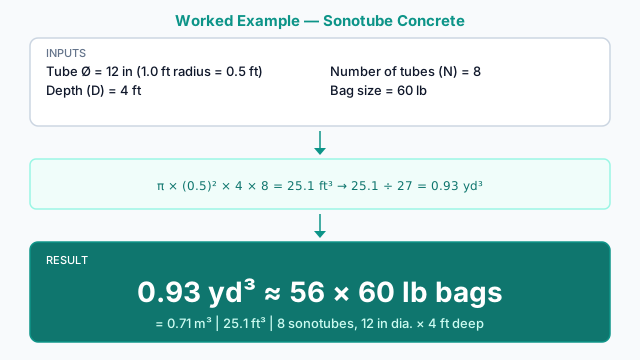
Say you're setting 8 deck-support piers at 12″ diameter and 4 ft deep — a typical elevated-deck job. Start with the radius: 12″ ÷ 2 = 6″ = 0.5 ft. Plug that into the cylinder formula: V = π × r² × h = 3.1416 × (0.5 ft)² × 4 ft = 3.1416 × 0.25 × 4 = 3.14 ft³ per tube. Multiply by the number of tubes: 3.14 ft³ × 8 = 25.13 ft³ total, which converts to 25.13 ÷ 27 = 0.93 yd³ — the figure shown in Fig. 1 below. Add a 5% waste allowance for these machine-drilled holes: 25.13 ft³ × 1.05 = 26.39 ft³ (0.98 yd³) — round up to 1 yd³ if you're ordering ready-mix. For bagged concrete instead, divide the pre-waste volume by bag yield: 25.13 ft³ ÷ 0.45 ft³ (60 lb bag) = 55.8, rounded up to 56 bags; the same pour takes 42 bags of 80 lb mix (25.13 ÷ 0.60) or 84 bags of 40 lb mix (25.13 ÷ 0.30). At under 1 yd³, most crews reach for bags rather than paying a ready-mix minimum-load fee, since this pour sits well under most plants' 1–2 yd³ delivery threshold.
Entering Your Sonotube Dimensions
- 1Enter tube diameter and depth (each takes its own unit) and the number of tubes on the project.
- 2Add a waste allowance — 5% for machine-drilled holes, 10% for hand-dug — and watch for the frost-line warning under 36".
- 3Press Calculate for per-tube and total volume, plus bag counts for 40, 60, and 80 lb bags.
The Sonotube Volume Formula
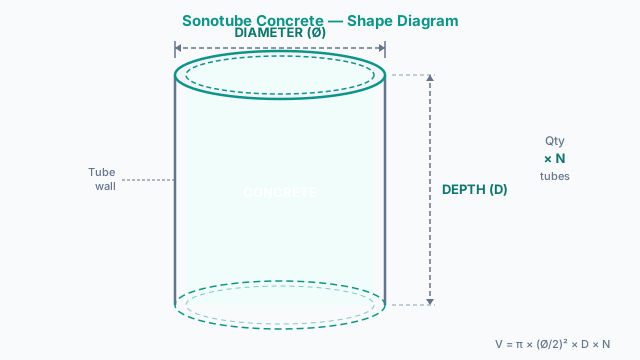
- 1) Per-Tube Volume (Cylinder)V = π × r² × h
r = Diameter ÷ 2 (converted to feet)
h = Depth (converted to feet) - 2) Project TotalVtotal = Vper-tube × Number of Tubes
- 3) Waste AllowanceVorder = Vtotal × (1 + Waste %)
- 4) Bag CountBags = ⌈ Vorder (ft³) ÷ Bag Coverage (ft³) ⌉
40 lb = 0.30 ft³ · 60 lb = 0.45 ft³ · 80 lb = 0.60 ft³ - 5) Cubic Yardsyd³ = ft³ ÷ 27
- 6) Project Cost (Advanced)Total = (Bags × Bag Price) + (yd³ × Yardage Price) + (Tubes × Tube Form Price)
Common Sonotube Sizes at a Glance
Sonotube-brand and compatible cardboard forms are sold in standard diameters. Use this guide to pick the right size for your load case.
| Diameter | Volume per Foot (ft³) | Typical Use |
|---|---|---|
| 6" | 0.196 | Fence posts, light mailboxes, small signs |
| 8" | 0.349 | Deck footings, pergola posts, lamp posts |
| 10" | 0.545 | Heavier decks, gazebo bases, short columns |
| 12" | 0.785 | Structural piers, carports, small foundations |
| 14" | 1.069 | Commercial decks, light industrial posts |
| 16" | 1.396 | Medium piers, garage-corner footings |
| 18" | 1.767 | Heavy piers, small-bridge abutments |
| 20" | 2.182 | Commercial columns, pole-barn piers |
| 24" | 3.142 | Large structural columns, bell caissons (shaft) |
Why Sonotube Pours Come Up Under
- Skipping the waste allowance. Sonotubes are clean forms, but ordering the bare computed volume assumes a perfectly round, plumb hole. Use 5% waste for machine-drilled holes and 10% for hand-dug — skip it and you're making a second trip for one more bag.
- Confusing nominal diameter with hole diameter. The diameter printed on the tube is the inside dimension the calculator uses. Hand-dug or auger-drilled holes rarely come out perfectly round, and any gap between the tube and the earth wall doesn't add usable volume to your order — it just gets backfilled with loose dirt.
- Pouring short of the frost line. IBC §1809.5 and IRC R403.1.4 require footings to extend below the frost line — typically 36″, but up to 48″+ in northern states. Under-ordering depth to save a few dollars on concrete risks a footing that heaves.
- Skipping tube bracing before backfill. An unbraced tube can bow or go out-of-plumb as you backfill around it, throwing off the clean cylinder geometry the volume formula assumes. Brace with 2×4 stakes every 12″ of depth and check plumb on two faces before pouring.
Pairing the Sonotube Calculator with Other Tools
The Sonotube calculator is purpose-built for straight-cylinder cardboard tube forms — deck posts, fence posts, mailbox bases, and light structural piers. For drilled shafts with an under-reamed bell at the base, the pier and caisson concrete calculator handles the frustum enlargement that this tool does not model. When the pour is for many posts along a fence run rather than individual piers, the fence post concrete calculator totals the concrete for the full run from fence length and post spacing. For post holes where gravel depth and post displacement are the key variables (rather than a clean cylindrical form), the post hole concrete calculator is better suited. Once you have the total cubic footage, the concrete bag calculator translates the volume into 40/60/80 lb bag counts and pallets.
Specs & References
Governs the structural design of concrete piers and columns formed with cardboard tube forms, including minimum dimensions, reinforcement requirements, and embedment depth requirements for below-frost-line installation.
Covers design and construction practices for drilled concrete piers, including the cylindrical shaft geometry (π × r² × h) used to calculate sonotube concrete volume, and embedment depth requirements for structural support.
Sonotube form diameter tolerances directly affect bearing area; in frost-prone climates, waxed tubes prevent heave bond — consult a licensed structural engineer to confirm pier depth, bell diameter, and frost protection requirements.
Ordering & Volume Questions
What is a sonotube?
Sonotube is the trademarked name (now genericized) for a waxed-cardboard cylindrical concrete form used to shape round columns, piers, and posts. Similar products from other brands work the same way — enter the nominal inside diameter into the calculator.
How many bags of concrete do I need for one sonotube?
It depends on diameter and depth. An 8″ × 42″ tube holds about 1.22 ft³, which works out to roughly 3 bags of 60 lb or 2 bags of 80 lb pre-mixed concrete per tube — before waste. This calculator does the exact math for any size.
Should I pour with bags or order ready-mix?
Bags are cheaper and easier for up to ~20 cubic feet (roughly 5–7 small tubes). Beyond that, a ready-mix truck is faster and usually cheaper once you factor in labor. Advanced Mode lets you compare both costs side-by-side.
How deep does a sonotube need to go?
In the U.S., the IBC §1809.5 and IRC R403.1.4 require footings to extend below the frost line — typically 36 inches, but up to 48+ inches in northern states. The calculator warns you if you enter less than 36″.
What diameter sonotube should I use for a deck post?
8″ diameter is the residential standard for deck posts supporting 6×6 wood columns. Use 10″ or 12″ for heavy loads, long-span beams, or commercial work per your structural drawings.
Do I need to add waste allowance for sonotubes?
Yes, 5–10% is recommended. Tubes are clean forms, so waste is lower than slab pours, but over-excavation, spillage, and partial bags still add up. Use 10% for hand-dug holes, 5% for augered or machine-drilled holes.
Can I use this for belled or flared bases?
No — this tool is for straight cylindrical tubes only. For belled caissons, use our Pier / Caisson Concrete Calculator which adds a frustum (belled base) volume to the shaft.
What concrete mix strength should I use?
3000–4000 psi (20–28 MPa) is standard for residential piers per ACI 332. For structural piers, follow the engineer's spec — typically 4000 psi or higher with air-entrainment in freeze-thaw zones.
Do I need rebar in a sonotube?
Short answer: yes for anything structural. ACI 318 requires longitudinal reinforcement in columns. Even fence and deck posts benefit from one or two vertical #4 bars plus ties to resist uplift and lateral loads. The calculator does not size rebar — that is a structural engineer's job.
Does the calculator account for the tube wall thickness?
No — cardboard tube walls are typically 0.2–0.3 inches and the nominal diameter printed on the form already refers to the inside dimension. Volume math uses the nominal diameter as the concrete diameter.
Can I enter different units for diameter and depth?
Yes. Diameter accepts inches, feet, cm, or mm; depth accepts inches, feet, meters, or cm. Enter each field in whatever unit your tape measure or spec sheet uses — the engine converts everything to feet internally.
What if my hole is wider than the tube at the bottom?
Extra concrete will fill the over-excavated space. This calculator assumes a clean cylindrical pour. Add 5–10% waste, or bump one step further to account for typical over-digging.
How do I brace a sonotube before pouring?
Backfill tamped earth around the tube every 12 inches of depth, and use 2×4 braces nailed to stakes above grade to hold alignment. Check plumb on two faces before pouring. Brace stays on for 24 hours minimum.
When can I strip the sonotube off?
Wait at least 24–48 hours after pour in warm weather, longer in cold weather. Score the seam with a utility knife and peel the cardboard away. Concrete should be hard to the touch with no surface moisture.
Is this calculator free?
Yes — completely free, no sign-up, no ads in the tool area, and results are printable. Concrete Calculator Max is 100% free for contractors, engineers, and DIYers.
Related Calculators
Concrete Bag Calculator by Project
Turn slab, footing, post hole and sonotube dimensions into an exact bag count — five shape modes, imperial or metric, with +5%/+10% waste buffers.
Pier / Caisson Concrete Calculator
Cylindrical shafts and drilled piers by length.
Column Concrete Calculator
Volume for square, rectangular, and circular columns.
Post Hole Concrete Calculator
Estimate concrete, gravel, and bag counts for fence posts, gate posts, deck posts, and more.
Fence Post Concrete Calculator
Calculate concrete bags and volume for fence posts by total fence length and post spacing, with post displacement subtraction and IRC depth check.