Filling Voids Without a Vibrator: Flowable Fill Volume
Flowable fill — formally called Controlled Low-Strength Material (CLSM) per ACI 229R — is a self-compacting, cementitious slurry used to fill voids where compacted granular backfill would be impractical or too slow. Common applications include utility trench backfill, decommissioned underground storage tank (UST) abandonment, abandoned pipe and culvert fill, void fill beneath slabs, and pipe bedding and haunching. Because CLSM flows into irregular spaces without mechanical compaction, it eliminates settlement risk and speeds project timelines — but calculating the correct volume is critical to avoid costly over-ordering or short-fill delays. Because most CLSM goes into trench and tank voids, our pillar guide on tank & trench concrete volume covers the same subtraction geometry.
This flowable fill calculator estimates CLSM volume in cubic yards, cubic feet, and cubic meters for three common void geometries: rectangular utility trenches, rectangular abandoned tanks or vaults, and cylindrical pipes or culverts. Per-field unit selectors (in, ft, yd, m, cm) let you mix plan dimensions in feet with pipe diameters in inches without manual conversion, and one-click presets for Utility Trench, Abandoned Tank, and Pipe/Culvert seed typical starting values. Enter your void dimensions, apply an overfill percentage, and press Calculate — the tool instantly delivers net volume, order volume (with overfill), a CLSM weight range at 100–125 pcf, and — in Advanced mode — a full cost estimate from your local CLSM price per yd³, plus an ACI 229R flag for placements exceeding one truckload (27 yd³). To move between cubic units, see our concrete volume conversions guide; to budget the pour, our overview of how much concrete costs; and to dodge the usual takeoff errors, our roundup of common concrete calculation mistakes.
Worked Example: 200 ft Utility Trench Backfill
A utility crew needs to backfill a 200 ft long, 2 ft wide, 4 ft deep trench with excavatable CLSM instead of compacting granular backfill in a run too narrow for a plate compactor. Net volume: 200 × 2 × 4 = 1,600 ft³, or 1,600 ÷ 27 = 59.3 yd³. Add a standard 5% overfill for a clean, square-cut trench: 59.3 × 1.05 = 62.2 yd³ to order. Because that exceeds one full truckload (27 yd³), the ACI 229R advisory fires — a reminder to submit a mix design and cast ASTM D4832 test cylinders before the pour. The CLSM weighs between 1,679 ft³ × 100 pcf ≈ 84 tons and 1,679 ft³ × 125 pcf ≈ 105 tons at the order volume, depending on fly-ash content. Targeting 30–100 psi at 28 days keeps the fill excavatable if this line ever needs to be reopened for repair.
How to Use the Flowable Fill Calculator
- 1Choose estimate mode. Click Quick for a fast volume and weight result, or Advanced to unlock the configurable overfill percentage and optional cost estimate.
- 2Select a fill application preset. Click Utility Trench, Abandoned Tank, or Pipe / Culvert to load standard starting dimensions for that void type. All values remain editable.
- 3Enter the void dimensions. For trenches and tanks, enter Length, Width, and Depth using the per-field unit dropdowns (in / ft / yd / m / cm). For pipe or culvert fill, enter the inside Diameter and total Length of the void.
- 4Verify unit selections. Each dimension field has its own unit selector — pipe diameter in inches and pipe length in feet can coexist. The calculator converts each value to feet independently before computing volume.
- 5Set the overfill percentage (Advanced). Open Advanced mode and adjust the Overfill / Waste % field. Use 5% for standard utility trenches with clean square cuts, and 8–10% for tanks, abandoned vaults, and pipe fill where surfaces are irregular.
- 6Enter a CLSM price per yd³ (Advanced, optional). Type your local flowable fill price per cubic yard to generate a total material cost estimate including the overfill factor.
- 7Press Calculate. The results panel updates with net volume (yd³, ft³, m³), order volume with overfill, CLSM weight range at 100–125 pcf, and cost if a price was entered.
- 8Review the compliance warning. If the total order volume exceeds 27 yd³ (one full truckload), the ACI 229R advisory appears — a reminder to submit a mix design and cast test cylinders per ASTM D4832.
- 9Confirm excavatability with your mix design. For future-excavatable CLSM, verify that your mix targets ≤ 150 psi at 28 days per ACI 229R. Non-excavatable fills typically exceed 300 psi and are used for permanent abandonment.
- 10Print or save your estimate. Click Print / Save to open a PDF-ready summary of all inputs, volumes in yd³ / ft³ / m³, CLSM weight, and cost. Select Save as PDF in your browser's Print dialog.
The Flowable Fill Volume Formulas
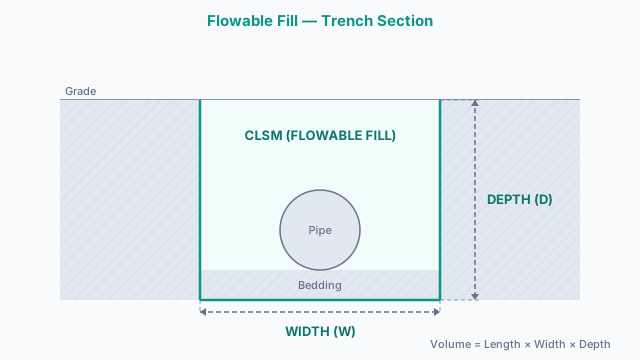
- 1) Rectangular void (trench or tank)Volume (ft³) = Length (ft) × Width (ft) × Depth (ft)
Volume (yd³) = Volume (ft³) ÷ 27
Volume (m³) = Volume (ft³) × 0.028317
All dimensions are converted to feet before multiplication. Works for utility trenches (known length, width, and depth) and rectangular abandoned tanks or vaults (inner length × inner width × inner depth). - 2) Cylindrical void (pipe or culvert)Volume (ft³) = π × (Diameter / 2)² × Length (ft)
Diameter and Length are each independently converted to feet before the formula is applied. Suitable for abandoned sewer mains, culverts, and casing annuli where the void is essentially cylindrical. - 3) Order volume with overfillOrder Volume (yd³) = Net Volume (yd³) × (1 + Overfill% / 100)
Overfill accounts for uneven void surfaces, soil sloughing, and end-of-run waste. Standard practice is 5% for clean trench cuts and 8–10% for tanks and irregular voids. - 4) CLSM weight estimateWeight (lb) = Volume (ft³) × Unit Weight (pcf)
Low estimate: 100 pcf · High estimate: 125 pcf
CLSM unit weight typically falls between 100 and 125 pcf depending on mix design (water-to-cement ratio, fly ash content, and aggregate). Normal-weight concrete is 150 pcf. The range spans excavatable low-strength mixes (fly-ash-heavy) to standard cement-sand mixes.
CLSM Application Guide — Mix Type and Strength by Use
ACI 229R classifies CLSM by compressive strength at 28 days. The most critical design parameter for most utility projects is excavatability — whether the hardened CLSM can be dug out with standard equipment in the future. Mixes exceeding 150 psi at 28 days are generally considered non-excavatable by hand tools; mixes above 300 psi require mechanical breakers.
| Application | Target 28-day Strength | Excavatable? | Notes |
|---|---|---|---|
| Shallow utility trench (< 4 ft) | 30–100 psi | Yes | Water, sewer, gas, telecom lines |
| Deep utility trench (≥ 4 ft) | 30–150 psi | Yes | Must not exceed 150 psi to retain excavatability per ACI 229R |
| Pipe bedding / haunching | 30–100 psi | Yes | Provides uniform support; eliminates point-load settlements |
| Abandoned pipe fill | 50–200 psi | Depends on spec | Culverts, decommissioned mains; strength per owner specs |
| Abandoned UST (underground storage tank) | 100–300 psi | Unlikely | Requires permit & tank cleaning; consult EPA OSWER guidance |
| Void fill under slabs / pavement | 50–150 psi | Varies | Slab-void repair; strength per structural requirements |
| Bridge approach fill | 50–150 psi | Varies | Eliminates approach settlement; per DOT specification |
| Annular space (pipe casing) | 30–100 psi | Yes | HDD bore annuli, pipe-within-casing fills; low viscosity required |
Strength ranges are guidance values per ACI 229R. Always specify compressive strength targets in your project mix design. Excavatable limit of 150 psi per ACI 229R §5.3.
Ordering Mistakes That Cost Money or Break Code on a CLSM Pour
- Specifying strength above 150 psi for a line that may need reopening. Non-excavatable CLSM (above 150 psi, often 100–300+ psi) requires mechanical breakers to remove. If the trench might need a future repair, target 30–100 psi to keep it diggable with hand tools and a backhoe.
- Using the 5% trench overfill on a tank or pipe fill. Irregular void surfaces on abandoned tanks, vaults, and pipe fills lose more material to soil gaps and connection points — use 8–10% for those, not the 5% that fits a clean, square-cut trench.
- Skipping the mix design submittal on large placements. Once your order volume exceeds 27 yd³ (one truckload), ACI 229R §6 calls for a submitted mix design and ASTM D4832 test cylinders — this calculator flags the threshold, but confirming with your engineer before the pour avoids a rejected placement.
- Filling an active or insufficiently cleaned UST. Abandoning an underground storage tank with CLSM is a regulated activity — it requires a closure plan, tank cleaning and vapor testing, and a permit. Never fill a tank that hasn't been certified clean; residual fuel vapors create an explosion hazard during placement.
Pairing the Flowable Fill Calculator with Other Tools
The Flowable Fill calculator is the right tool when your structure requires a self-compacting cementitious slurry that flows into irregular voids without mechanical compaction. When the trench will be backfilled with granular aggregate instead, the gravel calculator estimates volume and tonnage for crushed stone or sand fill. For a concrete-walled tank or vault that also needs shell volume, use the tank and trench concrete calculator for the shell pour. For deep drilled piers and caisson shafts, the pier and caisson concrete calculator handles shaft and bell geometry. When volume is established and you need to verify the ready-mix order size, the concrete yards calculator converts any volume to cubic yards for supplier ordering.
Specs & References
The primary ACI reference for CLSM mix design, applications, and performance. Defines the excavatable strength limit of 150 psi at 28 days (§5.3), specifies QC testing requirements for large placements (§6), and covers material proportioning for fly-ash-based and cement-based mixes. This calculator's compliance warning is based on ACI 229R §6 guidance.
Governs how CLSM test cylinders are cast and tested for compressive strength. Unlike concrete cylinders, CLSM specimens are cast without rodding or vibration, and tested at much earlier ages (1 and 3 days for set-time monitoring, 28 days for strength verification). This standard is invoked by the ACI 229R §6 QC protocol triggered by the compliance warning at >27 yd³.
Measures the flowability of fresh CLSM using a simple cylinder-lift test. A minimum flow diameter of 8 inches (200 mm) is typically specified for utility trench fills to ensure the mix can self-level and flow around utilities without voids. Flow consistency is the key fresh-state property distinguishing CLSM from conventional concrete or grout.
Governs the abandonment-in-place of underground storage tanks using inert fill material, including CLSM. Tank closure by filling requires site assessment, tank cleaning to remove residual product, local permit approval, and regulatory notification. Always obtain required permits before using CLSM for UST abandonment — regulatory requirements vary by state.
Standards cited for reference. Always consult a licensed civil or geotechnical engineer for project-specific CLSM mix design, placement, and regulatory compliance.
Ordering & Volume Questions
What is flowable fill?
Flowable fill is a self-compacting, cementitious backfill material that flows like a slurry and hardens to a low-strength solid. It is used in place of compacted granular backfill wherever mechanical compaction is impractical — narrow trenches, confined voids, abandoned structures, and pipe bedding zones. Because it is self-leveling, flowable fill eliminates the risk of under-compaction and associated surface settlement.
What does CLSM stand for?
CLSM stands for Controlled Low-Strength Material. The term was standardized by ACI Committee 229 to distinguish engineered low-strength cementitious fills (flowable fill) from ordinary concrete and grout. A CLSM mix is typically composed of water, Portland cement or fly ash, fine aggregate, and sometimes chemical admixtures. Compressive strength at 28 days is the primary design parameter and is controlled to a target range — often 30–150 psi for excavatable fills.
When should I use flowable fill instead of compacted backfill?
Use flowable fill when: (1) the trench is too narrow for a plate compactor, (2) the soil type is unsuitable for compaction to the required density, (3) future settlement near a roadway or structure cannot be tolerated, (4) the void is irregular and granular fill cannot be uniformly placed (abandoned tanks, culverts), or (5) construction speed is critical and re-compaction delays are unacceptable. In most utility trench applications, CLSM also reduces labor cost by eliminating multiple compaction lifts.
What is the compressive strength of excavatable flowable fill?
Per ACI 229R §5.3, excavatable CLSM should have a compressive strength at 28 days of no more than 150 psi (approximately 1.03 MPa) to ensure the material can be dug out with standard hand tools and a backhoe in the future. Strengths of 30–100 psi are common for shallow utility trenches. If future excavation is not anticipated (abandoned tanks, permanent void fill), higher-strength non-excavatable mixes (100–300+ psi) are acceptable and typically less expensive due to lower cement content.
How do I calculate the volume of flowable fill for a utility trench?
Volume (ft³) = Trench Length (ft) × Trench Width (ft) × Fill Depth (ft). Divide by 27 to convert to cubic yards. Example: a trench 200 feet long, 2 feet wide, and 4 feet deep contains 200 × 2 × 4 = 1,600 ft³ ÷ 27 = 59.3 yd³ net. Add 5% overfill to get approximately 62.2 yd³ to order. This calculator performs that calculation automatically — enter your dimensions and press Calculate.
What is the formula for calculating flowable fill volume in a pipe?
For a circular pipe or culvert fill, Volume (ft³) = π × (Diameter / 2)² × Length. Example: an 18-inch (1.5 ft diameter) culvert, 50 ft long: π × (0.75)² × 50 = π × 0.5625 × 50 ≈ 88.4 ft³ ÷ 27 ≈ 3.27 yd³. Add 8–10% overfill for pipe-end gaps and irregular terminations.
What is the difference between excavatable and non-excavatable CLSM?
Excavatable CLSM (≤ 150 psi at 28 days per ACI 229R) can be removed with a backhoe and hand tools — essential for utility trenches that may need to be reopened for future repairs or extensions. Non-excavatable CLSM (> 150 psi, often 100–300+ psi) hardens to a semi-rigid material that requires mechanical breakers to remove and is suited for permanent abandonment of tanks, voids, and culverts where future excavation is not expected.
How does flowable fill differ from regular concrete?
Flowable fill has a much lower cementitious content than concrete — typically 50–150 lb/yd³ versus 450–700 lb/yd³ for structural concrete. This produces a much lower compressive strength (30–300 psi vs. 3,000–5,000 psi). CLSM is also much wetter (high water-to-cement ratio) for self-leveling flow, and often contains fly ash as the primary cementitious component. It is not structural — it is a backfill and void-fill material only.
How long does flowable fill take to set?
Initial set typically occurs within 3 to 6 hours for cement-based CLSM mixes, allowing same-day trench backfill and next-day surface restoration. High-fly-ash mixes (low cement content) may take 12–24 hours to achieve initial set. ASTM D4832 cylinder testing at 1 and 3 days monitors early strength gain. Full 28-day strength is reached in 3–4 weeks. Traffic loads should not be applied until CLSM reaches sufficient early strength — consult your mix design for specific opening time.
Can flowable fill be used to fill an abandoned underground storage tank?
Yes, but UST abandonment-in-place with CLSM is a regulated activity. Requirements vary by state but generally include: submitting a closure plan, tank cleaning and vapor testing to remove residual fuel, removing or rendering inert all piping, obtaining a local permit, notifying the regulatory agency, and filing a post-closure report. The EPA OSWER Directive 9650.18 governs federal-level requirements. Never use flowable fill to fill an active or insufficiently cleaned UST — fuel vapors create explosion hazards during placement.
What overfill factor should I use for flowable fill?
As a general rule: 5% for clean, square-cut utility trenches; 8–10% for abandoned tanks, vaults, and pipe fill where surfaces are irregular and some fill will be lost to soil gaps or pipe connections; 10–15% for very large or irregular voids with uncertain geometry. This calculator defaults to 5% and lets you adjust in Advanced mode. Always confirm with your geotechnical engineer — over-ordering CLSM for large projects is expensive, but under-ordering causes incomplete fill and future settlement.
How heavy is flowable fill per cubic yard?
CLSM unit weight typically ranges from 100 to 125 pounds per cubic foot (pcf), or roughly 2,700 to 3,375 pounds per cubic yard. This is lighter than normal concrete (150 pcf / 4,050 lb/yd³) because CLSM mixes have higher water content and lower aggregate density. Fly-ash-heavy mixes are on the low end (100–110 pcf); standard cement-sand mixes are on the high end (115–125 pcf). The weight range in this calculator (100–125 pcf) covers both scenarios.
What are the ASTM test methods for flowable fill?
The two primary ASTM standards for fresh and hardened CLSM testing are: ASTM D6103 (flow consistency — measures the diameter spread of a fresh CLSM cylinder after lifting; minimum 8 inches typically specified) and ASTM D4832 (compressive strength — cylinders cast without rodding, tested at 1, 3, 7, and 28 days to verify target strength and excavatability). Additional tests include ASTM C138 for unit weight and ASTM D5971 for sampling fresh CLSM.
Is this flowable fill calculator free?
Yes — completely free with no sign-up, no account, and no download required. All calculations run locally in your browser and no data is stored or sent to a server. The calculator is available on any device with a modern browser.
Can I print or save my flowable fill estimate?
Yes. After pressing Calculate, click the Print / Save button in the results panel to open a clean, print-optimised page listing all inputs, net volume in yd³ / ft³ / m³, order volume with overfill, CLSM weight range, and cost estimate. Select Save as PDF in your browser's Print dialog to keep a digital copy for project records or material procurement.
Related Calculators
Tank or Trench Concrete Calc
Calculate concrete volume for tanks or trench structures easily.
Crushed Concrete Estimator Calculator
Calculate crushed concrete volume, tons, coverage, and total cost with compaction adjustments.
Gravel Calculator
Calculate gravel volume, tons, cubic yards, and estimated cost.
Post Hole Concrete Calculator
Estimate concrete, gravel, and bag counts for fence posts, gate posts, deck posts, and more.
Concrete Yards Calculator
Convert and compute volume into cubic yards.