Estimating Concrete for Drilled Piers and Belled Caissons
Drilled piers and caissons are deep-foundation elements that transfer structural loads past weak near-surface soils to a competent bearing stratum — rock, dense gravel, or stiff clay — that a shallow spread footing could never reach. Unlike a footing or slab where concrete volume scales cleanly with plan area, pier and caisson estimating has two complicating factors unique to drilled shafts: the bell and the borehole over-pour. A belled caisson enlarges its base into a cone-frustum shape to spread load over a wider bearing area; that bell alone can add 20–45% more concrete than the shaft above it. The open borehole is never a perfect cylinder — soil sloughing and drilling overbreak routinely consume 5–10% beyond the design geometry, invisible during the pour and only apparent on the batch-plant delivery ticket. Getting both factors into the estimate before you call the ready-mix plant is the difference between one truck and two. For bell-footing geometry, frustum formulas, and bag counts in depth, see our pillar guide on pier, caisson & sonotube concrete.
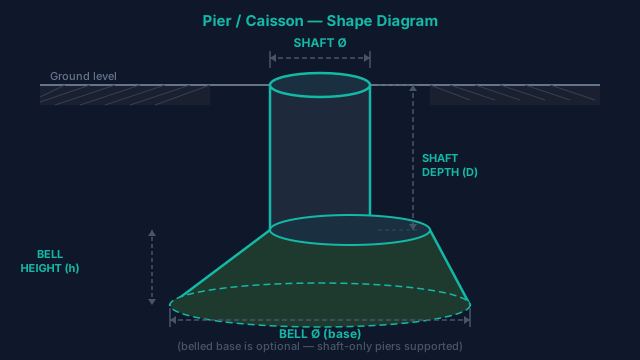
This calculator handles both a straight-shaft cylindrical pier (V = π × r² × h) and the optional belled base using the frustum formula (V = (π × h / 3) × (R₁² + R₁R₂ + R₂²)), combines them per pier, multiplies by the number of identical piers on your foundation plan, and applies a borehole waste allowance. It returns per-pier and project-total volumes in m³, yd³, and ft³ — alongside cubic-yard ordering buffers at +5% and +10% so you can schedule a continuous pour without the tremie hose running dry before the bell is filled. For a cardboard-form pour, see our guide on sonotube bags of concrete; for the spread-footing alternative, our concrete footing calculations; and for above-grade shafts, our guide on rectangular vs circular columns.
Beyond the shaft-and-bell math, the tool accepts five input units (m, cm, mm, ft, in) to match whatever your borehole log or geotechnical report uses, keeps shaft depth and bell height as separate fields so the bell zone is never double-counted, and reports four figures — per-pier net, per-pier with waste, project net, and project with waste — so you can cross-check each hole against the inspector's pour log. Both formulas are verified against ACI 318-19 and ACI 543R-12, and a Print / Save option exports a clean summary for the ready-mix order or the foundation log.
Worked Example: A Six-Caisson Belled Foundation Pour
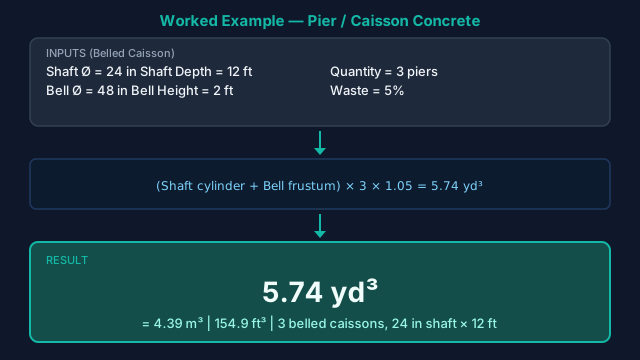
A commercial building project specifies six belled caissons. Each shaft is 24 inches in diameter drilled to 15 feet, terminating in a bell that widens from 24 inches at the neck to 48 inches at the base over a 3-foot bell height. Working in feet throughout, the shaft radius is 1 ft; the shaft volume per pier is π × (1)² × 15 = 47.12 ft³. The frustum bell adds (π × 3 / 3) × (1² + 1 × 2 + 2²) = π × 7 = 21.99 ft³, giving a combined volume of 69.11 ft³ = 2.56 yd³ per caisson.
Multiply by six piers: 69.11 × 6 = 414.66 ft³ = 15.36 yd³ net. Apply an 8% waste allowance — conservative but appropriate for a belled pour where the tremie hose is primed from the bottom of a wet hole: 15.36 × 1.08 = 16.59 yd³. The +10% buffer row reads about 16.9 yd³, so a single 17-yard ready-mix order covers the full project with margin for overbreak and hose priming.
For comparison, the same six piers without any bell would total only 6 × 47.12 = 282.7 ft³ = 10.47 yd³ net. The bell adds roughly 132 ft³ — about 47% more concrete than the shaft geometry alone — a volume that is easy to miss if a site supervisor measures only shaft footage from the driller's log and ignores the bell detail on the geotechnical drawing.
Entering Your Pier & Caisson Dimensions
- 1Select the Input Unit that matches your drawings or borehole log — meters, centimeters, millimeters, feet, or inches. Every dimension you enter (shaft and bell) is interpreted in this single unit.
- 2Enter the Shaft Diameter — the nominal bore size in the geotechnical report or structural drawings. Residential deck piers are commonly 12–16 in; light commercial shafts run 18–24 in; large drilled shafts for bridges or high-rise foundations may reach 36–48 in or more.
- 3Enter the Shaft Depth — the cylindrical bore length from grade (or cut-off elevation) to the top of the bell flare, or to the base of the pier if there is no bell. This value comes from the foundation schedule or confirmed borehole log depth.
- 4Enter the Pier Quantity — the number of identical piers sharing these dimensions. Mixed-size foundations must be calculated in separate runs and summed.
- 5(Optional) Toggle Belled Base on if the geotechnical design specifies an under-reamed bell. Enter the Top Diameter (equals the shaft diameter at the neck), the Bottom Diameter (the maximum bell spread at the bearing surface), and the Bell Height.
- 6Set the Waste / Overage % — typically 5–8% for straight shafts in stable, dry conditions; increase to 8–10% for belled caissons, wet holes, or pours using drilling slurry where the bell must be pumped from the bottom up.
- 7Click Calculate to see per-pier shaft, bell, combined, and waste-adjusted volumes, plus project totals in m³, yd³, and ft³ with +5% and +10% ordering buffers.
- 8Click Print / Save to export a clean summary for the project log, ready-mix ticket, or the inspector's pour card.
The Pier & Caisson Volume Formula
- 1) Shaft Volume (Cylinder)Vshaft = π × r² × h | r = Shaft Diameter ÷ 2
All dimensions are converted to a common unit before calculation. This assumes a uniform bore diameter over the full shaft depth — the standard condition for auger-cast or rotary-drilled shafts. Tapered shafts should be split into prismatic segments. - 2) Belled Base Volume (Frustum)Vbell = (π × hbell / 3) × (R₁² + R₁R₂ + R₂²)
R₁ = top radius (neck of bell, equals shaft radius), R₂ = bottom radius (maximum under-ream spread). The frustum result is added to the shaft volume to produce the total per-pier concrete volume. - 3) Waste Allowance and Project TotalsPer-Pier With Waste = (Vshaft + Vbell) × (1 + Waste% ÷ 100)
Project Total = Per-Pier Volume × Quantity | Project With Waste = Per-Pier With Waste × Quantity
Waste is applied per pier before multiplying by quantity — correctly reflecting that each individual borehole carries its own sloughing and priming loss independently of the others.
Common Pier & Caisson Sizes at a Glance
Common drilled-pier configurations with estimated shaft-only concrete volume for a quick sanity check. Bell volumes must be added separately using the calculator above. Maximum bell diameter is indicative — always confirm with the geotechnical engineer and structural drawings.
| Application | Shaft Dia. | Typical Depth | Shaft Volume (yd³) | Max Bell Dia. |
|---|---|---|---|---|
| Residential deck pier | 12 in (0.30 m) | 4–8 ft | 0.07–0.14 | — (straight) |
| Light commercial drilled shaft | 18 in (0.46 m) | 10–20 ft | 0.29–0.59 | 36–42 in |
| Commercial belled caisson | 24 in (0.61 m) | 15–30 ft | 0.65–1.31 | 48–60 in |
| Bridge or high-rise shaft | 36 in (0.91 m) | 20–50 ft | 1.47–3.63 | 72–90 in |
| Large-diameter drilled shaft | 48 in (1.22 m) | 30–80 ft | 3.93–10.47 | 96+ in |
Shaft volumes computed from V = π r² h at mid-range depth. Actual volumes depend on confirmed borehole depth from the geotechnical log. Use the concrete yards calculator to verify or round up the final ready-mix order once shaft volume is established.
Why Pier & Caisson Pours Come Up Under
- Ignoring the bell volume entirely. Site teams who simply convert shaft diameter × depth to a cylinder routinely under-order by 20–45% on belled caissons. A 48-inch bell on a 24-inch shaft nearly triples the base area and can add close to half a cubic yard per caisson — a volume that is easy to miss if you read only the shaft footage from the driller's log. Always check the geotechnical drawing for the bell detail and enter it here.
- Including bell height in the shaft depth field. Shaft depth should cover only the cylindrical bore — from grade or cut-off elevation to the top of the bell flare. If you extend the shaft depth through the bell zone and also enter a bell height, the calculator counts that zone twice: once as a cylinder in the shaft formula and again as a frustum in the bell formula. Shaft depth and bell height are separate, additive inputs.
- Applying slab-level waste to drilled shafts. A slab is an open, visible pour where concrete spread is easy to control — 5% waste is often enough. A drilled shaft is a confined, wet bore poured under a tremie or pump. Soil sloughing, borehole overbreak, and tremie-hose priming add real, unrecoverable volume; 8–10% waste is more appropriate for belled caissons in cohesive soils or below the groundwater table.
- Grouping mixed-size piers into one calculation. The pier-quantity field multiplies every shaft by the same diameter, depth, and bell geometry. A foundation with three 24-inch shafts at 15 feet and two 36-inch shafts at 20 feet must be calculated in two separate runs and then added. Averaging the two sizes into one run — however tempting — applies a single incorrect geometry to all five piers and distorts the concrete order.
Pairing the Pier & Caisson Calculator with Other Tools
Use this pier and caisson calculator for drilled shafts and under-reamed caissons — deep elements where load is transferred by end bearing on a competent stratum or by skin friction along a long shaft, and where the bell frustum is the distinguishing geometry. For shallow spread foundations that bear near grade and transfer load across a wide plan area, use the footing concrete calculator, which handles rectangular and square pad geometry. Short drilled cylinders that function as above-grade vertical members belong in the column concrete calculator — same π r² h formula, but set up for vertical, above-grade counting. The horizontal grade beams and cap beams that link pier heads use the beam calculator. For small residential piers where you want to convert the cubic footage into a bag count, the concrete bag calculator translates yd³ directly into 60 lb or 80 lb bag quantities. If you have already computed the total shaft volume and simply need to verify or round up the ready-mix truck size, the concrete yards calculator is the fastest path to a confirmed order figure.
Where These Figures Come From
Governs concrete strength, cover, and reinforcement for drilled piers as structural foundation elements. Section 26.4 requires a minimum compressive strength of 3,000 PSI for most cast-in-place concrete; most deep-foundation specs call for 4,000–5,000 PSI for shaft concrete placed under a tremie to ensure workability and strength gain in a confined wet environment.
Covers design and installation for drilled shafts and belled caissons, including minimum shaft diameter, bell geometry limits (bell diameter typically ≤ 3× shaft diameter), concrete placement methods (tremie, pump, or free-fall), and inspection tolerances. The bell-diameter ratio guidance this calculator references comes directly from this document.
The FHWA reference manual for drilled shaft construction. Covers borehole stability, slurry use, temporary casing, and the concrete quantities required for under-reamed caissons — including how borehole overbreak and caving soils increase actual consumption beyond design geometry and why a higher waste allowance than a slab pour is standard practice.
Caisson bearing capacity depends on confirmed stratum depth and approved bell geometry; a licensed geotechnical engineer must verify the bearing layer and approve bell diameter before under-reaming begins — this calculator estimates concrete volume only and does not size, design, or approve foundation elements.
Common Pier & Caisson Ordering Questions
What is the difference between a pier and a caisson?
In common US construction usage the terms are often interchangeable — both refer to a drilled, cast-in-place deep foundation element. Technically, a caisson is the hole itself (or a pre-fabricated casing lowered into place), while a pier is the concrete column cast inside it. When engineers say 'belled caisson' they mean a drilled shaft with an under-reamed enlarged base; this calculator handles both the straight cylindrical shaft and the belled variety using separate geometry inputs.
How do I calculate pier concrete volume by hand?
For a straight cylindrical shaft multiply π × r² × depth, where r is the shaft radius in a consistent unit. For a 24 in (r = 1 ft) shaft at 15 ft deep: π × 1² × 15 = 47.12 ft³ = 1.75 yd³. For a belled caisson add the frustum: (π × h_bell / 3) × (R₁² + R₁R₂ + R₂²). A 3 ft bell from 12 to 24 in radius adds (π × 3 / 3) × (1 + 2 + 4) = 21.99 ft³. Multiply the combined per-pier volume by pier count and add waste.
Can this calculator handle belled caissons?
Yes. Enable the Belled Base toggle and enter the top neck diameter (equal to the shaft diameter), the bottom bell diameter (the maximum under-ream spread at the bearing surface), and the bell height. The tool applies the frustum formula V = (π × h / 3) × (R₁² + R₁R₂ + R₂²) and adds the result to the shaft volume automatically.
What is the typical bell diameter ratio for caissons?
Geotechnical practice and ACI 543R-12 generally limit the bell diameter to a maximum of 3× the shaft diameter. A 24-inch shaft can typically support a bell up to about 72 inches — though actual bell size is driven by the bearing load demand and confirmed bearing capacity, not by the ratio alone. The geotechnical engineer of record sets the maximum bell diameter.
How much waste should I add for drilled piers?
Allow 5–8% for straight shafts in stable, dry soils where overbreak is minimal. Increase to 8–10% for belled caissons in cohesive soils, for shafts drilled below the water table, or for pours using drilling slurry — conditions where the borehole walls are less stable and the tremie hose must be primed from the bottom of a wet hole, consuming concrete that never reaches the design cross-section.
Why is borehole over-pour higher than slab or footing over-pour?
A slab is an open pour on a prepared surface — excess concrete is visible and controllable. A drilled shaft is a confined bore that you cannot see into during the pour. Soil sloughing adds irregular unmeasured volume at the shaft wall, the tremie hose must be primed before concrete begins to rise in the bell, and concrete placed under hydrostatic pressure can widen weak zones in the soil. These losses appear only on the batch-plant delivery ticket after the pour is complete.
What concrete strength should I specify for drilled piers?
ACI 318-19 requires a minimum 3,000 PSI (20.7 MPa) for most structural concrete. Most deep-foundation specifications call for 4,000–5,000 PSI for tremie-placed shaft concrete to ensure adequate slump retention, flowability around the cage, and long-term strength gain in a confined, wet environment. Mix design and compressive strength are specified by the structural engineer — this calculator estimates concrete volume only.
What shaft depth should I enter if there is a bell?
Enter only the cylindrical bore length — from grade or cut-off elevation down to the top of the bell flare. Do not include the bell height in the shaft depth, or the bell zone will be counted twice: once as a cylinder in the shaft formula and again as a frustum in the bell formula. Shaft depth and bell height are separate, additive inputs that together represent the total bore length.
Does the calculator show per-pier and total volumes?
Yes. Results show four figures: per-pier net volume, per-pier with waste, project-total net, and project-total with waste — all in m³, yd³, and ft³. The per-pier figures let you cross-check the calculator output against the inspector's individual pour log for each hole.
How do I use the yd³ (+5% / +10%) ordering buffers?
After pressing Calculate, the results panel shows the waste-adjusted project total in yd³ followed by +5% and +10% buffer rows. These are quick rounding targets when calling the batch plant. Most ready-mix plants supply in whole or half-yard increments, so you pick the buffer row that clears your waste-adjusted total and round up to the nearest delivery increment.
When should I use a belled caisson instead of a straight shaft?
Bells are used when the bearing layer is a competent stratum reachable by the drill rig and the end-bearing area must be enlarged to meet load demand without drilling deeper. Straight shafts are preferred when load is carried by skin friction along the full shaft length, when the bearing layer is too hard or too deep to under-ream economically, or when the drilling equipment cannot accommodate the wider under-ream tool.
Does this tool include reinforcement cage sizing or mix design?
No. The calculator estimates concrete volume only. Cage diameter, longitudinal bar size, spiral or hoop spacing, and cover over the steel are set by the structural design per ACI 318-19 and must come from a licensed structural engineer's drawings before steel is fabricated or concrete is ordered.
How is this pier calculator different from the footing or post-hole calculators?
The footing calculator handles shallow spread footings — rectangular pads near grade that transfer load through wide bearing area. The post-hole calculator estimates small cylindrical holes for fence or sign anchors (4–12 in diameter, under 4 ft deep). The pier and caisson calculator is for structural drilled shafts — larger diameters (12 in and up), greater depths, and the optional belled enlargement at bearing — which require the frustum formula and a higher waste allowance than shallow work.
Can I estimate a small residential deck pier with this tool?
Yes. For a 12–16 in diameter deck pier, 4–8 ft deep with no bell, simply enter the shaft diameter and depth, set quantity to the number of piers, leave the belled base off, and use a 5% waste allowance. The ft³ and yd³ result tells you how many 60 lb or 80 lb bags to have on site. See the concrete bag calculator if you want to convert yd³ directly into bag counts.
What slump should drilled shaft concrete have?
ACI 543R-12 and FHWA-NHI-10-016 recommend 6–9 inches of slump for drilled shaft concrete placed by tremie or pump. This range ensures the mix flows around the reinforcing cage and displaces drilling mud or water without segregating. Stiff mixes (under 4 in slump) can arch above the cage and leave voids — a critical defect in a shaft that relies on full cross-section integrity for load transfer to the bearing stratum.
Can I print or save my pier and caisson estimate?
Yes. After pressing Calculate, click Print / Save to generate a clean A4 summary listing shaft diameter, depth, bell dimensions, waste %, and all volume figures per pier and for the full project. Choose Save as PDF in your browser print dialog to keep a copy for the engineer's borehole log, the batch-plant order, or the foundation inspection record.
Related Calculators
Concrete Bag Calculator by Project
Turn slab, footing, post hole and sonotube dimensions into an exact bag count — five shape modes, imperial or metric, with +5%/+10% waste buffers.
Sonotube Concrete Calculator
Volume, cubic yards & bag counts for cylindrical tube forms.
Column Concrete Calculator
Volume for square, rectangular, and circular columns.
Footing Concrete Calculator
Continuous, isolated, and combined footings.
Post Hole Concrete Calculator
Estimate concrete, gravel, and bag counts for fence posts, gate posts, deck posts, and more.