Turning a Curb Profile Into Cubic Yards
Curb and gutter is one of the most common roadway concrete applications — used on city streets, parking lots, subdivisions, and commercial sites to control stormwater runoff, define lane edges, and protect the pavement base from lateral erosion. Accurate concrete quantity estimation is essential for ordering the right amount of ready-mix, avoiding costly short loads or over-orders, and keeping paving projects on schedule. Because curb and gutter runs in a long continuous strip, even a small error in the assumed cross-section multiplies across hundreds or thousands of linear feet. The errors that bite hardest on long runs are catalogued in our pillar guide to common concrete calculation mistakes.
This calculator uses a two-component cross-section model: the flat gutter pan (width × thickness) and the raised curb body (width × face height). Pick a profile preset — barrier, rollover, or mountable curb — or enter your own dimensions, and it multiplies the combined cross-section area by the run length to produce total concrete volume, expressed in cubic yards, cubic feet, and cubic meters, with bag counts for 40 / 50 / 60 / 80 lb pre-mix bags and an optional ready-mix cost estimate. Results also split the pour into gutter pan and curb body volumes and report a coverage rate in linear feet per cubic yard — a fast cross-check against a DOT pay-item schedule — and a compliance alert fires if the gutter thickness you enter falls below the 4-inch minimum most state specifications require. For the underlying flatwork math, see our guide on how to calculate concrete for a slab; to move between cubic units, our concrete volume conversions guide; and to budget the run, our overview of how much concrete costs.
Worked Example: 250 LF Driveway Apron with Mountable Curb
A 250 LF driveway apron uses mountable curb: an 18″ × 4″ gutter pan and a 3″ × 10″ curb. Cross-section area: (18″ ÷ 12 × 4″ ÷ 12) + (10″ ÷ 12 × 3″ ÷ 12) = (1.5 × 0.333) + (0.833 × 0.25) = 0.500 + 0.208 = 0.708 ft². Total volume: 0.708 ft² × 250 LF = 177.0 ft³, or 177.0 ÷ 27 = 6.56 yd³ — matching the reference table's published rate of about 0.026 yd³/LF for this profile (250 × 0.026 ≈ 6.5 yd³). Add 5% waste for a straight run: 6.56 × 1.05 = 6.89 yd³ — round up to 7.0 yd³ on the ready-mix ticket. At $155/yd³, that's roughly $1,085 in material, excluding forming and finishing labor. The coverage rate works out to 250 ÷ 6.89 ≈ 36 LF per cubic yard — a quick number to sanity-check against a DOT pay-item schedule on larger runs.
A pitfall the volume math doesn't catch: contraction joints in the curb and gutter should line up with the joints in the adjacent pavement slab, not run on their own independent spacing. When a paving crew cuts curb joints without reference to the panel joints next to it, the two systems crack independently under thermal movement, and the mismatch shows up as reflective cracking at the curb face within a season or two — a cosmetic and maintenance problem the concrete quantity was never going to prevent.
How to Use the Curb & Gutter Concrete Calculator
- 1Pick a profile preset (barrier, rollover, or mountable curb) or enter your own gutter pan and curb body dimensions.
- 2Enter the total run length, then set a waste percentage in Advanced mode (5% for straight runs, 8–10% for radius work).
- 3Press Calculate for the gutter pan and curb body volumes, total yd³, coverage rate (LF/yd³), and bag counts.
The Curb & Gutter Volume Formulas
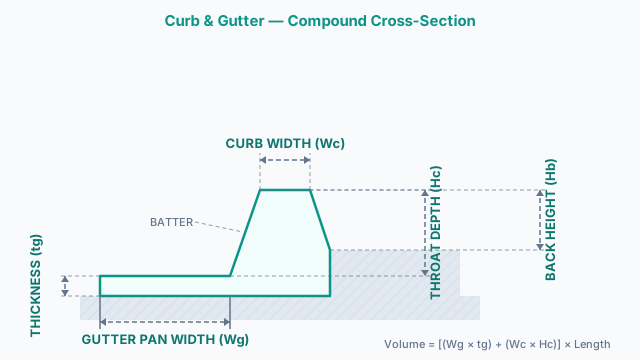
- 1) Cross-Section AreaCross-Section (ft²) = (Gutter Pan Width × Gutter Thickness) + (Curb Width × Curb Face Height)
Both components are converted to feet before multiplication. The gutter pan and curb body are treated as non-overlapping rectangles — a conservative simplification that matches standard estimating practice for symmetrical profiles. - 2) Total VolumeVolume (ft³) = Cross-Section Area (ft²) × Run Length (ft)
All dimensions are converted to feet before multiplication. The result is a cubic-foot volume for the full run. - 3) Unit Conversionsyd³ = ft³ ÷ 27 | m³ = ft³ × 0.028317
Cubic yards are the standard ordering unit for ready-mix concrete in the United States. Cubic meters are used for metric project documentation. - 4) Waste-Adjusted VolumeAdjusted Volume = Base Volume × (1 + Waste% ÷ 100)
Applied to the total ft³ before converting to yd³ and before computing bag counts. A 5% waste factor is standard for straight curb runs; 8–10% is used for radius work or when forming accuracy is uncertain. - 5) Coverage RateLF/yd³ = Run Length (ft) ÷ Total Volume (yd³)
Expresses how many linear feet of curb one cubic yard of concrete covers for the entered cross-section. Useful for field verification and pay-quantity auditing. - 6) Bag CountsBags = ⌈ Adjusted Volume (ft³) ÷ Bag Yield (ft³) ⌉
Bag yields: 40 lb → 0.30 ft³; 50 lb → 0.375 ft³; 60 lb → 0.45 ft³; 80 lb → 0.60 ft³. Counts are rounded up to whole bags.
Standard Curb & Gutter Profiles at a Glance
The table below lists common curb and gutter profiles with their standard dimensions and concrete volume per linear foot. Use these as a quick sanity-check against your calculator results.
| Profile Type | Gutter Width × Thickness | Curb Face Ht × Width | yd³/LF | 100 LF Total (yd³) |
|---|---|---|---|---|
| Barrier Curb, 6" (AASHTO Type B) | 24" × 6" | 6" × 6" | 0.046 | 4.63 |
| Rollover / Drive-over, 4" (AASHTO Type D) | 24" × 6" | 4" × 8" | 0.045 | 4.52 |
| Mountable Curb, 3" | 18" × 4" | 3" × 10" | 0.026 | 2.62 |
| Heavy-Duty Barrier, 8" | 30" × 8" | 8" × 8" | 0.078 | 7.82 |
| Low-Profile Curb, 2" | 12" × 4" | 2" × 6" | 0.015 | 1.54 |
Volumes calculated using the rectangular approximation: (gutter width × gutter thickness + curb width × curb face height) × 1 LF. Actual cross-sections may include tapered curb faces that reduce volume slightly. Always verify against project specifications.
Ordering Mistakes That Show Up Later on a Curb Run
- Cutting curb joints on their own spacing instead of the pavement's. Contraction joints in the curb and gutter should line up with the adjacent pavement panel joints, not run independently. Mismatched joints crack separately under thermal movement, showing up as reflective cracking at the curb face within a season or two.
- Using 5% waste on radius or curved sections. Straight runs hold to 5%; radius work and tight-turn returns need 8–10% because curved forming loses more material to spillage and form adjustment per linear foot.
- Pouring below the 4-inch gutter minimum. Most state DOT specifications set 4 to 6 inches as the minimum gutter slab thickness. Thinner sections crack sooner under frost heave and vehicle overhang loading — the calculator's compliance alert exists specifically to catch this before the order goes in.
- Treating the tapered curb face as a full rectangle. The rectangular approximation used here is a conservative simplification — real tapered curb faces hold slightly less concrete than gutter width × thickness plus curb width × face height suggests. On long runs that small per-foot margin becomes useful slack rather than a shortfall.
Pairing the Curb & Gutter Calculator with Other Tools
The Curb and Gutter calculator estimates concrete for the combined roadway curb-and-gutter cross-section. For the adjacent sidewalk panel beyond the curb and gutter section, the concrete sidewalk calculator estimates flatwork volume with joint spacing included. When the project also includes a vertical wall behind the gutter, the wall concrete calculator handles the above-grade wall volume. For a top-level volume check in cubic yards before calling a ready-mix plant, the concrete yards calculator provides a quick conversion and waste buffer. To plan reinforcement for the curb or gutter section, the rebar calculator estimates bar count and linear footage.
Where These Figures Come From
Defines standard curb and gutter cross-section types (Type B barrier, Type D rollover, mountable) used as presets in this calculator. The standard reference for roadway geometric design in the United States.
Governs concrete strength, mix design, and minimum cover requirements. Most state DOT specifications for curb and gutter reference a minimum compressive strength of 3,000 to 3,500 PSI per ACI 318-19 §26.4.
Governs the production, delivery, and testing of ready-mixed concrete. Applicable to all curb and gutter pours using a transit-mix truck. Specifies slump, air content, and strength testing requirements.
Curb and gutter concrete is highly exposed — thin cross-sections are vulnerable to plastic shrinkage cracking if curing is neglected. ACI 308R recommends 7 days of moist curing or a curing compound meeting ASTM C309 to protect the exposed surface.
Curb and gutter profiles, flow-line grades, and inlet spacing are governed by state DOT Standard Plans and local drainage ordinances; always submit engineered drainage calculations to your municipality before construction begins.
Common Curb & Gutter Ordering Questions
What is a curb and gutter calculator?
A curb and gutter calculator estimates the volume of concrete needed to pour a section of roadway curb and gutter. It uses the cross-section geometry — gutter pan width and thickness, and curb face height and width — multiplied by the run length to compute total concrete volume. This calculator expresses the result in cubic yards, cubic feet, and cubic meters, with bag counts for pre-mix bags and an optional ready-mix cost estimate.
How does a curb and gutter concrete calculator work?
The calculator breaks the cross-section into two rectangles: the gutter pan (width × thickness) and the curb body (width × face height). It adds the two areas, converts all dimensions to feet, then multiplies by the run length to get cubic feet. That total is divided by 27 for cubic yards and multiplied by 0.028317 for cubic meters. A waste percentage is applied before computing bag counts, which are rounded up to the nearest whole bag.
What is the difference between a curb and a gutter?
A curb is the raised concrete border at the edge of the roadway — it contains vehicle traffic, defines the road edge, and protects the pavement from lateral movement. A gutter is the flat or sloped concrete channel adjacent to the curb that collects and directs surface water toward inlets and storm drains. On most paved roads, curb and gutter are integral — poured in a single continuous operation as one unit — hence the combined term 'curb and gutter.'
What are the standard AASHTO curb profiles?
The AASHTO Green Book defines several standard curb types used across state highway systems. The most common for roadway applications are Type B (barrier curb with a 6-inch vertical face, typical on urban arterials and highways), Type D (rollover or drive-over curb with a 4-inch sloped face, used in residential streets and parking lots), and mountable curb (a very low 2–3 inch profile for driveways and parking areas). Each type has standard gutter pan and curb body dimensions specified in the Green Book.
How much concrete does standard barrier curb and gutter need per linear foot?
A standard AASHTO Type B barrier curb with a 24-inch gutter pan (24" wide × 6" thick) and a 6-inch curb (6" face height × 6" wide) requires a cross-section area of 1.25 ft² per linear foot, which equals approximately 0.046 yd³ per LF. For 100 linear feet, that is about 4.63 yd³ of concrete before waste. With a 5% waste allowance, order approximately 4.86 yd³.
What is the minimum concrete strength for curb and gutter?
Most state DOT specifications require a minimum compressive strength of 3,000 to 3,500 PSI (f'c) for curb and gutter concrete at 28 days per ACI 318-19 §26.4. High-traffic arterials and highways often specify 3,500 to 4,000 PSI. Some specifications also require a minimum air content of 5–7% for freeze-thaw durability and a maximum water-cement ratio of 0.45 for exposure to deicing chemicals.
What is the difference between barrier curb and rollover (drive-over) curb?
A barrier curb has a near-vertical or slightly sloped front face (typically 6 to 8 inches tall) designed to prevent vehicles from mounting the curb. It is used on high-speed roads, medians, and areas where pedestrian protection is needed. A rollover or drive-over curb has a low, gently sloped profile (typically 4 to 6 inches tall) that vehicles can mount without damage — used at driveways, parking lot entrances, and low-speed residential streets. Rollover curbs require somewhat more curb width to achieve the sloped profile.
How deep should a gutter slab be?
Most state DOT standard specifications require a minimum gutter slab thickness of 4 to 6 inches, with 6 inches being the most common standard for roadway applications per AASHTO GDPS-4-M. Parking lots with light vehicle traffic sometimes use a 4-inch gutter slab. Thinner gutter slabs are more susceptible to cracking from frost heave and vehicle overhang loading. If your project plans specify a gutter thickness under 4 inches, verify with the project engineer before ordering concrete.
What is the formula for calculating curb and gutter concrete?
Volume (ft³) = [(Gutter Pan Width × Gutter Thickness) + (Curb Width × Curb Face Height)] × Run Length. All dimensions in feet. Convert to cubic yards by dividing by 27. Example: 24" gutter × 6" thick + 6" curb × 6" tall = [(2 × 0.5) + (0.5 × 0.5)] = [1.0 + 0.25] = 1.25 ft²/LF × 100 LF = 125 ft³ ÷ 27 = 4.63 yd³.
How long does curb and gutter concrete take to cure before traffic?
Concrete reaches approximately 70% of its 28-day design strength in about 7 days. Most DOT specifications prohibit traffic on freshly poured curb and gutter for a minimum of 3 days for pedestrian foot traffic and 7 days for construction vehicle traffic. Full 28-day strength must be achieved before opening to normal traffic loading. ACI 308R recommends maintaining moist-curing conditions for a minimum of 7 days using wet burlap, curing blankets, or a curing compound meeting ASTM C309.
Do I need rebar in curb and gutter concrete?
Most standard roadway curb and gutter is unreinforced concrete — the small cross-section size means rebar is impractical, and the concrete gains sufficient strength from the mix design alone. However, some DOT specifications require a continuous #4 rebar bar run through the curb for curbs over 200 linear feet, at radius points, and at transitions. Heavy-duty barrier curbs on high-speed arterials may require full longitudinal and transverse reinforcement. Always check your project's DOT standard specifications.
Can I calculate a curved or radius curb with this calculator?
Yes — for radius or curved curb runs, simply enter the arc length as the run length rather than the chord length. The arc length equals the radius multiplied by the angle in radians (arc = r × θ). For a 90-degree curve with a 20-foot radius, the arc length is 20 × π/2 ≈ 31.4 feet. Enter 31.4 ft as the run length. For complex curb layouts, calculate each straight and curved segment separately and sum the results.
Is the calculator free to use?
Yes — completely free with no sign-up, no account, and no download required. All calculations run locally in your browser and no data is stored or sent to a server. You can use it on desktop, tablet, or mobile for as many estimates as you need.
Can I print or save my curb and gutter estimate?
Yes. After pressing Calculate, click the Print / Save button in the results panel to open a clean, print-optimised page listing all inputs, the volume breakdown (gutter pan and curb body), totals in yd³ / ft³ / m³, coverage rate, bag counts for all four bag sizes, and the cost estimate if you entered a price. In your browser's Print dialog, select Save as PDF to keep a digital copy for project documentation.
What is the typical cost per linear foot for curb and gutter?
As of 2024–2025, installed curb and gutter costs range from $20 to $55 per linear foot in the United States, depending on curb type, local labor rates, and project scale. Material (concrete only) typically runs $6 to $12 per linear foot for standard barrier curb. Large commercial projects with long straight runs cost less per LF than short residential jobs with many curves and transitions. Use the Advanced mode and enter your local concrete price per cubic yard to estimate material cost with this calculator.
Related Calculators
Slab Concrete Calculator
Estimate concrete for slabs, patios, and floors.
Concrete Sidewalk Calculator
Estimate concrete volume, bags, and cost for slabs, patios, and floors.
Concrete Yards Calculator
Convert and compute volume into cubic yards.
Gravel Calculator
Calculate gravel volume, tons, cubic yards, and estimated cost.
Concrete Driveway Cost Calculator
Estimate cost of concrete for driveways.