The Waist-Slab-Plus-Steps Math Behind a Concrete Staircase
Estimating concrete for a staircase is one of the most geometry-intensive tasks in residential and commercial construction. Unlike a flat slab, a cast-in-place stair involves an inclined waist slab — whose volume runs along the hypotenuse of the flight, not the horizontal span — plus triangular step wedges that sit on top to form each tread and riser, plus any intermediate or terminal landings. Mis-measuring even one dimension can leave you a quarter-yard short on pour day, stalling the crew and triggering a costly surcharge delivery. This calculator handles that geometry precisely, letting contractors, engineers, and self-builders get the right concrete quantity the first time. For the waist-slab-plus-steps volume theory behind these numbers, see our pillar guide on staircase concrete basics.
Choose Waist-Slab mode for reinforced inclined-slab construction, or Solid mode for pre-cast step stacks and conservative budget estimating — the calculator applies the hypotenuse length Ls = √(run² + rise²) to the waist slab rather than the flat footprint, then adds triangular step wedges and any top or bottom landing as separate line items. Enter your step count, tread depth, riser height, stair width, and — for waist-slab construction — the structural waist thickness, in m, cm, mm, ft, or in. The tool returns total volume in m³, ft³, yd³, and liters, plus approximate concrete weight (2,400 kg/m³) and a component-by-component breakdown, so you can reconcile waist slab, step wedges, and landings individually against your drawing quantities. For flat slab sections beyond the stair flight, pair this with the slab concrete calculator; for structural beams or stringers that sometimes support stair flights, see the beam concrete calculator. For the landing slab math, see our guide on how to calculate concrete for a slab; for the reinforcement, our rebar sizing & spacing reference; and for small hand-mixed pours, how many bags of concrete you need.
Worked Example: 12-Step Waist-Slab Staircase
Scenario: A contractor is forming a 12-step waist-slab staircase at a residential home. Each step has a 7 in riser (0.583 ft) and an 11 in tread (0.917 ft, nosing-to-nosing). The stair is 4 ft wide and the structural engineer specified a 6 in (0.5 ft) waist slab. A top landing, 4 ft × 4 ft × 4 in, will be poured monolithically.
Step 1 — Sloped length. Total run = 12 × 0.917 = 11.0 ft. Total rise = 12 × 0.583 = 7.0 ft. Hypotenuse Ls = √(11² + 7²) = √170 ≈ 13.04 ft. This is why a stair is not the same as a flat slab of the same footprint — the waist slab is poured along the slope, not across the horizontal plan.
Step 2 — Waist volume. 0.5 ft × 4 ft × 13.04 ft = 26.08 ft³.
Step 3 — Step wedges. ½ × 12 × 0.917 × 0.583 × 4 = 12.83 ft³. These triangular prisms form the visible tread-and-riser profile that sits on top of the waist slab.
Step 4 — Top landing. 4 ft × 4 ft × (4 ÷ 12) ft = 5.33 ft³.
Step 5 — Grand total. 26.08 + 12.83 + 5.33 = 44.24 ft³ ÷ 27 = 1.64 yd³. Adding a 5% waste margin gives 1.72 yd³ — round up to 1.75 yd³ to match the plant’s nearest quarter-yard truck increment.
How to Use the Staircase Concrete Calculator
- 1Select Calculation Mode — choose Waist-Slab for a reinforced concrete inclined-slab flight, or Solid for a mass stair or pre-cast step stack.
- 2Choose Input Units — pick m, cm, mm, ft, or in from the unit selector and enter all fields consistently in that single unit to avoid conversion errors.
- 3Enter Step Count and Geometry — input the number of steps, tread depth (measured nosing-to-nosing per IRC), and riser height; confirm they satisfy the R311.7 limits shown in the reference table below.
- 4Enter Stair Width — use the clear inside dimension between walls or stringers, not the overall structural or formwork width.
- 5Enter Waist Slab Thickness (waist-slab mode only) — use the value your structural engineer specified; typically 5–7 in for residential spans. Never estimate or reduce this without written engineering approval.
- 6Enable Landings if Present — toggle Bottom Landing and/or Top Landing and provide each landing's length, width, and thickness separately.
- 7Click Calculate — the tool computes the sloped length, waist volume, step-wedge volume, landing volumes, and sums them to give m³, ft³, yd³, liters, and approximate concrete weight.
- 8Apply a Waste Allowance — tap +5% or +10% on the yd³ result to account for pump waste, inclined-pour spillage, and formwork residue. Stair pours warrant at least 5%; complex flights warrant 7–10%.
- 9Review the Component Breakdown — verify waist slab, step wedges, and landing volumes individually against your drawing quantities before placing the order.
- 10Print or Save the Estimate — use Print / Save to produce a formatted summary for the supplier ticket, project file, or engineer sign-off package.
The Staircase Volume Formulas
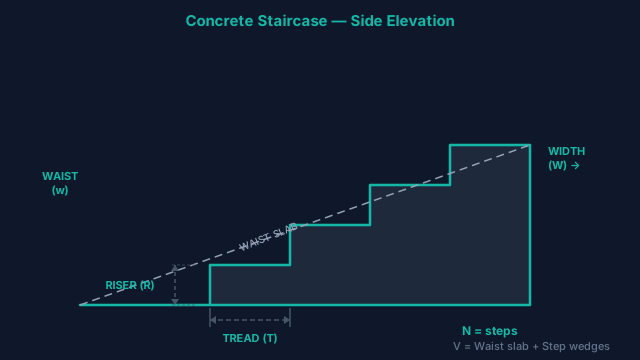
- 1) Waist-Slab StairsSloped length: Ls = √(Total Run² + Total Rise²)
Waist volume = Waist Thickness × Stair Width × Ls
Step wedges = ½ × Steps × Tread × Riser × Stair Width
Models the inclined structural slab and step prisms separately — the correct approach for all reinforced concrete waist-slab stairs. Waist slab runs along the slope; wedges form the tread-riser profile above it. - 2) Solid (Mass) StairsSteps volume = Steps × Tread × Riser × Stair Width
Treats the flight as stacked rectangular prisms — conservative by design. Use when there is no distinct waist slab or when specifications call for a solid mass pour. The solid estimate typically runs 10–20% higher than the waist-slab estimate for identical dimensions. - 3) Landing VolumesLanding volume = Length × Width × Thickness (each landing calculated separately)
Rectangular prisms added to the flight subtotal. Top and bottom landings are independent — include only the ones present in your design. - 4) Concrete WeightApprox. weight = Volume (m³) × 2,400 kg/m³
Normal-weight concrete per ACI 318-19. Structural lightweight mixes (1,840–1,920 kg/m³) reduce the weight estimate by 20–25 %; use the closest density if your specification differs.
Standard Staircase Dimensions — IRC Code Reference
Getting riser and tread sizes right before forming concrete stairs is critical — unlike timber stairs, they cannot be adjusted after the pour sets. The limits below follow the U.S. International Residential Code (IRC R311.7); always confirm against your local authority having jurisdiction (AHJ) before pouring.
| Dimension | IRC R311.7 Limit | Comfortable Range |
|---|---|---|
| Riser height | ≤ 7¾ in (197 mm) | 6½–7 in (165–178 mm) |
| Tread depth (nosing-to-nosing) | ≥ 10 in (254 mm) | 10–11 in (254–279 mm) |
| Stair width (clear) | ≥ 36 in (914 mm) | 36–44 in (914–1,118 mm) |
| Vertical headroom | ≥ 6 ft 8 in (2,032 mm) | ≥ 6 ft 8 in |
| Riser uniformity (max variation) | ≤ ⅜ in (9.5 mm) | ≤ ¼ in (6.4 mm) |
| Waist slab thickness | Per structural design | 5–7 in (125–175 mm) |
Comfort formulas: the “7-11 rule” pairs a 7 in riser with an 11 in tread; the ergonomic stride formula is 2 × Riser + Tread ≈ 24–25 in — at 7 in and 11 in this equals 25 in, right in the comfort zone. IRC requires every riser and tread in a flight to remain within ⅜ in of each other for safety and uniformity.
Ordering Mistakes That Leave a Staircase Pour Short
- Using the horizontal span instead of the sloped waist length.
Plugging the total horizontal run into a flat-slab formula ignores that the waist slab follows the hypotenuse of the flight. For a 7-ft rise and 11-ft run the hypotenuse is 13.04 ft — using 11 ft underestimates waist volume by about 18%, which on a typical residential flight translates to roughly 0.25–0.35 yd³ short at the pour.
- Omitting landing volumes.
A standard 4 ft × 4 ft × 4 in landing adds roughly 0.20 yd³. Flights with both a bottom and a top landing can leave you 0.40–0.50 yd³ short — enough to stall the pour mid-flight waiting for a same-day surcharge delivery that may not arrive in time.
- Measuring tread depth from riser face to riser face instead of nosing-to-nosing.
IRC R311.7 requires tread depth measured from nosing projection to nosing projection. A 1-inch nosing on a 10-inch clear tread means the correct input is 11 in. Entering 10 in instead understates step-wedge volume across all 12 steps by roughly 9% of the wedge subtotal — a small error per step that compounds quickly.
- Ordering without a waste factor.
Stair formwork is tighter and the pour angle steeper than a flat slab, leading to more pump-line waste, inclined-surface spillage, and bleed water loss. The 5% margin adequate for a driveway is the bare minimum for stairs; complex or pump pours warrant 7–10%. Running short mid-flight — with the truck gone and the mix starting to set — is one of the most costly pours mistakes in residential concrete work.
Pairing the Staircase Calculator with Other Tools
Use the staircase concrete calculator when your project is a cast-in-place concrete flight of stairs — with or without landings — and you need to separate the inclined waist-slab volume from the step-wedge volume. For flat slab sections such as a landing slab poured independently of the flight, the slab concrete calculator handles rectangular flat-pour volumes more directly. If your stair flight is supported by a hidden load-bearing beam or stringer, pair this tool with the beam concrete calculator to estimate that structural element separately. For a rough project-level concrete scope across slabs, walls, footings, and stairs combined, start with the concrete yards calculator. If the stair pour is small enough for on-site bag mixing rather than a ready-mix truck, the concrete bag calculator tells you how many 60 lb or 80 lb bags to buy. For retaining walls or perimeter walls adjacent to a flight, see the wall concrete calculator.
Specs & References
Governs the structural concrete elements of a staircase — including the waist slab (designed as a one-way slab spanning between landing beams), minimum compressive strength, concrete cover for waist-slab reinforcement, and the normal-weight concrete density of 2,400 kg/m³ used in this calculator’s weight estimate.
Defines the geometry that drives every staircase concrete estimate: maximum 7¾ in riser, minimum 10 in tread (nosing-to-nosing), minimum 36 in clear width, ⅜ in riser uniformity, and minimum 6 ft 8 in headroom. The reference table above is derived directly from these limits.
Applies to staircase landing slabs — horizontal flatwork elements poured with or adjacent to the flight. Covers finishing, curing, joint placement, and surface tolerance (F-number) requirements when the landing must achieve a smooth, safe, and level walking surface.
Staircase concrete volumes must account for waist slab slope along the hypotenuse, triangular step-wedge prisms, nosing projections in tread depth, and landing slab thicknesses. Structural adequacy under concentrated stair loads — point loads at landings and distributed load on the inclined waist slab — must be verified by a licensed structural engineer before forming and pouring.
Ordering & Volume Questions
What is a staircase concrete calculator?
A staircase concrete calculator estimates the volume of concrete needed to pour a flight of stairs, including the inclined waist slab, triangular step wedges, and optional top and bottom landings. It takes dimensional inputs — riser height, tread depth (nosing-to-nosing), stair width, waist slab thickness, and number of steps — and returns volume in m³, ft³, yd³, and liters so you can order ready-mix or bags with precision. Without a purpose-built stair tool, estimators often over-order by 20–30% using a flat-slab formula on the footprint, or short-order by forgetting the inclined hypotenuse length and landing volumes.
What's the difference between the waist-slab and solid stair calculation methods?
A waist-slab staircase has a structural inclined slab (the "waist") as its backbone, with triangular step wedges on top forming the treads and risers. Volume runs along the true sloped length (the hypotenuse), and each wedge is a triangular prism (½ × tread × riser × width). A solid (mass) staircase is modeled as stacked rectangular steps, summing full tread × riser × width for every step. Waist-slab is the standard reinforced concrete method; solid suits pre-cast stacks or masonry-backed stairs. For the same dimensions, solid typically estimates 10–20% more concrete than waist-slab because it double-counts the space between the slope and the step profile.
How do you manually calculate concrete volume for a staircase?
For a waist-slab flight: (1) Total run = Steps × Tread; (2) Total rise = Steps × Riser; (3) Sloped length Ls = √(run² + rise²); (4) Waist volume = Thickness × Width × Ls; (5) Wedge volume = ½ × Steps × Tread × Riser × Width; (6) add landing volumes (L × W × T each). Sum all components and divide by 27 to convert ft³ to yd³. Example: 12 steps at 7 in riser / 11 in tread / 4 ft wide / 6 in waist with a 4×4×4 in top landing = 44.24 ft³ ÷ 27 = 1.64 yd³ before waste.
What dimensions do I need to use this staircase concrete calculator?
You need: (1) number of steps, (2) tread depth measured nosing-to-nosing, (3) riser height, (4) stair width — the clear inside dimension between walls or stringers, and (5) waist slab thickness for waist-slab mode, taken from your structural drawings. If landings are present, also provide each landing's length, width, and thickness. All dimensions can be entered in m, cm, mm, ft, or in — choose one unit and stay consistent throughout.
Can I include both a top and bottom landing in the calculation?
Yes. The calculator has independent toggles for a bottom landing and a top landing. Enable the ones present in your design and provide length, width, and thickness for each. Both are treated as rectangular prisms and added to the flight volume. The component breakdown shows their individual contributions alongside the waist slab and wedges, so you can verify each against your drawings — useful when the top and bottom landings differ in size or thickness.
How thick should a concrete staircase waist slab be?
For typical residential flights spanning 10–15 ft between landings, waist slabs are commonly 5–7 in (125–175 mm) thick, designed to span as a one-way slab carrying the combined dead load of slab, wedges, finish, and handrail, plus a live load of 40–100 psf. The exact thickness is determined by your structural engineer from clear span, live load class, and reinforcement layout. Enter that specified value in the calculator — never reduce the waist thickness without written engineering approval, as doing so understates both volume and structural capacity.
What are the IRC code requirements for stair risers, treads, and width?
Under IRC R311.7 for residential construction: maximum riser height = 7¾ in (197 mm); minimum tread depth = 10 in (254 mm) measured nosing-to-nosing; minimum stair width = 36 in (914 mm) clear; minimum headroom = 6 ft 8 in (2,032 mm); and riser uniformity limit = ⅜ in (9.5 mm) maximum difference between the tallest and shortest riser in any flight. These limits define the geometry inputs that drive your concrete volume estimate — non-compliant geometry produces an inaccurate and code-violating stair regardless of how carefully you estimate material.
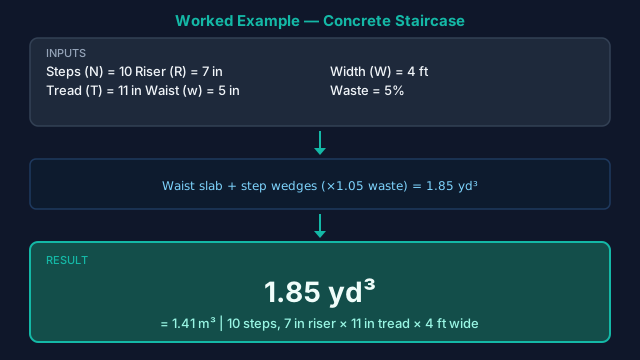
How much concrete does a typical 10-step residential staircase require?
A single residential flight of 10 steps at 7 in riser / 11 in tread / 36 in (3 ft) wide with a 6 in waist slab totals roughly 0.9–1.2 yd³ without landings. Adding a standard 3×3 ft top landing pushes it to about 1.1–1.4 yd³. Wider stairs (4 ft) or thicker waist slabs (7 in) push the range to 1.4–1.8 yd³. Always calculate with your actual dimensions — stair geometry varies enough that the average figure is unreliable for ordering.
What is the 7-11 rule and how does it affect staircase design?
The "7-11 rule" pairs a 7-inch riser with an 11-inch tread to produce a comfortable walking pitch for most adults. The ergonomic stride formula is 2 × Riser + Tread ≈ 24–25 inches; at 7 in and 11 in this gives 2×7+11 = 25 in, right in the comfort zone. IRC prohibits risers above 7¾ in or treads below 10 in. Because concrete stairs are permanent after the pour, confirming your riser-tread pair before calculating volume is critical — there is no shimming or adjusting a concrete stair after it sets.
Why do waist-slab and solid stair calculations give different results for the same stair?
The solid method sums every step as a full rectangular prism (tread × riser × width), which over-counts the concrete beneath the inclined waist plane. The waist-slab method separates the inclined slab (running along the hypotenuse) from the triangular step wedges above it, avoiding double-counting the space they share. For a typical 12-step residential flight, the solid estimate often runs 15–20% higher than the waist-slab estimate. If your design genuinely is a solid mass stair with no separate structural waist, use solid; otherwise use waist-slab to avoid over-ordering.
Should I add a waste factor when ordering staircase concrete?
Yes, always — and more than you would for a flat slab. Stair pours involve tight formwork, difficult pump angles, concrete segregation risk on the inclined surface, and higher spillage than standard flatwork. A 5% waste factor is the minimum for straightforward pours; complex multi-flight stairs, pump pours, or stairs in confined spaces warrant 7–10%. The calculator's +5% and +10% helpers show your adjusted yd³ so you can round to the nearest quarter-yard increment the plant offers.
Does the calculator account for nosing projections on the tread?
The calculator uses the tread depth you enter, which should be measured nosing-to-nosing as required by IRC R311.7. If your treads have a ¾–1½ in nosing projection beyond the riser face below, that projection is already captured in the nosing-to-nosing dimension. A 1 in nosing on a 10 in clear tread means your input should be 11 in, not 10 in. Entering the clear tread depth instead of the nosing-to-nosing distance will understate step-wedge volume across all steps and result in a short order.
What concrete mix strength should I specify for an exterior staircase?
For exterior concrete stairs exposed to freeze-thaw cycles, ACI 318-19 Table 19.3.3 specifies a minimum compressive strength of 4,500 psi (31 MPa) with 4–7% air entrainment for moderate to severe exposure (F1/F2). Interior protected stairs can use 3,000–4,000 psi (21–28 MPa). Always obtain the mix design from your structural engineer or conform to the project's concrete specification — do not downgrade for cost on a structural element that carries public foot traffic.
Is the staircase concrete calculator free to use?
Yes, completely free — no account, download, sign-up, or payment required. The tool runs in your browser on any device, desktop or mobile. You can calculate as many stair configurations as needed, save or print results for project records, and bookmark the page for quick access on future projects.
Can I print or save my staircase concrete estimate?
Yes. Click Print / Save on the results panel to open a formatted print view that includes all inputs, the full component breakdown (waist slab, step wedges, bottom landing, top landing), and totals in yd³. In the browser's print dialog, select Save as PDF to archive a digital copy. The branded PDF is suitable for attaching to a ready-mix supplier ticket, project specification file, or structural engineer's review package.
Related Calculators
Concrete Bag Calculator by Project
Turn slab, footing, post hole and sonotube dimensions into an exact bag count — five shape modes, imperial or metric, with +5%/+10% waste buffers.
Concrete Steps Calculator (DIY Porch & Entry)
Estimate concrete volume and 40/50/60/80 lb bag counts for DIY porch and entry steps — riser, tread, width, and step count inputs with IRC R311.7 compliance check.
Slab Concrete Calculator
Estimate concrete for slabs, patios, and floors.
Footing Concrete Calculator
Continuous, isolated, and combined footings.
Concrete Yards Calculator
Convert and compute volume into cubic yards.
Wall Concrete Calculator
Vertical concrete wall volumes, single or multi-segment.