Sizing Concrete for DIY Porch and Entry Steps
Pouring your own concrete steps is one of the most satisfying DIY improvements you can make — a solid entry adds curb appeal, eliminates trip hazards, and lasts for decades. Getting the concrete quantity right before you order materials saves a mid-pour scramble and avoids costly leftover. This calculator handles the geometry for you: enter riser height, tread depth, stair width, and the number of steps, and it returns concrete volume in cubic feet, cubic yards, and cubic meters, plus pre-mix bag counts for 40, 50, 60, and 80 lb bags. The underlying volume math is the same one in our guide on how to calculate concrete for a slab; to buy by the sack, see how many bags of concrete you need; and for crack-resistant steps, our guide on how to reinforce a concrete slab.
The calculation uses the solid-step method — it treats each step as a rectangular solid (riser × tread × width) and multiplies by the step count, then checks your riser and tread live against IRC R311.7's limits and reports weight, useful when steps sit on a deck frame. This approach is ideal for small DIY pours of 2–5 steps where you form each step independently with lumber or metal forms. It intentionally differs from the structural waist-slab method used for engineered multi-flight staircases — for those projects, use the Staircase Concrete Calculator and read our pillar guide on staircase concrete basics.
Worked Example: 4 Entry Steps From a 24-Inch Rise
Start from your total rise, not a riser height you like. A 24-inch total rise split across 3 steps gives 24 ÷ 3 = 8 in per riser — over the IRC's 7¾ in max. Split it across 4 steps instead: 24 ÷ 4 = 6 in per riser, comfortably within code and close to the 7-11 comfort rule. At 6 in riser × 11 in tread × 36 in width × 4 steps, net volume is 0.5 ft × 0.917 ft × 3 ft × 4 = 5.50 ft³. Add 10% waste: 5.50 × 1.10 = 6.05 ft³ (0.22 yd³) — roughly 14 bags of 60 lb mix (6.05 ÷ 0.45), or 11 bags of 80 lb mix (6.05 ÷ 0.60). At well under 0.5 yd³, this pour is squarely in bag territory rather than ready-mix delivery. The finished steps weigh 6.05 ft³ × 150 lb/ft³ ≈ 908 lb.
A pitfall specific to free-standing steps: unlike a slab, entry steps are often poured tight against the house but not structurally tied to its foundation. In freeze-thaw climates, the steps and the foundation can heave at different rates, opening a gap — or a trip lip — right at the threshold where the top step meets the door sill. A footing below the frost line under the steps, not just under the house, is what keeps the two moving together.
Entering Your Step Dimensions
- 1Enter the number of steps, riser height, tread depth, and stair width — inches or feet, whichever matches your plans.
- 2Watch for the IRC R311.7 warning if riser exceeds 7¾" or tread falls below 10", and adjust the waste allowance in Advanced mode if your forms are complex.
- 3Press Calculate for cubic yards, bag counts, and weight.
The Solid-Step Volume Formula
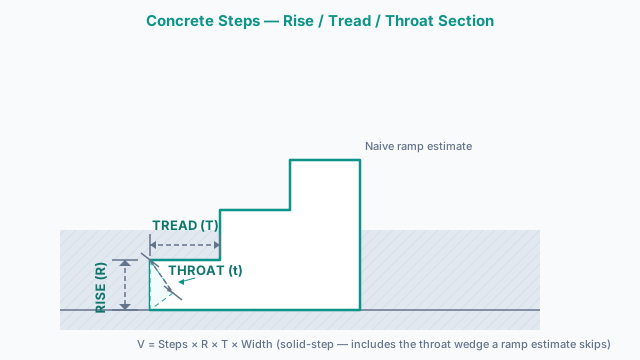
- 1) Step volume (solid method)Step volume = Number of steps × Riser height × Tread depth × Stair width
All dimensions are converted to feet before multiplication. Result in cubic feet. - 2) Unit conversionsCubic yards = cubic feet ÷ 27 | Cubic meters = cubic feet × 0.0283168
Ready-mix suppliers quote in cubic yards; metric output is provided for reference. - 3) Waste-adjusted volumeAdjusted volume = Net volume × (1 + Waste% ÷ 100)
Bag counts are calculated on the waste-adjusted volume; ordering on net volume risks running short. - 4) Pre-mix bag countsBags = ⌈Adjusted ft³ ÷ Yield per bag⌉ (ceiling function — always round up)
Yields: 40 lb → 0.30 ft³ | 50 lb → 0.375 ft³ | 60 lb → 0.45 ft³ | 80 lb → 0.60 ft³ (per CONCRETE_BAG_COVERAGE, derived from manufacturer data). - 5) WeightWeight (lb) = Adjusted ft³ × 150 pcf (normal-weight concrete density per ASTM C138)
Also reported in kg and short tons. Normal-weight concrete is 145–155 pcf; 150 pcf is the standard design value per ACI 318-19.
Typical DIY Step Sizes and Volumes at a Glance
| Steps | Riser (in) | Tread (in) | Width (in) | Net (ft³) | +10% (yd³) |
|---|---|---|---|---|---|
| 2 | 7.5" | 11" | 36" | 3.44 | 0.14 |
| 3 | 7.5" | 11" | 36" | 5.16 | 0.21 |
| 3 | 7.5" | 11" | 48" | 6.88 | 0.28 |
| 4 | 7" | 12" | 48" | 9.33 | 0.38 |
| 4 | 7.5" | 11" | 48" | 9.17 | 0.37 |
| 5 | 7" | 12" | 36" | 8.75 | 0.36 |
| 5 | 7.5" | 11" | 48" | 11.46 | 0.47 |
Volumes computed using the solid-step method. Add 10% waste before ordering. Small pours under 0.5 yd³ are almost always more economical with pre-mix bags than a ready-mix truck.
Why DIY Step Pours Come Up Short — or Off Code
- Picking a riser height before checking total rise. A riser you like on paper can push you over the IRC's 7¾″ max once you divide the real total rise by your chosen step count. Always divide total rise by step count first, then verify the result against code — not the other way around.
- Skipping the waste factor. 10% is the standard allowance for small DIY pours — it covers minor spillage, form leakage at joints, and concrete left in the mixer drum or wheelbarrow. Order on net volume alone and you will almost certainly run short at the last step.
- Not tying the steps to a frost-depth footing. Steps poured tight against the house but resting on their own shallow base can heave independently of the foundation in freeze-thaw climates, opening a gap or trip lip at the door sill. A footing below the local frost line under the steps keeps the two moving together.
- Using the solid-step method for a full multi-flight staircase. Solid-step is right for 2–5 DIY entry steps, but it over- or under-estimates volume on engineered multi-flight stairs with landings — switch to the Staircase Concrete Calculator for those.
Pairing the Steps Calculator with Other Tools
This calculator uses the simple solid-step method for 2–5 DIY porch steps. For structural multi-flight staircases with landings, waist-slab geometry, or engineered drawings, use the Staircase Concrete Calculator instead. If the steps rest on a separate concrete landing pad, estimate that pad separately with the slab concrete calculator or the concrete pad calculator. Steps in cold climates require a footing below the frost line — calculate that pour with the footing concrete calculator. For the bag count before your home-center order, the concrete bag calculator translates cubic footage to 40/60/80 lb bag quantities.
Mix & Placement Standards
International Residential Code — Stairways (R311.7)
Sets the residential maximum riser height of 7¾ in (197 mm) and minimum tread depth of 10 in (254 mm). This calculator warns live when either limit is violated to help you catch code issues before forming.
ACI 318-19 — Building Code Requirements for Structural Concrete
The standard density value of 150 pcf (2,400 kg/m³) for normal-weight concrete used in this calculator's weight output is consistent with ACI 318-19 design practice.
ASTM C138 — Standard Test Method for Density (Unit Weight) of Concrete
Governs how concrete density is measured in the field. The 150 pcf design value used here is the industry-standard nominal density per ASTM C138 for normal-weight aggregate concrete.
ACI 305R — Guide to Hot Weather Concreting
Recommended when pouring steps in warm weather: keep concrete temperature below 95°F (35°C), dampen forms before pouring, and cure with wet burlap or curing compound to prevent surface cracking.
Stair geometry must comply with IBC/IRC rise-run limits (7 in. max rise, 11 in. min tread) and footings must extend below the local frost line; verify dimensions and permit requirements with your local building department before forming.
DIY Steps — Questions Before You Order
What is a concrete steps calculator?
A concrete steps calculator is an online tool that computes the volume of concrete needed to pour a set of steps. You enter the number of steps, riser height, tread depth, and stair width — the calculator multiplies those dimensions using the solid-step formula and returns the total volume in cubic feet, cubic yards, and cubic meters, plus pre-mix bag counts. This one is purpose-built for small DIY porch and entry steps (2–5 steps), not large structural flights.
How does the calculator work?
It applies the solid-step formula: Volume = Number of steps × Riser height × Tread depth × Stair width. All dimensions are converted to feet internally, giving a result in cubic feet. That is then divided by 27 to get cubic yards (the ordering unit for ready-mix) and multiplied by 0.0283 for cubic meters. Bag counts are calculated by dividing the waste-adjusted volume by each bag's published yield (e.g., 0.45 ft³ for a 60 lb bag) and rounding up.
What is the difference between this calculator and the Staircase Concrete Calculator?
This calculator uses the simple solid-step method intended for small DIY pours of 2–5 porch or entry steps — rectangular form geometry, no landings, no structural waist slab. The Staircase Concrete Calculator handles structural staircase design: it supports waist-slab and solid-stair methods, landings, wedge volumes, and full multi-flight geometry. If you're pouring a front stoop, use this one. If you're detailing an interior flight with landings or an engineer's drawing, use the Staircase Concrete Calculator.
How many bags of concrete do I need for 3 steps?
It depends on your dimensions. For typical front entry steps — 3 risers at 7.5 in, 11 in treads, 36 in wide — the net volume is about 5.16 ft³, or 5.7 ft³ with 10% waste. That works out to roughly 13 bags of 40 lb (0.30 ft³ each), 16 bags of 50 lb, or 10 bags of 60 lb. Enter your exact dimensions in the calculator above for an accurate count.
Should I use bags or order ready-mix?
For pours under about 0.5 cubic yards (≈ 13.5 ft³), pre-mix bags are almost always more economical because ready-mix trucks have a minimum delivery charge (typically $150–$250 on top of the concrete price). A 3-step front stoop with a 36 in width will usually come in well under 0.25 yd³ — firmly in bag territory. For pours over 1 yd³, or if you have a large porch, it's worth calling your local batch plant for a quote.
What riser height and tread depth should I use?
IRC R311.7 sets the U.S. residential limits: maximum riser height of 7¾ in (197 mm) and minimum tread depth of 10 in (254 mm). The classic '7-11 rule' — a 7 in riser with an 11 in tread — satisfies the formula 2R + T = 25 in (comfortable stride range is 24–25 in) and is comfortable for most adults. Keep all risers within ⅜ in of each other; uneven risers are the leading cause of stair trips.
How much waste should I add?
10% is the standard allowance for small DIY pours: it covers minor spillage during mixing and pouring, form leakage at joints, and the concrete that stays in the mixer drum or wheelbarrow. If your forms are complex (curved edges, unusual angles) or you're mixing by hand in small batches, consider 12–15%. Never order on the net volume alone — you will almost certainly run short at the last step.
Can I pour concrete steps in cold weather?
Yes, but with precautions. Fresh concrete must stay above 50°F (10°C) to cure properly; below 40°F (4°C), hydration essentially stops. In cold weather: use hot mix water, cover poured steps with insulating blankets, and avoid pouring when air temperatures are forecast to drop below 40°F within 24 hours. ACI 306R (Cold Weather Concreting) is the definitive guide for temperatures below 50°F.
What mix should I use for outdoor steps?
For exterior steps exposed to freeze-thaw cycles, specify a minimum 4,000 psi (28 MPa) mix with air entrainment (5–7% air for severe exposure). Pre-bag mixes labeled 'High Strength' or '5000 psi' are good choices. Standard 3,000 psi bags work for interior or mild-climate applications. Check the bag label for the design strength and air entrainment status.
Do I need a permit for concrete steps?
It depends on your municipality and the scale of the work. Many jurisdictions permit small stoops (under 30 in above grade) without a formal permit; taller or load-bearing structures typically require one. Always check with your local building department before pouring — permits exist to ensure the work is safe and won't affect your homeowner's insurance.
Why does the calculator use the solid-step method instead of the waist-slab method?
The solid-step method (volume = steps × riser × tread × width) directly models how most DIY steps are formed and poured: each tread and riser is a separate form fill. The waist-slab method models a structural inclined slab with triangular step wedges on top — it's the correct engineering approach for cast-in-place stairs with rebar, but it underestimates volume for the fully-solid poured-in-place steps typical of front stoops. For 2–5 DIY steps, the solid-step result is both simpler to verify and more conservative (slightly higher volume), which is safer when ordering materials.
Is the calculator free?
Yes, completely free. No account is needed and all calculations happen in your browser. You can use it as many times as you like and print or save results at no cost.
Can I print or save my estimate?
Yes. After calculating, click the green Print / Save button in the results panel. This opens a clean print-ready page with your inputs and all results. In your browser's print dialog, select 'Save as PDF' to keep a digital copy for your material order or permit package.
How do I account for a footing under the steps?
This calculator covers the stair volume only. If local code requires a footing under the steps (common in frost-affected climates), calculate that separately using the Footing Concrete Calculator. A typical rule of thumb is a 12 in wide × 8 in deep footing extending 6 in beyond the bottom step on each side, but your building department will give the exact requirement for your frost depth.
What if my steps are not all the same size?
This calculator assumes uniform risers, treads, and width across all steps — the standard for code-compliant DIY stairs. If your steps genuinely vary (e.g., a landing splits two flights, or riser heights differ), calculate each uniform segment separately and add the volumes. Alternatively, use the Staircase Concrete Calculator which supports more complex multi-segment geometry.
Related Calculators
Concrete Bag Calculator by Project
Turn slab, footing, post hole and sonotube dimensions into an exact bag count — five shape modes, imperial or metric, with +5%/+10% waste buffers.
Staircase Concrete Calculator
Flights, landings, risers, and treads volume.
Slab Concrete Calculator
Estimate concrete for slabs, patios, and floors.
Concrete Pad Calculator (AC, Shed, Hot Tub, Generator)
Estimate concrete volume, bag counts, and cost for small equipment pads — AC unit, shed, hot tub, and generator presets included.
Footing Concrete Calculator
Continuous, isolated, and combined footings.