Sizing a Patio Pour by Shape
The Concrete Patio Calculator takes the guesswork out of one of the most popular backyard projects. Whether you're pouring a simple square slab for a bistro table or a sweeping 20×30 ft entertaining space, accurate concrete estimation prevents the frustration of short-ordering mid-pour or overpaying for material that never gets used. Under-ordering by even half a yard can halt a project and leave cold joints; over-ordering wastes hundreds of dollars in ready-mix. This tool gives you the numbers you need in seconds. A patio is a slab on ground, so the method follows our pillar guide on how to calculate concrete for a slab.
The calculator accepts both rectangular and circular patio shapes and applies the right volume formula automatically when you switch between them. Enter your dimensions in feet and your slab thickness in inches, and it outputs concrete volume in cubic yards, cubic feet, and cubic meters; pre-mixed bag counts for 40-lb, 60-lb, and 80-lb bags; estimated slab weight in pounds and tons; and — in Advanced mode — a full cost breakdown including ready-mix, labor, and finishing. An ACI 318-19 §7.3 compliance check flags any thickness below 4 inches before you order. Before you pour, it helps to read how much a concrete slab costs, check how many concrete bags a slab needs if you're mixing on site, and review how to reinforce a concrete slab for crack control.
Worked Example: a 12×16 ft Rectangular Patio
A 12 ft × 16 ft rectangular patio poured 4 inches thick is one of the most common backyard sizes. Convert thickness to feet: 4″ ÷ 12 = 0.333 ft. Volume: 12 × 16 × 0.333 = 64.0 ft³, or 64.0 ÷ 27 = 2.37 yd³. Add 10% waste for subgrade irregularities and spillage: 2.37 × 1.10 = 2.61 yd³ — round up to 2.75 yd³ on the ready-mix ticket, since most plants sell in quarter-yard increments and won't split a smaller load. That same 64 ft³ works out to roughly 107 bags of 60 lb pre-mix or 80 bags of 80 lb — at this volume, ready-mix delivery is almost always cheaper than a hundred-plus bags of hand-mixed concrete. The slab weighs 64 ft³ × 150 lb/ft³ ≈ 9,600 lbs (4.8 tons).
A circular patio uses a different formula. A 14 ft diameter circular patio at the same 4-inch thickness: π × (14 ÷ 2)² × 0.333 = π × 49 × 0.333 ≈ 51.3 ft³, or 1.90 yd³. Add 10% waste and you're ordering 2.09 yd³ — round up to 2.25 yd³ on the ticket. The calculator switches between the rectangular and circular formulas automatically when you change shape, so you never have to do the π conversion by hand.
How to Use the Concrete Patio Calculator
- 1Choose Rectangular or Circular, then enter length and width (or diameter) in feet and slab thickness in inches.
- 2Set a waste factor — 10% for most patios, 15% for curved or uneven-subbase sites — and switch to Advanced mode for a cost breakdown.
- 3Press Calculate for cubic yards, bag counts, slab weight, and (in Advanced mode) total project cost.
The Rectangular and Circular Patio Volume Formulas
- 1) Rectangular Patio VolumeVolume (ft³) = Length (ft) × Width (ft) × Thickness (ft)
Thickness is entered in inches and converted to feet by dividing by 12. A 12 × 16 ft patio at 4 in: 12 × 16 × 0.333 = 64.0 ft³ = 2.37 yd³. - 2) Circular Patio VolumeVolume (ft³) = π × (Diameter / 2)² × Thickness (ft)
A 16 ft diameter circular patio at 4 in: π × 8² × 0.333 = 66.99 ft³ ≈ 2.48 yd³. - 3) Cubic Yards ConversionCubic Yards = Cubic Feet ÷ 27
There are 27 cubic feet in one cubic yard. Ready-mix concrete is ordered and priced by the cubic yard in the United States. - 4) Waste FactorTotal Volume = Base Volume × (1 + Waste% ÷ 100)
At 10% waste: 2.37 yd³ × 1.10 = 2.61 yd³ to order. Industry standard for flat slabs is 5–10%; use 15% for irregular shapes. - 5) Bag CountBags = ⌈Total ft³ ÷ Yield per bag⌉ (always rounded up)
Yields: 40-lb = 0.30 ft³, 60-lb = 0.45 ft³, 80-lb = 0.60 ft³. For 70.4 ft³: 80-lb bags = ⌈70.4 ÷ 0.60⌉ = 118 bags. - 6) Slab WeightWeight (lb) = Total Volume (ft³) × 150 lb/ft³
Normal-weight concrete density is 150 lb/ft³ (ACI 318). A 70 ft³ slab weighs approximately 10,500 lbs (5.25 US tons). - 7) Total Project Cost (Advanced)Total Cost = (Volume in yd³ × Price/yd³) + (Area in ft² × Labor/ft²) + (Area in ft² × Finishing/ft²)
Material, labor, and finishing are calculated independently so you can adjust any component without affecting the others.
A patio slab doesn't need footings below the frost line — it floats on a compacted subbase — but that doesn't make frost irrelevant. Without adequate base compaction and drainage, seasonal frost heave can still lift and crack an unreinforced slab unevenly, the same way it would a sidewalk. A 4–6 inch compacted gravel base with positive drainage away from the slab does more to prevent this than adding thickness alone.
Concrete Patio Thickness at a Glance
Slab thickness is the single most influential dimension for both structural performance and material cost. Doubling thickness from 4 to 8 inches doubles your concrete order and roughly doubles cost. Use this guide to select the right thickness for your patio use case.
| Thickness | Use Case | Standard / Notes |
|---|---|---|
| 3 inches | Decorative overlays / thin-set repairs | Not a structural slab. ACI 318 minimum not met. |
| 4 inches | Residential patio, walkway, garden path | ACI 318-19 §7.3 minimum for residential exposed slabs. |
| 5 inches | Heavy-use patio, BBQ/outdoor kitchen slab | Recommended when heavy furniture or hot tubs are placed on the slab. |
| 6 inches | Adjacent to driveway, light vehicle access | Suitable for occasional vehicle access or heavy loading. |
| 8 inches | Commercial patio, regular vehicle traffic | Typically requires rebar reinforcement per ACI 318. |
In freeze-thaw climates, specify air-entrained concrete with 5–7% air content regardless of thickness. This dramatically improves resistance to surface scaling caused by deicing salts.
Why Patio Pours Come Up Short
- Applying the rectangular formula to a circular patio. π × r² gives a smaller number than L × W for the same footprint — using the wrong formula either over- or under-orders. Switch shape mode in the calculator rather than approximating a circle as a square.
- Skipping the waste factor. The industry standard for flat rectangular slabs is 5–10%; skip it and you're ordering the bare theoretical minimum with zero margin for subgrade dips or spillage.
- Pouring below the 4-inch ACI minimum. ACI 318-19 §7.3 sets 4 inches as the residential minimum for exposed slabs-on-ground. Going thinner to save on concrete increases cracking risk under furniture point loads and freeze-thaw cycling.
- Skipping the compacted gravel base. A patio floats on subbase rather than a footing, so a well-compacted 4–6 inch gravel base with positive drainage matters more here than on a footed structure — thickness alone won't compensate for a soft or wet subgrade.
Pairing the Patio Calculator with Other Tools
The Concrete Patio Calculator handles standard rectangular and circular outdoor slabs. When your patio connects to a structure requiring a thickened perimeter edge, the monolithic slab calculator handles the combined pour. For a contractor-grade cost breakdown — concrete material, delivery fees, pump truck, finishing labor — the concrete slab cost calculator provides the full itemized budget. The broader slab concrete calculator covers slabs with sub-base options and reinforcement guidance. Small equipment pads (AC unit, hot tub, generator) have their own preset tool: the concrete pad calculator. To confirm your bag count before calling the home center, use the concrete bag calculator.
Where These Figures Come From
The ACI guide for concrete slab construction including residential patios — covering subbase preparation, 4-inch minimum thickness recommendations, concrete strength selection (2,500–4,000 PSI), and curing methods.
Section 7.3 establishes minimum thickness requirements for slabs-on-ground. The ACI 318-19 §7.3 compliance warning in this calculator fires when patio thickness falls below the 4-inch residential minimum.
Governs ready-mix truck delivery for patio pours — the preferred method for any project over 1.5–2 cubic yards. Specifies maximum delivery time, slump limits, and acceptance criteria at the point of discharge.
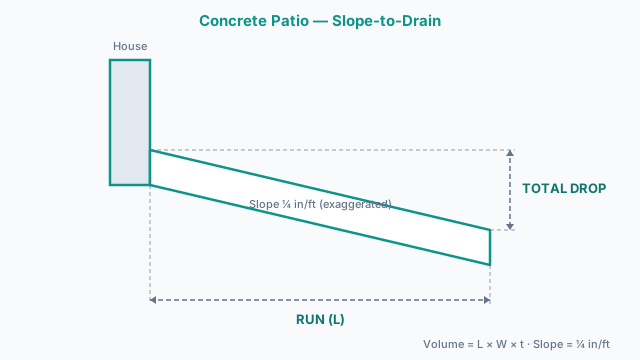
Patio slabs require control joints at maximum 8–10 ft intervals to manage shrinkage cracking; slope drainage at 1/8 in./ft minimum and consult a licensed contractor for sub-base depth in expansive or clay-rich soils.
Common Concrete Patio Ordering Questions
What is a concrete patio calculator?
A concrete patio calculator estimates the volume of concrete needed to pour a patio slab given its length, width, and thickness. It converts that volume to cubic yards (for ready-mix ordering), cubic feet, bag counts for pre-mixed concrete, and estimated slab weight. Our calculator also includes a cost estimator and ACI compliance check.
How much concrete do I need for a 10×10 patio?
A 10×10 ft patio at 4 inches thick requires approximately 1.23 cubic yards including a 10% waste allowance. At 6 inches thick, that increases to 1.85 cubic yards. At 4 inches, you would need approximately 56 bags of 80-lb pre-mixed concrete, or about 75 bags of 60-lb.
How much concrete do I need for a 12×16 patio?
A 12×16 ft patio at standard 4-inch thickness requires approximately 2.37 cubic yards of concrete including 10% waste. At 6 inches thick, the estimate rises to 3.56 cubic yards. This is large enough that ready-mix delivery is typically more economical than pre-bagged concrete.
How much concrete do I need for a 16×20 patio?
A 16×20 ft patio at 4 inches thick requires approximately 3.95 cubic yards with 10% waste. At 6 inches thick, it requires roughly 5.93 cubic yards. A project of this scale strongly benefits from ready-mix truck delivery, as hand-mixing that many bags is impractical.
How thick should a concrete patio be?
ACI 318-19 §7.3 recommends a minimum of 4 inches for residential exposed slabs. Most contractors pour to 4 inches for standard patios. Use 5–6 inches if heavy outdoor furniture, a hot tub, or occasional vehicle access is planned. Always reinforce with rebar or wire mesh for 6-inch or thicker slabs.
Should I use ready-mix concrete or bags for a patio?
For patios over 1.5–2 cubic yards, ready-mix truck delivery is almost always more economical and produces a superior, more consistent mix. Hand-mixing 80-lb bags for a medium patio means opening and mixing 100+ bags — a full day's labor. Bags are appropriate for small patch jobs or patios under roughly 50 square feet at 4 inches.
What PSI concrete should I use for a patio?
2,500–3,000 PSI is the standard specification for residential patios in temperate climates. In freeze-thaw climates, specify 3,500–4,000 PSI with 5–7% air entrainment to resist surface scaling. Commercial or load-bearing patios should use 4,000 PSI or higher as directed by a structural engineer.
How do I calculate concrete for a circular patio?
Use the formula: Volume (ft³) = π × (diameter ÷ 2)² × thickness in feet. For a 16 ft diameter circular patio at 4 inches thick: π × 8² × 0.333 = 66.99 ft³ ÷ 27 = 2.48 yd³. Our calculator handles this automatically when you select the Circular / Round shape option.
What is the waste factor and how much should I add?
A waste factor accounts for subgrade irregularities, form flex, accidental spillage, and the need to round up to the nearest half-yard on a ready-mix order. The industry standard for flat rectangular slabs is 5–10%. Use 10% as a default; increase to 15% for curved patios or sites with uneven or soft subbase.
How heavy is a concrete patio?
Normal-weight concrete weighs approximately 150 lb/ft³. A 12×16 ft patio at 4 inches thick (64 ft³) weighs around 9,600 lbs — nearly 5 tons. This matters for structural support if the patio is elevated, and for understanding load transfer to underlying soil.
Do concrete patios need rebar or wire mesh?
ACI 318 does not mandate rebar for lightly-loaded residential ground-supported slabs, but most contractors recommend wire mesh (6×6 W1.4×W1.4) or #3 rebar on 18-inch centers for slabs 4 inches or thicker. Reinforcement controls crack width and extends service life, especially in freeze-thaw climates.
How much does a concrete patio cost?
In the US, a standard poured concrete patio costs $6–$10 per square foot for a basic broom finish, including materials, forming, placement, and curing. Decorative finishes (stamped, stained, or exposed aggregate) add $3–$8 per square foot. A 12×16 ft patio typically costs $1,150–$1,900 basic or up to $3,000 with decorative finish.
Is the concrete patio calculator free?
Yes. The Concrete Patio Calculator on Concrete Calculator Max is completely free with no registration, subscription, or hidden fees. You can use it as many times as needed for different project sizes and shapes.
Can I print or save my patio concrete estimate?
Yes. After calculating, press the Print / Save button. A formatted report opens in a new tab with all your inputs, volume results, bag counts, weight, and cost breakdown. In your browser's Print dialog, choose Save as PDF to save a digital copy for purchase orders, permits, or contractor comparisons.
What is the ACI 318-19 §7.3 warning in the calculator?
ACI 318-19 Section 7.3 specifies minimum thickness requirements for slabs-on-ground. The calculator warns you when your entered thickness falls below 4 inches because thinner slabs are more susceptible to cracking under thermal cycling, freeze-thaw action, and point loading from furniture legs or foot traffic.
Related Calculators
Slab Concrete Calculator
Estimate concrete for slabs, patios, and floors.
Concrete Sidewalk Calculator
Estimate concrete volume, bags, and cost for slabs, patios, and floors.
Concrete Pad Calculator (AC, Shed, Hot Tub, Generator)
Estimate concrete volume, bag counts, and cost for small equipment pads — AC unit, shed, hot tub, and generator presets included.
Concrete Slab Cost Calculator
Estimate cost of concrete for slabs, patios, and floors.
Gravel Calculator
Calculate gravel volume, tons, cubic yards, and estimated cost.