What a Slab's Load Capacity Depends On
Load capacity is the structural measure that separates a usable floor from a dangerous one. Unlike slab volume estimation or slab weight calculation, load capacity analysis tells you how many pounds per square foot of live load a reinforced concrete slab can sustain before either bending (flexure) or being cut through (shear) causes structural failure. Four variables govern that number: slab thickness and cover (which set the effective depth), concrete compressive strength, steel yield strength, and rebar size and spacing (which set the tension reinforcement area). This calculator targets one-way reinforced concrete slabs — the most prevalent type in residential homes, apartment buildings, and light commercial structures — and applies ACI 318-19 strength design methodology to derive a maximum service live load in psf. Capacity is governed by the reinforcement, so start with our pillar guide on how to reinforce a concrete slab.
Enter the slab thickness, clear span, concrete compressive strength (f'c), steel yield strength (fy), rebar bar size, and spacing, and the tool instantly computes the effective depth, flexural moment capacity, one-way shear capacity, and governing service live load — all within the ASCE 7 load combination framework (1.2D + 1.6L). The results help structural engineers verify a preliminary design, assist contractors in confirming existing slab adequacy, and support inspectors reviewing renovation loads. For every slab project, pair this structural check with the slab concrete calculator for volume ordering and the concrete slab cost calculator for budget planning. For the steel detailing that sets capacity, see our rebar sizing & spacing reference; for the volume input, how to calculate concrete for a slab; and for dead-load figures, how much concrete weighs.
Assumptions Behind the Slab Load Capacity Calculation
Before running numbers, know what the model assumes — every one of these narrows the calculator's scope to a specific, common structural condition:
- ACI 318-19 strength design (LRFD). The calculator applies the Load and Resistance Factor Design method from ACI 318-19 — the same code licensed structural engineers use for US building permits — rather than older allowable-stress design.
- One-way slab behavior. The slab is modeled as a series of independent 12-inch-wide beam strips spanning in one direction. This is valid only when the span-to-width ratio exceeds 2:1; square or near-square slabs supported on all four sides behave as two-way slabs with biaxial bending and punching shear, which this tool does not analyze.
- Tension-controlled section (φ = 0.9 for flexure, φ = 0.75 for shear). These ACI 318 §21.2 resistance factors assume the reinforcement ratio keeps the section tension-controlled — true for the great majority of lightly-to-moderately reinforced slabs — and are applied without requiring a separate strain-compatibility check.
- Normal-weight concrete (λ = 1.0). The one-way shear equation uses the lightweight concrete factor λ = 1.0, valid for standard normal-weight mixes at 150 pcf. Lightweight aggregate concrete would require a reduced λ and a separate shear check.
- Simply-supported span. The moment and shear equations assume a simple span between two supports (M = wL²/8), not a continuous multi-span slab. Continuous slabs redistribute moment to supports and would need a continuous-beam analysis instead.
- Strength check only — no deflection or vibration. The model verifies ultimate capacity against factored loads; it does not check serviceability deflection (ACI 318 §24.2 limits of L/360 live-load / L/240 total-load) or vibration sensitivity, both of which can govern long or thin spans even when strength passes comfortably.
The Governing Slab Load Capacity Equations
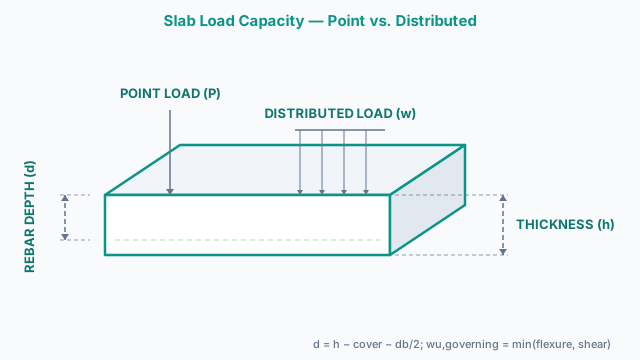
- 1) Effective Depth (d)d = h − cover − db/2
h = total slab thickness; cover = clear concrete cover to reinforcement; db = bar diameter. This is the key mechanical-advantage dimension: both the flexural moment arm (d − a/2) and the shear area (b × d) scale with d. - 2) Reinforcement Area per Foot (As)As = (Abar ÷ spacing) × 12
Abar is the tabulated cross-sectional area for the selected bar (#3 = 0.11 in², #4 = 0.20 in², #5 = 0.31 in², #6 = 0.44 in², #7 = 0.60 in², #8 = 0.79 in²). Spacing in inches; multiplied by 12 to normalize to a 1-foot-wide strip. - 3) Stress-Block Depth (a) — ACI 318 §22.2.2a = (As × fy) ÷ (0.85 × f'c × b)
b = 12 in (1-foot strip width). The Whitney rectangular stress block approximates the nonlinear concrete compression distribution. “a” is the depth of the equivalent rectangular block, always less than the effective depth d for tension-controlled sections. - 4) Flexural Capacity (φMn) — ACI 318 §22.3Mn = As × fy × (d − a/2)
φMn = 0.9 × Mn (φ = 0.9 for tension-controlled sections, ACI 318 §21.2)
The term (d − a/2) is the lever arm from the centroid of tension steel to the centroid of the compression block. - 5) Governing Factored Load — Flexurewu,flex = (8 × φMn) ÷ L²
Derived from the simply-supported beam moment equation M = wL²/8, solved for w. L = clear span in feet; result is in lb/ft (psf for a 1-foot strip), representing the maximum factored uniform load the slab can resist before flexural failure. - 6) One-Way Shear Capacity (φVc) — ACI 318 §22.5.5Vc = 2 × λ × √f'c × b × d
φVc = 0.75 × Vc (φ = 0.75 for shear, ACI 318 §21.2)
wu,shear = 2 × φVc ÷ L
λ = 1.0 for normal-weight concrete. The factor 2 in the shear-to-uniform-load conversion accounts for equal reactions at both supports of a simply-supported span. Note that shear capacity depends only on concrete section properties — not on rebar quantity. - 7) Maximum Service Live Load (L_max)Lmax = (wu,governing − 1.2 × Dtotal) ÷ 1.6
Dtotal = slab self-weight + superimposed dead load (psf). wu,governing = min(wu,flex, wu,shear). The ASCE 7 gravity combination 1.2D + 1.6L is rearranged to isolate the maximum allowable service live load L.
Entering Your Slab Load Capacity Parameters
- 1Select a project type preset — Residential, Commercial, or Industrial — to load sensible defaults for concrete compressive strength, cover depth, and rebar. Presets speed up input without locking you into fixed values; adjust any field after the preset loads.
- 2Enter the slab thickness in inches. Residential one-way slabs typically run 5–7 inches; light commercial floors range from 7–9 inches. Thickness directly sets the effective depth and the shear area — both core variables in the analysis.
- 3Enter the clear span length in feet — the unobstructed distance between face-of-support (beam, wall, or column). Span length appears squared in the moment equation, so even a half-foot error significantly shifts the flexural capacity result.
- 4Set the concrete cover to reinforcement in inches. The standard cover for interior-protected slabs is 0.75–1 inch (ACI 318 Table 20.6.1.1); exterior or moisture-exposed slabs require 1.5 inches. Cover reduces the effective depth, so use the actual specified value from your plans.
- 5Input the concrete compressive strength (f'c) in psi. Common values: 3,000 psi for residential slabs, 4,000 psi for general commercial, and 5,000 psi for high-load industrial floors. Higher f'c improves both shear capacity and the compressive block efficiency.
- 6Select the steel yield strength (fy). Grade 60 (60,000 psi) is the standard for all modern US structural rebar; Grade 40 (40,000 psi) may appear in older construction or lightly loaded non-structural slabs.
- 7Choose the rebar bar size from the dropdown (#3 through #11). The calculator looks up the exact cross-sectional area for that bar (e.g., #5 = 0.31 in², #6 = 0.44 in²) and uses it to compute As per linear foot.
- 8Enter the rebar spacing in inches center-to-center (e.g., 6 in., 9 in., 12 in.). Tighter spacing increases As and therefore flexural capacity; wider spacing reduces it and can shift the governing failure mode.
- 9Input the superimposed dead load (SDL) in psf — the weight of floor finishes, tile, carpet, ceilings below the slab, mechanical ductwork, or fixed partitions. A typical residential SDL is 10–20 psf. Leave at 0 if you need the bare slab capacity without finishes.
- 10Press Calculate. The results panel shows: effective depth d, tension-block depth a, design flexural capacity φMn, design shear capacity φVc, governing failure mode, and maximum allowable service live load in psf.
- 11Compare the computed maximum live load against your project's required occupancy live load from ASCE 7 Table 4.3-1 (40 psf residential living areas, 50 psf offices, 100 psf public assembly). A green Pass confirms the slab meets the demand; a red Fail means you need a thicker slab, tighter rebar, or stronger concrete.
- 12Use the Print / Save button to export a formatted structural summary for project documentation, permit packages, or contractor coordination.
Occupancy Live Load Design Values — ASCE 7-22 Table 4.3-1
Compare your calculated maximum service live load against the minimum occupancy requirement for your project type. The slab must meet or exceed the tabulated value to satisfy code.
| Occupancy / Use | Min. Live Load (psf) | Typical Application |
|---|---|---|
| Residential — Sleeping Areas | 30 psf | Bedrooms and sleeping rooms |
| Residential — Living Areas | 40 psf | Living rooms, dining, kitchens |
| Office Areas | 50 psf | General office floors |
| Assembly — Fixed Seats | 60 psf | Theaters, auditoriums, stadiums |
| Assembly — Movable Seats | 100 psf | Ballrooms, gymnasiums, convention halls |
| Corridors / Lobbies (First Floor) | 100 psf | High-traffic public spaces |
| Retail — First Floor | 100 psf | Sales floor, ground level retail |
| Retail — Upper Floors | 75 psf | Second floor and above retail |
| Light Storage Warehouses | 125 psf | Light manufacturing, general storage |
| Heavy Storage / Manufacturing | 250 psf | Heavy rack storage, industrial floors |
| Parking — Passenger Cars Only | 40 psf | Garage slabs for cars, no trucks |
| Rooftop Terrace / Accessible Roof | 100 psf | Plazas, rooftop amenity decks |
Source: ASCE 7-22 Table 4.3-1 (minimum values). Local codes or Authority Having Jurisdiction (AHJ) may specify higher minimums — always confirm against the governing jurisdiction’s adopted code edition.
Worked Analysis: 6-Inch Residential Floor Slab
Scenario: A 6-inch thick residential floor slab spans 12 feet clear between supporting beams. Concrete is f'c = 4,000 psi (normal-weight, 150 pcf); steel is Grade 60 (fy = 60,000 psi). Reinforcement is #5 bars at 9 inches on center with 0.75-inch clear cover. SDL = 15 psf (ceramic tile + drywall ceiling). Required occupancy live load: 40 psf.
- 1 — Effective depth: d = 6” − 0.75” cover − 0.5 × 0.625” (#5 diameter) = 4.94 in
- 2 — As per foot: Abar (#5) = 0.31 in²; As = (0.31 ÷ 9 in) × 12 = 0.413 in²/ft
- 3 — Tension-block depth: a = (0.413 × 60,000) ÷ (0.85 × 4,000 × 12) = 0.607 in
- 4 — Nominal moment: Mn = 0.413 × 60,000 × (4.94 − 0.607÷2) = 113,700 in·lb/ft → φMn = 0.9 × 113,700 = 102,330 in·lb/ft (8,528 ft·lb/ft)
- 5 — wu (flexure): wu,flex = 8 × 8,528 ÷ 12² = 474 psf
- 6 — One-way shear: Vc = 2 × √4,000 × 12 × 4.94 = 7,493 lb; φVc = 0.75 × 7,493 = 5,620 lb; wu,shear = 2 × 5,620 ÷ 12 = 937 psf
- 7 — Governing mode: Flexure governs at wu = 474 psf (shear capacity of 937 psf is not limiting)
- 8 — Total dead load: D = slab self-weight + SDL = (150 × 6÷12) + 15 = 75 + 15 = 90 psf
- 9 — Max service live load: Lmax = (474 − 1.2 × 90) ÷ 1.6 = (474 − 108) ÷ 1.6 = 229 psf
Result: 229 psf > 40 psf required → PASS. The slab has nearly 6× the required residential live load capacity. The design is flexure-governed with substantial reserve, suggesting the slab could be thinned or rebar spaced more widely if cost reduction is a goal — with a licensed engineer’s review.
Limits of This Slab Load Capacity Estimate
- ⚠️Checking only flexure and missing shear
Many quick hand calculations verify bending capacity but skip one-way shear. For short-span or thick slabs (span-to-depth ratio below about 10:1), shear can govern at a factored load intensity that is 30–50% below the flexural capacity — making the flexure-only answer unconservatively high. This calculator always computes both φMn and φVc automatically.
- ⚠️One-way analysis does not cover two-way slabs
One-way strip analysis is only valid when the slab’s span-to-width ratio exceeds 2:1. If your slab is supported on all four sides with a roughly square footprint (ratio near 1:1), two-way behavior governs — biaxial bending, punching shear around columns, and plate-theory distribution effects that this tool does not model. Applying this calculator to a two-way slab gives an unsafe overestimate of capacity.
- ⚠️No deflection or vibration check
This tool checks ultimate strength only. It does not check serviceability deflection (ACI 318 §24.2 limits of L/360 live-load / L/240 total-load) or vibration sensitivity. A slab that passes the strength check here may still need to be thickened to control cracking, ponding, or perceptible bounce — deflection frequently governs long spans even when strength has large reserve.
- ⚠️Consult a licensed structural engineer before relying on the result
Static load capacity estimates do not account for dynamic impact, vibration fatigue, long-term creep deflection, or construction-tolerance variability in bar placement (±3/8 in per ACI 318 §26.6) and concrete strength (±10% typical). Treat this calculator’s output as a preliminary design or feasibility check — always engage a licensed structural engineer to verify any slab intended for vehicle loading, heavy equipment, or occupancies above 100 psf, and before finalizing permit drawings.
For the volume of concrete needed to pour this slab, use the slab concrete calculator. For installed cost, see the concrete slab cost calculator. For the slab’s dead weight as an input to a broader structural loading analysis, use the concrete slab weight calculator.
Governing Codes & Standards
Provides the LRFD strength design equations for flexure (§22.2–22.3) and one-way shear (§22.5.5), the resistance factors φ = 0.9 (flexure) and φ = 0.75 (shear) in §21.2, and the Whitney rectangular stress-block model that drives every step of this calculator’s capacity analysis for suspended one-way slabs.
Specifies the minimum occupancy live load values in Table 4.3-1 that this calculator compares against, and establishes the 1.2D + 1.6L strength-level gravity combination in §2.3.1 that is rearranged to back-calculate the maximum permissible service live load.
Covers subgrade modulus-based design for ground-supported slabs — the complementary reference for users who need to understand how slab-on-grade load capacity analysis (Westergaard method) differs from the suspended one-way slab LRFD approach used in this tool.
Static load capacity estimates do not account for dynamic impact, vibration fatigue, or long-term creep deflection — always engage a licensed structural engineer to verify any slab intended for vehicle loading, heavy equipment, or occupancies above 100 psf.
Engineering & Design Questions
What is a concrete slab load capacity calculator?
A concrete slab load capacity calculator is a structural analysis tool that applies ACI 318-19 strength design equations to a reinforced one-way slab cross-section and returns the maximum safe service live load in pounds per square foot (psf). It checks both flexural moment capacity (φMn) and one-way shear capacity (φVc), identifies the governing failure mode, applies the ASCE 7 load combination 1.2D + 1.6L, and tells you whether a given slab design meets an occupancy's required live load — without requiring manual structural engineering calculations.
How does a concrete slab load capacity calculator work?
The calculator models a 12-inch wide representative strip of the slab as a shallow beam. It computes the reinforcement area from bar size and spacing, derives the effective depth from slab thickness and cover, and applies ACI 318's Whitney rectangular stress-block model to find the flexural capacity (φMn). Separately, it computes the concrete shear resistance (φVc) using ACI 318 §22.5.5. Both capacities are converted to equivalent uniform load intensities, the lower one governs, and the ASCE 7 gravity combination is rearranged to isolate the maximum allowable service live load in psf.
What does 'one-way slab' mean in this structural context?
A one-way slab is a reinforced concrete slab where the span-to-width ratio exceeds 2:1, so bending occurs primarily in one direction — from support to support along the shorter span. This allows the slab to be analyzed as a series of independent 12-inch wide beam strips per ACI 318. If your slab is supported on all four sides with a roughly square footprint (ratio near 1:1), it behaves as a two-way slab with biaxial bending and punching shear — a different, more complex analysis not handled by this tool.
What are the standard residential floor live load requirements?
ASCE 7-22 Table 4.3-1 sets the minimum live load at 40 psf for residential living areas (living rooms, dining rooms, kitchens) and 30 psf for sleeping areas (bedrooms). This is the target your calculated maximum live load must meet or exceed. For comparison, office areas require 50 psf, public corridors require 100 psf, and retail sales floors require 75–100 psf depending on the floor level. Local codes may be stricter — always verify with your Authority Having Jurisdiction before finalizing a structural design.
How does slab thickness affect load capacity?
Slab thickness drives load capacity in two independent ways. First, it increases the effective depth d (the moment arm from the compression face to the tension steel centroid), which multiplies the flexural moment Mn almost linearly — add one inch of thickness and the moment arm grows by nearly that full inch. Second, it increases the shear area (b × d), directly scaling the concrete's shear resistance φVc. For most residential slabs, a one-inch increase in thickness raises the governing load capacity by 15–25%, depending on which failure mode controls.
When does shear govern instead of flexure?
Shear tends to govern in short-span, thick-slab configurations where the span-to-depth ratio is low (below roughly 10:1). In these cases, the slab has a large moment arm and high flexural capacity, but shear demand in the reaction zones rises faster than the concrete's shear strength. Conversely, for long, thin slabs (span-to-depth ratio above 15:1), flexure almost always governs because the moment demand rises as L² while shear rises only as L. The calculator identifies the governing mode automatically — if shear governs your design, increasing slab thickness is more effective than adding rebar.
What is effective depth and why is it critical?
Effective depth (d) is the distance from the extreme compression fiber (top face in positive bending) to the centroid of the tension reinforcement. It is not the same as slab thickness — it is reduced by the concrete cover and half the bar diameter. For a 6-inch slab with 0.75-inch cover and #5 bars (0.625-inch diameter), d = 6 − 0.75 − 0.31 = 4.94 inches. Both the flexural moment arm (d − a/2) and the shear area (b × d) multiply directly with d. An error of even 0.5 inch can shift capacity estimates by 10–15%, so always use the specified cover from your structural drawings.
What is the 1.2D + 1.6L load combination and why is it mandatory?
The 1.2D + 1.6L gravity combination is the ASCE 7 strength-level load combination that must be paired with ACI 318's LRFD-based nominal resistance and φ-factor system. The 1.2 factor on dead load accounts for construction tolerance and density variability; the 1.6 factor on live load reflects greater uncertainty in occupancy loading over a building's life. Using unfactored loads with ACI 318 φMn produces an unconservative result because the code's resistance equations are calibrated to be paired with these specific demand amplifiers — not with service-level loads.
Can I use this calculator for a slab-on-grade (ground-supported slab)?
No. This calculator is for suspended one-way slabs spanning between discrete supports. Slabs-on-grade derive their capacity from a completely different mechanism: the modulus of subgrade reaction (k-value) of the soil below provides distributed elastic support, and failure is governed by soil bearing and slab curling — not by beam flexure or one-way shear. For slabs-on-grade, the ACI 360R-10 Westergaard method applies, and the key input is the subgrade k-value rather than span length.
What superimposed dead loads should I include in the calculation?
Superimposed dead load (SDL) is everything permanently attached to or supported by the slab that is not the slab's own self-weight: floor finishes (ceramic tile = 10–15 psf; hardwood = 3–4 psf; carpet + pad = 2–3 psf), ceiling systems below the slab (plaster = 10–15 psf; drywall on metal framing = 5–8 psf), mechanical HVAC ductwork (5–15 psf), and fixed partitions (15–20 psf per ACI 318 §4.3.3). Including SDL reduces the allowable live load because the 1.2D factored demand consumes some of the slab's structural reserve.
Does this calculator check for serviceability deflection?
No. This tool checks ultimate strength only — whether the slab has enough structural capacity to resist factored loads without failure. It does not check serviceability deflection, which ACI 318 §24.2 limits to L/360 under live load and L/240 under total load. In practice, deflection controls slab design more strictly than strength for long spans, thin slabs, or systems sensitive to vibration. A slab that passes the strength check here may still need to be thickened or post-tensioned to limit cracking and ponding. Always perform a deflection check for production-use designs.
How do I improve a slab's capacity if the result fails?
You have four primary design levers: (1) Increase slab thickness — improves both flexural and shear capacity and is usually the most cost-effective path for ground-up construction; (2) Decrease rebar spacing — more bars per foot increases As and therefore φMn; (3) Use a larger bar size — larger bars provide more area per unit of spacing without changing hole layout; (4) Increase concrete compressive strength (f'c) — improves shear capacity (scales as √f'c) and reduces the tension-block depth a, modestly improving moment arm. If shear governs, focus on thickness and f'c; if flexure governs, focus on rebar area.
Is the concrete slab load capacity calculator free to use?
Yes, the calculator is completely free with no registration, subscription, or download required. All computation runs entirely in your browser — no data is transmitted to any server. You can run as many scenarios as needed for different slab configurations, and the Print / Save feature generates a formatted structural summary at no cost.
Can I print or save my load capacity estimate for project files?
Yes. After running a calculation, click the Print / Save button in the results panel. A formatted print view opens showing all inputs (slab thickness, span, cover, f'c, fy, bar size, spacing, SDL), derived section properties (effective depth d, steel area As, tension-block depth a), structural capacities (φMn, φVc, governing mode), and the final maximum service live load in psf. Use your browser's 'Save as PDF' option to create a digital copy for permit documentation or contractor coordination.
How accurate is this structural load capacity estimate?
The calculations follow ACI 318-19 §22 and ASCE 7-22 §2.3 exactly for a simply-supported, normally-reinforced, normal-weight concrete one-way slab. Accuracy depends on input accuracy — particularly the concrete cover and rebar spacing, both of which affect the effective depth. Real construction conditions such as bar placement tolerances (±3/8 inch per ACI 318 §26.6), concrete strength variation (typically ±10%), and shrinkage cracking can reduce actual capacity below the theoretical value. These results are suitable for preliminary design verification and feasibility checks; engage a licensed structural engineer for permit drawings and structural certification.
Related Calculators
Concrete Slab Weight Calculator
Estimate weight of concrete for slabs, patios, and floors.
Slab Concrete Calculator
Estimate concrete for slabs, patios, and floors.
Rebar Calculator
Estimate rebar bars, linear footage, weight, and cost for slabs, footings, and walls.
Rebar Spacing Calculator
Calculate rebar bar count from a target c-t-c spacing or find spacing from a bar count, with ACI 318-19 compliance checks for slabs, footings, walls, and beams.
Footing Concrete Calculator
Continuous, isolated, and combined footings.