How to Calculate Gravel Cost for Any Project
The most expensive gravel budgeting mistake is comparing two quotes that use different units — one supplier prices by the ton, another by the cubic yard — without running the density conversion. Crushed stone #57 weighs approximately 1.35 tons per cubic yard, so a quote of $48/yd and $36/ton are nearly identical at $48.60/yd equivalent; but the same math on pea gravel (1.20 tons/yd³) gives $43.20/yd for the ton-priced supplier, a meaningful savings. Add a delivery fee that varies by $75–$150 between suppliers in the same metro area, and a rough guess at project cost can miss by $200–$400 on a modest residential job. The gravel calculator handles the volume-and-weight question; this gravel cost calculator handles the total-invoice question — material cost, delivery, and per-square-foot budget.
This calculator accepts project area dimensions (length, width, depth) or a known quantity already in tons or cubic yards. It applies the selected material's bulk density to bridge the ton/yard unit gap, then adds the supplier's unit price and flat delivery fee to produce: total material cost, delivery cost, all-in project total, and cost per square foot. An optional waste-factor field covers compaction loss, irregular borders, and delivery minimums.
Switch to Known Quantity mode when a supplier has already quoted you a tonnage or yardage, change the depth field to compare specs instantly, and use Print/Save to export a formatted estimate for bid packages, client proposals, or permit documentation.
Gravel Cost Drivers, Line by Line
Prices below are 2024–25 US bulk market averages for orders of 5+ tons or 5+ yards. Less-than-truckload or bagged product costs significantly more. Regional variation is substantial — Northeast and Pacific Northwest markets trend 15–25% above Midwest and Southeast averages where aggregate quarries are more numerous.
| Material | $/ton (bulk) | $/cu yd (bulk) | Density (tons/yd³) | Common Uses |
|---|---|---|---|---|
| Crushed Stone #57 | $28–$55 | $35–$70 | 1.35 | Driveways, drainage base |
| Pea Gravel | $35–$60 | $45–$75 | 1.20 | Landscaping, play areas, paths |
| Crushed Limestone | $25–$45 | $32–$58 | 1.40 | Driveways, garden paths, base layer |
| Bank-Run Gravel | $15–$35 | $20–$45 | 1.30 | Sub-base fill, rough grading |
| Class 5 Road Base | $18–$32 | $23–$42 | 1.38 | Driveway base, parking areas |
| River Rock | $55–$100 | $70–$125 | 1.30 | Decorative beds, water features |
| Lava Rock | $75–$150 | $95–$190 | 0.55 | Decorative landscaping, raised beds |
| Marble Chips | $100–$200 | $130–$260 | 1.45 | Garden paths, formal landscaping |
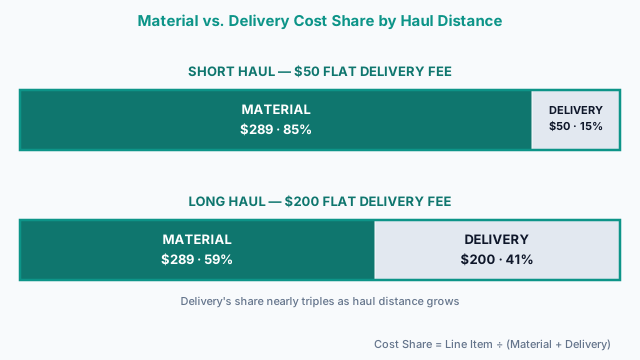
Delivery fees not included — add $50–$200 flat per load depending on haul distance and supplier minimums. Source: RS Means Building Construction Cost Data, adjusted for 2024–25 conditions.
Sample Estimate: A Driveway Apron in Crushed Limestone
A homeowner is extending a driveway apron: 40 ft × 10 ft × 4 inches deep using crushed limestone. Step 1 — volume: 40 × 10 = 400 sq ft; 4 in ÷ 12 = 0.333 ft; 400 × 0.333 = 133.3 cu ft ÷ 27 = 4.94 cu yd. Step 2 — add 10% waste: 4.94 × 1.10 = 5.43 cu yd. Step 3 — convert to tons: crushed limestone density = 1.40 tons/yd³; 5.43 × 1.40 = 7.60 tons. Step 4 — material cost: supplier A quotes $38/ton; 7.60 × $38 = $288.80. Add $95 delivery = $383.80 total, or $0.96/sq ft. Supplier B quotes $52/yd: 5.43 × $52 = $282.36 + $120 delivery = $402.36 — supplier A wins by $19 despite looking more expensive per unit. Running both quotes through the calculator reveals the true difference in seconds.
Costing Your Gravel Project with the Calculator
- 1Choose your project type preset — Driveway, Landscaping Bed, or Custom — to pre-load typical depth and material defaults for that application.
- 2Select your input method: 'From Dimensions' (enter length, width, and depth) or 'Known Quantity' (enter tons or cubic yards you've already determined).
- 3If using Dimensions, enter the length and width of your project area in feet. Set the depth in inches — landscaping beds typically use 2–3 inches; driveways need 4–6 inches for stability.
- 4Select the gravel material type from the dropdown. This loads the material's bulk density so the calculator can convert accurately between cubic yards and tons.
- 5Set your waste factor. Use 5–10% for clean rectangular areas; 10–15% for irregular shapes, tight borders, or when your calculated quantity falls below the supplier's delivery minimum.
- 6In the Pricing section, enter your supplier's unit price and select whether they charge per ton or per cubic yard. Run the calculator again with a second supplier's numbers to compare all-in totals.
- 7Enter the supplier's flat delivery fee. If delivery is mileage-based, use your best estimate or ask the supplier for the rate from their yard to your site.
- 8Optionally, add a crew spreading cost — either a flat fee or estimated hours multiplied by your crew's hourly rate — to calculate the fully installed price.
- 9Press Calculate to see material cost, delivery fee, total project cost, and per-square-foot rate.
- 10Use the Print/Save button to export a formatted estimate for bid packages, client proposals, or permit documentation.
- 11Adjust the depth or waste factor and recalculate to find the project specification that fits your budget before calling the supplier.
How the Gravel Total Is Built
- 1) Volume from DimensionsV (cu ft) = Length (ft) × Width (ft) × Depth (ft)
V (cu yd) = V (cu ft) ÷ 27
When depth is in inches, divide by 12 to convert to feet first. A 40 ft × 10 ft area at 3 inches deep = 400 × 0.25 = 100 cu ft ÷ 27 = 3.70 cu yd. - 2) Tons from Cubic YardsTons = Volume (cu yd) × Bulk Density (tons/yd³)
Bulk density varies by material: crushed stone #57 ≈ 1.35 tons/yd³; pea gravel ≈ 1.20; crushed limestone ≈ 1.40; bank-run ≈ 1.30. These are loose (poured) values — compacted in-place density is typically 10–15% higher. - 3) Waste-Adjusted QuantityAdjusted Qty = Base Qty × (1 + Waste % ÷ 100)
Applied before pricing. A 10% waste factor on 4.94 cu yd gives 5.43 cu yd ordered and priced. - 4) Material CostMaterial Cost = Adjusted Quantity × Unit Price
Quantity and price must be in the same unit (both tons or both yards). When the units differ, the density conversion runs automatically before multiplying. - 5) Total Cost & Per-Square-Foot RateTotal = Material Cost + Delivery Fee (+ Labor if entered)
Cost/sf = Total ÷ (Length × Width)
The per-square-foot figure lets you compare gravel directly against concrete (~$6–$10/sf poured) or asphalt (~$3–$6/sf) on the same coverage area.
Budgeting Mistakes That Inflate a Gravel Quote
- 1Comparing ton prices to yard prices directly
$36/ton looks cheaper than $48/yd until you run the density math. For crushed stone at 1.35 tons/yd³, $36/ton = $48.60/yd — essentially equal. For pea gravel at 1.20 tons/yd³, $36/ton = $43.20/yd — genuinely cheaper. Never compare raw unit prices across different pricing units without converting first.
- 2Ordering below the supplier's delivery minimum
Most bulk suppliers require a minimum of 5 tons or 5 yards per delivery. If your project needs 3.5 yards, you'll be invoiced for 5. Use the waste-factor field or deliberately spec a slightly larger project footprint to use the full load productively rather than paying for stockpiled overage.
- 3Under-specifying depth and reordering mid-project
A 2-inch nominal depth compacts to roughly 1.5 inches under foot or vehicle traffic within weeks. Driveways need 4–6 inches; pedestrian paths need at least 3 inches for a stable surface. A re-order mid-project means a second delivery fee. Use the gravel calculator to compare 3-inch vs. 4-inch depth cost before ordering.
- 4Counting one delivery fee on a two-haul project
If the project is large enough to require two separate truckloads — or if a second phase (top dressing, additional layer) is planned for later — each delivery incurs the flat fee. Budget both fees from the start. The difference between planning one $120 fee and unexpectedly paying a second $95 is $95 of unplanned spend on an otherwise well-estimated job.
Which Gravel Tool Fits Your Job
Use this gravel cost calculator when you have a supplier quote in hand and need to produce a full project budget — material cost, delivery, and per-square-foot total. If you need to determine how much material to order before you have pricing, start with the gravel calculator to get the cubic yard and ton quantities, then return here to price them. If your specific question is how many tons equal how many yards for a particular material — because a supplier quote and a delivery ticket use different units — the gravel tons-to-yards calculator provides a focused conversion reference with a per-material density table. For decorative pea gravel on pathways or patios, the pea gravel calculator includes coverage-rate tables by depth tailored to that material's loose, flowing characteristics.
Pricing Sources & Cost Standards
Defines the aggregate size designations (#57, #67, #89, #4) that US suppliers use to catalog and price crushed stone. Specifying the correct ASTM D448 size number when requesting quotes ensures the material you price matches what the project needs — size differences affect compaction behavior, drainage, and bulk density, all of which shift the ton/yard conversion used in this calculator.
Establishes the test method for the bulk density values (lb/ft³ or tons/yd³) this calculator uses when converting cubic yard volume to tons for pricing. The densities in the cost-driver table above are ASTM C29 loose bulk values; compacted in-place density is typically 10–15% higher and varies by gradation and moisture content.
The regional price benchmarks in the table above are indexed against RS Means unit cost data for gravel and crushed stone, adjusted for 2024–25 market conditions. RS Means tracks quarterly price changes across US regions and is the standard reference used by estimators, owners, and contractors for construction cost budgeting.
Material prices vary by region, supplier, and season. Bulk density values are typical loose-fill ranges — request your supplier's material data sheet for precision cost verification on structural-fill or specification-grade applications.
Comparing gravel against a poured-concrete option for the same footprint? Our sourced ready-mix concrete price survey compiles dated, per-metro concrete pricing with every source linked, alongside a BLS regional price-trend anchor.
Cost & Pricing Questions
How much does gravel cost per ton in 2024–25?
Bulk crushed stone runs $28–$55/ton depending on region and stone type. Pea gravel costs $35–$60/ton; river rock $55–$100/ton; lava rock and decorative stone $75–$150/ton. Northeast and Pacific Northwest markets trend 15–25% above Midwest and Southeast averages where aggregate sources are more plentiful. Bank-run gravel and Class 5 road base start as low as $15–$35/ton, making them the most cost-effective option for base-layer and fill applications.
How much does gravel cost per cubic yard?
Crushed stone bulk pricing runs $35–$70/cu yd; pea gravel $45–$75/yd; river rock $70–$125/yd; lava rock $95–$190/yd; marble chips $130–$260/yd. Bank-run and Class 5 gravel fall in the $20–$45/yd range. The per-yard price reflects loading method (front-end loader at a landscape yard vs. weigh scales at a quarry) as well as the supplier's unit-margin preference. Always convert to the same unit before comparing two quotes — use the Known Quantity mode here to do it instantly.
Is it cheaper to buy gravel by the ton or by the yard?
Neither unit is inherently cheaper — it depends on the material's density and each supplier's margin per unit. A quote of $48/yd and $36/ton for crushed stone #57 (1.35 tons/yd³) are nearly equal: $36 × 1.35 = $48.60/yd. The same math on pea gravel (1.20 tons/yd³) gives $36 × 1.20 = $43.20/yd — the ton-priced supplier wins there. Always run both quotes through this calculator to find the lower all-in total once delivery is factored in.
How much does gravel delivery typically cost?
Local landscape suppliers typically charge a flat delivery fee of $50–$150 depending on haul distance and minimum load size. Regional quarry deliveries may charge by the mile ($2–$4/mile from the gate) or by the hour for the truck. Some suppliers waive the delivery fee for large orders — often 10+ tons or 8+ yards. Always ask whether the quoted fee includes an unloading time allowance, or whether the driver simply dumps and leaves, since being unavailable at delivery can result in a misplaced load.
What is the cheapest type of gravel for a driveway?
Bank-run gravel and Class 5 road base are the least expensive at $15–$35/ton and are the standard choice for driveway base layers. Crushed limestone ($25–$45/ton) provides better compaction and drainage than bank-run and is a common step-up for the base layer. Crushed stone #57 ($28–$55/ton) is the most commonly specified surface layer for residential driveways because the angular faces interlock under vehicle weight. Avoid pea gravel for driveways — its round shape migrates under tires and creates a loose, unstable surface.
What is a delivery minimum, and why does it affect my cost?
Most bulk suppliers require a minimum order — typically 5 tons or 5 cubic yards per delivery. If your project needs 3.5 yards, you'll be invoiced for 5. Options: increase coverage area or depth to use the full load productively; stockpile the overage for a future project; or find a landscape yard that sells smaller quantities (usually at a higher per-unit cost). The waste-factor field helps determine how close your need is to the supplier minimum before you call.
How do I estimate gravel cost for a 10×10 area?
A 10 ft × 10 ft = 100 sq ft area at 3-inch depth: 100 × (3/12) = 25 cu ft ÷ 27 = 0.93 cu yd. With 10% waste: 1.02 cu yd. At crushed stone density 1.35 tons/yd³: 1.38 tons. At $45/ton: $62 material. Add $95 delivery = $157 total, or about $1.57/sq ft. Note that 1.38 tons is well below most suppliers' 5-ton minimum — you may be invoiced for 5 tons ($225 + delivery) regardless. For small patches, purchasing bagged gravel from a home-improvement store (typically $5–$8 per 0.5 cu ft bag) often costs less than a bulk delivery with a minimum charge.
How much does it cost to have gravel spread?
Manual spreading and raking runs $35–$75/hour or a flat rate of $50–$150 for small jobs under 500 sq ft. Skid-steer spreading is $75–$150/hour but significantly faster — a typical driveway can be spread in under an hour mechanically vs. 3–6 person-hours by hand. For large commercial areas over 2,000 sq ft, the efficiency gain from mechanical spreading usually justifies the cost. Add the labor estimate in this calculator's optional labor field to see the fully installed price.
Does the season affect gravel prices?
Yes. Gravel prices rise in spring and early summer (peak construction season) and soften in late fall and winter. In northern US markets, winter pricing can dip 10–20% because residential demand drops sharply, though some quarries reduce hours or stop accepting small residential orders. If your project timeline is flexible, a fall or early-winter delivery can reduce material cost. However, frozen or saturated ground may complicate spreading and compaction, so balance the cost savings against the installation conditions.
Should I get multiple gravel quotes?
Always. Price variation between suppliers in the same metro area is commonly $10–$15/ton, and delivery fees can differ by $50–$100 per load. On a 10-ton driveway job, a $12/ton price difference equals $120 on material alone. Enter each supplier's quote into this calculator using the same project dimensions — the all-in total comparison reveals who is actually cheaper once delivery is included. Even a 5-minute call to a second quarry almost always pays for itself.
Why is river rock so much more expensive than crushed stone?
River rock is collected from riverbed or glacial deposits, washed to remove fines, sorted by size, and transported — a more labor-intensive supply chain than crushing quarried rock. It also commands an aesthetic premium for decorative applications (beds, water features, Zen gardens) where appearance drives the spec. For structural applications — driveways, drainage bases, structural fill — crushed stone delivers better compaction and drainage at a fraction of river rock's cost. Use river rock where appearance is the priority; use crushed stone where performance is.
What is this gravel cost calculator, and is it free?
This gravel cost calculator is a free online tool that estimates the total project cost for any bulk gravel or crushed stone job. Enter area dimensions or a known quantity, select the material type, enter your supplier's unit price and delivery fee, and receive a full cost breakdown: material cost, delivery, total invoice, and per-square-foot rate. No account, no sign-up, and no charge — fully free on any device.
Can I print or save my gravel cost estimate?
Yes. After clicking Calculate, the Print/Save button generates a formatted print view of your project inputs and full cost results. In the browser print dialog, select 'Save as PDF' to create a shareable digital document. This is useful for client proposals, HOA approval applications, permit-cost backup documentation, or keeping alongside supplier invoices to compare actual vs. estimated costs after the project completes.
How does the calculator handle the ton vs. cubic yard pricing mismatch?
When you enter dimensions (producing a cubic yard volume) but select 'per ton' as the pricing unit, the calculator multiplies the cubic yard quantity by the selected material's bulk density to convert to tons before applying the price. For example, 5.43 cu yd of crushed limestone at 1.40 tons/yd³ = 7.60 tons; at $38/ton = $288.80 in material cost. The same logic runs in reverse — if you know tons and the supplier quotes by the yard, the calculator converts before pricing. The material-type selector loads the correct density automatically.
What is the difference between this calculator and the general gravel calculator?
The gravel calculator focuses on volume and weight — how many cubic yards and tons you need for a given area and depth, answering 'how much material do I order?' This gravel cost calculator takes the next step: it adds supplier pricing, delivery fees, and optional labor to answer 'what will it cost?' If you haven't determined your quantity yet, start with the gravel calculator, then bring the cubic yard or ton result here in Known Quantity mode to get the full project budget.
Related Calculators
Gravel Calculator
Calculate gravel volume, tons, cubic yards, and estimated cost.
Gravel Driveway Calculator
Estimate driveway gravel in tons, yards, and total cost.
Gravel Tons to Yards Calculator
Convert between gravel tons and cubic yards.
Concrete Driveway Cost Calculator
Estimate cost of concrete for driveways.
Crushed Concrete Estimator Calculator
Calculate crushed concrete volume, tons, coverage, and total cost with compaction adjustments.