How Many Tons of Gravel a Driveway's Base and Surface Layers Take
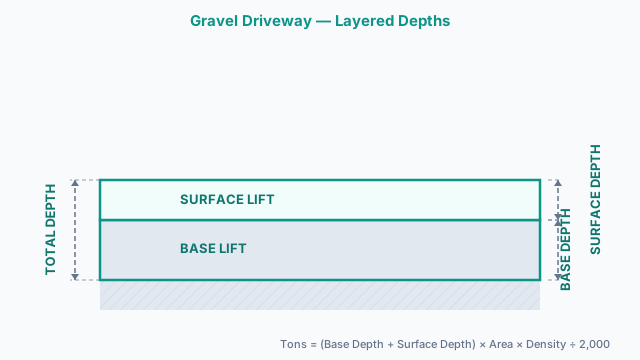
A gravel driveway is not one material poured to one depth — it is a stack of layers, each using a different stone grade for a different job. A sub-base of large angular stone carries the structural load and locks together under vehicle weight, while a thin surface course of smaller stone gives you a smooth, drivable finish. The Gravel Driveway Calculator is built around that reality: it estimates tons and cubic yards for one layer at a time, using your driveway's footprint, that layer's depth, and the density of the stone you're ordering — so you can run it once per layer and get an accurate total for the whole driveway rather than a single blended guess.
This is distinct from the general-purpose Gravel Calculator, which is sized for a single, uniform fill — a path, patio base, or drainage bed poured to one depth. A driveway build almost always needs the calculator run two or three times: once per layer, at that layer's specific depth and stone grade, with the tonnage from each run added together for your total order.
Gravel Driveway Layer & Stone Grade Reference
Typical stone grade, depth, and density by driveway layer. Run the calculator once per layer using the depth and density shown here, then add the tonnage from each run for your total order.
| Layer | Stone Grade | Typical Depth | Density | Purpose |
|---|---|---|---|---|
| Sub-base | #3 or #4 crushed stone (1–2 in) | 4–6 in | ~105 lb/ft³ | Large angular stone that locks together and carries the structural load; thicken on soft or clay soil, skip only on firm, well-drained ground |
| Base / middle | #57 crushed stone (½–1 in) | 3–4 in | ~105 lb/ft³ | Bridges the voids in the sub-base and adds a drainage layer; optional on short, light-duty driveways |
| Surface course | #8 stone, crusher run, or pea gravel | 2–3 in | 100–105 lb/ft³ | Smaller, compactable stone for the drivable finish; crusher run packs hardest, pea gravel is loosest and migrates most under tires |
Densities are averages for angular crushed stone and pea gravel. Enter your supplier's specific density in the calculator's Custom Density field for the most accurate tonnage.
Entering Your Gravel Driveway Dimensions
- 1Select your measurement unit — inches, feet, centimeters, or meters — for the driveway length and width.
- 2Enter the Driveway Length and Driveway Width. Measure the full footprint you're covering, including any turnaround or apron area at the road.
- 3Enter the Gravel Layer Depth for the specific layer you're estimating right now — for example 4–6 inches for the sub-base, or 2–3 inches for the surface course. The depth has its own unit selector, separate from length and width.
- 4Select a Gravel Type — General Gravel, Pea Gravel, or Crushed Stone — to load a standard density, or choose Custom Density to enter your supplier's exact lb/ft³ figure.
- 5Set the Waste Factor. 10% is standard and covers compaction settling and stone that works into the subgrade; use up to 15–20% on soft or uneven ground.
- 6Optionally enter a Material Price per ton or per cubic yard, and a Delivery Fee, to get a total cost estimate alongside the tonnage.
- 7Click Calculate. Read the area, volume, and tonnage for that layer, then repeat the process for each additional layer — sub-base, base, and surface — and add the tonnage figures together for your full driveway order.
How the Gravel Driveway Tonnage Is Calculated
- 1) Driveway AreaArea (ft²) = Length (ft) × Width (ft)
Length and width are converted to feet first regardless of the unit you entered them in. - 2) Raw Layer VolumeVraw = Area (ft²) × Layer Depth (ft)
The layer depth you enter is converted to feet independently of the length/width unit. - 3) Volume with Waste FactorVft³ = Vraw × (1 + Waste% ÷ 100)
Vyd³ = Vft³ ÷ 27
Waste is applied before the tonnage conversion, so it inflates both the cubic-yard and tonnage figures together. - 4) Weight / TonnageWeight (lb) = Vft³ × Density (lb/ft³)
Tons = Weight (lb) ÷ 2,000
Density defaults to 105 lb/ft³ for general gravel and crushed stone, or 100 lb/ft³ for pea gravel — override either with your supplier's figure via Custom Density. - 5) Material & Total CostMaterial Cost = Tons × Price per Ton (or) Cubic Yards × Price per Yard
Total Cost = Material Cost + Delivery Fee
Choose the pricing mode that matches how your supplier quotes — by the ton or by the cubic yard — before entering the unit price.
Worked Takeoff: 12×50 ft Gravel Driveway (Base + Surface)
You're building a 12 ft wide, 50 ft long driveway (600 ft²) with a 4-inch #57 base layer and a 2-inch #8 surface layer, both at 105 lb/ft³ with a 10% waste factor. The calculator is run twice — once per layer.
Run 1 — Base layer (4 in depth)
- Raw volume = 600 ft² × (4 ÷ 12) ft = 200 ft³
- With 10% waste = 200 × 1.10 = 220 ft³ = 220 ÷ 27 = 8.15 yd³
- Tonnage = 220 ft³ × 105 lb/ft³ ÷ 2,000 = 11.55 tons
Run 2 — Surface layer (2 in depth)
- Raw volume = 600 ft² × (2 ÷ 12) ft = 100 ft³
- With 10% waste = 100 × 1.10 = 110 ft³ = 110 ÷ 27 = 4.07 yd³
- Tonnage = 110 ft³ × 105 lb/ft³ ÷ 2,000 = 5.78 tons
Total order = 11.55 + 5.78 = 17.33 tons (8.15 + 4.07 = 12.22 yd³ combined). At $42 per ton delivered plus a flat $150 delivery fee, material cost runs about $727.65, for a total project cost near $877.65.
Entering a single blended depth instead of two layer runs — say, one pass at 6 inches using the base stone's density for the whole depth — would misprice the surface course and typically over- or under-order by 2–4 tons on a driveway this size.
Quantity Mistakes That Leave a Gravel Driveway Short
- 1Skipping the sub-base layer entirely
Ordering only a single top layer of decorative or surface stone saves money up front but gives no structural base. On anything but bone-dry, well-drained soil, the driveway ruts and potholes within a season or two as vehicle weight pushes surface stone down into the subgrade instead of riding on top of it.
- 2Not crowning the driveway for drainage
A flat driveway surface holds water, which softens the base and accelerates rutting. Building in a slight crown (roughly 1/4 inch of rise per foot of width) or a consistent cross-slope sheds water to the sides and is worth accounting for in your grading plan before you order stone, since a crowned surface can need marginally more surface-course material than a flat calculation assumes.
- 3Using the wrong stone grade for the surface course
Rounded pea gravel looks attractive but doesn't interlock — it migrates under tire spin and scatters onto lawns and into gutters, requiring frequent top-ups. Crusher run (a stone-and-fines blend) or angular #8 stone compacts and stays in place far better for a daily-use driveway surface.
- 4Ordering by volume when the supplier sells by weight, or vice versa
Ton-to-yard conversion depends on the specific stone's density, which varies by material and moisture content. Confirm your supplier's density figure (commonly 1.35–1.5 tons per cubic yard for crushed stone) and enter it as a Custom Density rather than relying on the calculator's general default if your quote is unusually light or heavy stone.
When to Use the Gravel Driveway Calculator vs. Related Tools
Use this Gravel Driveway Calculator when you're building or resurfacing a driveway in distinct layers and need tonnage and cost for each layer's stone grade and depth separately. For a single, uniform gravel fill — a path, patio base, or drainage bed poured to one depth — the general-purpose Gravel Calculator is the simpler tool.
If your material budget needs to include regional pricing and delivery fees broken out line by line, the Gravel Cost Calculator produces a fully itemized estimate. Considering recycled material for the sub-base or base layer instead of virgin crushed stone? The Crushed Concrete Calculator estimates quantities for RCA (recycled concrete aggregate), a common and often lower-cost base alternative accepted by many municipalities.
And if your supplier quotes one unit but you need the other — tons on the invoice, cubic yards on your plan, or the reverse — the Gravel Tons to Yards Calculator converts between the two using your material's specific bulk density.
Product Standards & Specs
Defines the numbered stone grades — #3, #4, #57, #8 — referenced throughout this page and used to size the sub-base, base, and surface layers of a gravel driveway.
The AASHTO gradation and quality specification most road and driveway base material is sold against. It governs the sub-base and base layer material this calculator estimates tonnage for, including compaction and drainage performance requirements.
Where a driveway ties into a concrete apron or approach slab, this specification governs the aggregate quality used in that concrete — relevant if you're transitioning from gravel to a paved section at the road.
Standards cited for reference. Verify stone grade availability and pricing with your local aggregate supplier, and check municipal requirements for driveway approach material.
Quantity & Ordering Questions
How much gravel do I need for my driveway?
It depends on your driveway's length and width, and the depth of each layer you're building. A typical two-layer driveway (4–6 inch base plus 2–3 inch surface) on a 12×50 ft footprint needs roughly 17–18 tons total. Measure your driveway's footprint and run the calculator once per layer at that layer's depth and stone grade for an accurate combined total.
How deep should each gravel layer be?
A base layer of larger crushed stone (#3 or #4) typically runs 4–6 inches deep, a middle layer of #57 stone runs 3–4 inches if used, and a surface course of #8 stone, crusher run, or pea gravel runs 2–3 inches. Calculate the tonnage for each layer separately, using that layer's specific depth and density, then add the totals together.
How many tons of gravel do I need for a driveway?
Tonnage depends on the total volume in cubic feet and the density of your stone. A cubic yard of crushed stone driveway gravel weighs roughly 1.4–1.5 tons. For the worked 12×50 ft example on this page — a 4-inch base plus a 2-inch surface layer — total tonnage comes to about 17.3 tons. Enter your own dimensions into the calculator for a precise, layer-by-layer figure.
How much does driveway gravel cost?
Costs vary by region and stone grade, typically running $25–$65 per ton or $35–$75 per cubic yard for crushed stone, with pea gravel and decorative surface stone often priced higher. Delivery is usually a separate flat fee. Enter a price per ton or per yard plus your delivery fee in the calculator to get a full project cost alongside the tonnage.
What is the best stone grade for a driveway base?
A stable base usually calls for 4–6 inches of larger angular crushed stone — #3 or #4 stone per ASTM D448 — to provide load-bearing capacity and drainage beneath the finish layer. Avoid rounded river rock for the base; it doesn't interlock the way angular crushed stone does and won't compact into a stable platform.
What kind of gravel is best for the driveway surface?
Use angular material, not rounded stone. Crusher run (a stone-and-fines blend) packs the hardest and holds up best under regular vehicle traffic. #8 stone is a common clean alternative. Pea gravel looks attractive and drains well but shifts and scatters under tire spin, so it's best reserved for low-traffic or decorative sections rather than a daily-use surface.
How much extra gravel should I order for waste and compaction?
Loose gravel loses roughly 10–20% of its placed volume to compaction and settling into the subgrade below. Use a 10% waste factor for a firm, well-drained base, or up to 15–20% on soft or uneven ground, so you don't come up short mid-delivery.
Can I use this calculator for just one layer, or do I have to enter the whole driveway at once?
The calculator estimates one layer per run, since each layer has its own depth and stone density. For a standard two- or three-layer driveway, run it once per layer — sub-base, base, and surface — and add the resulting tonnage figures together for your total order.
Do I need a different calculator if I only need one uniform layer?
If you're placing a single, uniform gravel fill rather than a layered driveway — a path, patio base, or drainage bed at one consistent depth — the general Gravel Calculator is a simpler match. This Gravel Driveway Calculator is built specifically for estimating and pricing multiple stacked layers.
Is the gravel driveway calculator free?
Yes, completely free, with no account or usage limit. You can run it as many times as you need — once per layer — and use the Print / Save button to export each layer's results for your records or to bring to your supplier.
Related Calculators
Gravel Calculator
Calculate gravel volume, tons, cubic yards, and estimated cost.
Gravel Cost Calculator
Estimate total project cost including delivery for gravel projects.
Pea Gravel Calculator
Estimate pea gravel needed for landscaping.
Crushed Concrete Estimator Calculator
Calculate crushed concrete volume, tons, coverage, and total cost with compaction adjustments.
Concrete Driveway Cost Calculator
Estimate cost of concrete for driveways.