Sizing a Pea Gravel Bed: Decorative Coverage, Not Driveway Base
Pea gravel is a finishing material, not a structural base course — it fills garden beds, walking paths, patios, fire pit surrounds, paver and flagstone joints, and play-area fall zones with a smooth, rounded stone that is comfortable underfoot. That changes how you should take it off. Where a driveway base course is estimated by compacted layer thickness, a pea gravel bed is estimated by loose fill depth, and the right depth depends entirely on what the bed is for: 2 in for a light decorative top-dress, 3 in over landscape fabric for weed suppression, or a code-driven 9–12 in of loose fill for playground surfacing under CPSC and ASTM F1292 guidance. This calculator handles the rectangular footprint math and converts it directly to loose cubic yards, bulk weight in tons, and standard bag counts.
Because pea gravel is sold and specified differently than crushed base-course aggregate, this tool is purpose-built for the decorative and landscaping use case — it is not the calculator to reach for when you are pricing a compacted gravel driveway. If your project is a layered driveway base, use the Gravel Driveway Calculator instead, which handles per-layer compaction. For any other stone type or a cross-material density comparison, see the general Gravel Calculator.
Pea Gravel Size & Coverage Reference
Pea gravel is sold under several product names depending on grading and intended use. Coverage per ton below assumes the calculator's default dry bulk density of approximately 100 lb/ft³ — a supplier quoting a different coverage figure at the same depth is likely using a denser or damper stone.
| Product | Nominal Size | Color / Grade | Best Use | Coverage / Ton |
|---|---|---|---|---|
| 3/8" Natural Pea Gravel | 3/8 in | Natural tan / buff / gray blend | Decorative beds, garden paths, borders | ~120 sq ft @ 2 in |
| 1/2" Multi-Color Pea Gravel | 1/2 in | Mixed earth tones (pink, white, tan, brown) | Accent beds, planter top-dress, fire pit surrounds | ~110 sq ft @ 2 in |
| 3/8" Washed Drainage Pea Gravel | 3/8 in, low-fines washed | Gray | French drains, downspout beds, pipe bedding | ~80 sq ft @ 3 in |
| Paver / Flagstone Joint Fill | 1/8"–3/8" fine screenings | Natural | Sweeping between pavers and flagstone joints | ~450 sq ft @ 0.5 in |
| CPSC / ASTM F1292 Play-Area Pea Gravel | 3/8"–5/8" rounded | Natural | Playground fall-zone loose-fill surfacing | ~27 sq ft @ 9 in engineered depth |
Coverage figures are estimates at ~100 lb/ft³ dry bulk density. Damp pea gravel weighs 5–10% more per ton, which reduces actual coverage per ton slightly — always confirm bulk density with your supplier for play-area or drainage installations where depth compliance matters.
Entering Your Pea Gravel Project Dimensions
- 1Choose your unit of measurement (inches, feet, centimeters, or meters) from the Units selector at the top of Step 1 — this applies to the Length and Width fields.
- 2Enter the Length and Width of the rectangular area to be covered. For an L-shaped or irregular bed, split it into rectangular sections, run the calculator once per section, and add the results together.
- 3Enter Gravel Depth and choose its unit separately from Length and Width — the calculator lets you mix units, for example dimensions in feet with a depth in inches. Typical depth is 2 in for decorative cover or 3 in for weed suppression over landscape fabric.
- 4In Step 2, enter Bag Size in pounds (defaults to 50 lb, the standard home-improvement-store bag). Change this if your supplier sells 25 lb or 40 lb bags instead.
- 5Set the Waste Factor percentage (defaults to 5%). This adds a margin for spillage and spreading loss — raise it to 15–20% for sloped or open-edge beds where pea gravel migrates over time.
- 6Enter a Material Price and choose the Price Mode it applies to: Per Bag, Per Ton, or Per Cy (cubic yard). The calculator prices the whole project using whichever unit you provide.
- 7Click Calculate. The results panel shows Est. Bags, Bulk Volume in cubic yards, Bulk Weight in tons, and Total Cost.
- 8Use the Print / Save button to open a formatted summary of your inputs and results — save it as a PDF or bring it to the supply yard for quoting.
- 9Use Reset to clear all fields and return to the calculator's default example values.
How the Pea Gravel Tonnage Is Calculated
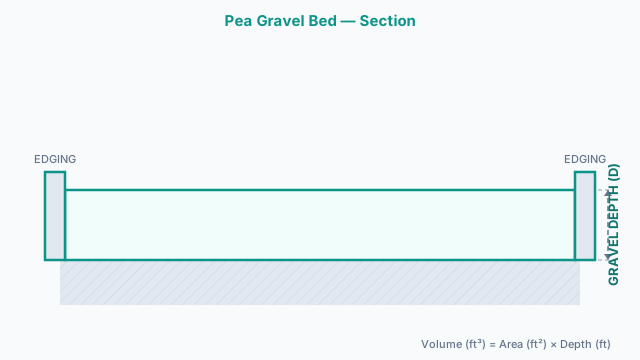
- 1) Footprint AreaArea (ft²) = Length × Width
Length and Width are each converted to feet before multiplying, so dimensions entered in inches, centimeters, or meters resolve to a single square-foot figure automatically. - 2) Raw Loose VolumeVolume (ft³) = Area (ft²) × Depth (ft)
Depth is converted to feet independently of the Length/Width unit, so a depth entered in inches multiplies correctly against an area measured in feet or meters. - 3) Waste AdjustmentAdjusted Volume (ft³) = Raw Volume × (1 + Waste% ÷ 100)
Applied before the volume is converted to cubic yards, weight, or bag count — the waste factor covers spillage and spreading loss, not the density calculation itself. - 4) Cubic YardsVolume (yd³) = Adjusted Volume (ft³) ÷ 27
This is the figure a bulk supply yard loads against — there are exactly 27 cubic feet in one cubic yard. - 5) Weight From DensityWeight (lb) = Adjusted Volume (ft³) × 100 lb/ft³ | Weight (tons) = Weight (lb) ÷ 2,000
The calculator uses a fixed dry bulk density of 100 lb/ft³ (≈1,600 kg/m³) for pea gravel, consistent with ASTM C33 grading data for well-graded fine aggregate. One cubic yard of pea gravel weighs roughly 2,700 lb (1.35 tons) at this density. - 6) Bag CountBags = ⌈ Weight (lb) ÷ Bag Size (lb) ⌉
Bag count is driven off total weight, not volume, so it always matches whatever bag size you enter in Step 2 — the default 50 lb bag, or a 25 lb or 40 lb size if that is what your store stocks. The result rounds up to the nearest whole bag. - 7) Total CostPer Ton: Cost = Weight (tons) × Price | Per Cy: Cost = Volume (yd³) × Price | Per Bag: Cost = Bags × Price
The calculator prices the project using whichever Price Mode you select in Step 2, so bulk-yard tonnage quotes and hardware-store bag prices can both be checked without manual conversion.
Worked Takeoff: A 16 × 4 ft Decorative Garden Border
You are finishing a 16 ft long, 4 ft wide border bed along a fence line with pea gravel at a 3 in weed-control depth over landscape fabric, using the default 5% waste factor.
- Footprint area = 16 ft × 4 ft = 64 ft²
- Depth = 3 in ÷ 12 = 0.25 ft
- Raw volume = 64 ft² × 0.25 ft = 16 ft³
- 5% waste factor = 16 × 1.05 = 16.8 ft³ adjusted
- Cubic yards = 16.8 ÷ 27 = 0.62 yd³
- Weight = 16.8 ft³ × 100 lb/ft³ = 1,680 lb ÷ 2,000 = 0.84 tons
- Bags at 50 lb each = ⌈1,680 ÷ 50⌉ = 34 bags
- Cost at $45/ton (bulk) = 0.84 × $45 = $37.80 | Cost at $5.50/bag = 34 × $5.50 = $187.00
Bulk delivery is roughly one-fifth the price of buying by the bag for this size project — the crossover typically favors bulk once a job exceeds about 1–2 cubic yards. Had this border been ordered at 2 in instead of 3 in, it would have needed only 0.55 tons — but without landscape fabric at that shallower depth, weeds commonly push through within a season.
Quantity Mistakes That Leave a Pea Gravel Bed Short
- 1Using a decorative depth for a play-area fall zone
A 2–3 in decorative cover is nowhere near sufficient loose-fill depth under playground equipment. CPSC and ASTM F1292 guidance calls for roughly 9 in of compressed loose fill (about 12 in loose) for equipment up to 8 ft high, and more for taller structures. Ordering at a decorative depth for a play area is a fall-protection safety shortfall, not just a coverage shortfall — size play-area beds against the equipment's critical fall height, not against how the bed looks.
- 2Skipping edging on a sloped or open-edge bed
Pea gravel's rounded shape gives it a low angle of repose, so it migrates toward the low side of any bed with even a mild grade. Without solid edging (aluminum, steel, or a concrete curb restraint at least 3 in tall), stone works its way into adjacent lawn or mulch beds within one to two seasons, thinning the covered depth below the design figure even though the correct volume was ordered.
- 3Omitting landscape fabric under the gravel layer
Bare soil beneath pea gravel lets stones sink into the ground over time and gives weed seeds a direct path to daylight — both problems shrink the effective covered depth even though nothing physically left the bed. A woven fabric rated for gravel, with seams overlapped 6 in and edges staked down, keeps the ordered depth doing its job for years instead of months.
- 4Comparing a pea gravel order to a crushed-stone order by weight alone
Pea gravel runs about 100 lb/ft³ while angular crushed stone commonly runs 105–120 lb/ft³. Ordering the same tonnage as a previous crushed-stone delivery yields noticeably less volume of pea gravel — or the reverse, over-ordering pea gravel volume when converting from a crushed-stone tonnage quote. Compare by cubic yards, not tons, when switching stone types, and use the Gravel Tons to Yards Calculator to reconcile supplier quotes across materials.
When to Use the Pea Gravel Calculator vs. Related Tools
Use this Pea Gravel Calculator when the stone is rounded pea gravel (roughly 3/8 in) and the application is decorative or drainage: garden paths, patios, borders, fire pit surrounds, dry creek beds, paver joints, or play-area surfacing. It fixes the density at pea gravel's typical 100 lb/ft³ so the tonnage and bag counts line up with what a supply yard or hardware store will hand you.
Switch to the Gravel Calculator when you have not settled on a stone type yet — it lets you enter a custom density and compare tonnage across crushed stone, gravel, and sand in one pass. For a compacted, layered driveway base course — a project that almost always uses angular crushed stone rather than rounded pea gravel — use the Gravel Driveway Calculator, which handles per-layer compaction factors that a decorative bed does not need.
If the primary question is total project budget including delivery and spreading labor rather than just material quantity, use the Gravel Cost Calculator. And if a supplier has already quoted you a tonnage and you need to check the cubic-yard volume you are actually receiving, the Gravel Tons to Yards Calculator converts between the two at your specified density.
ASTM Material Specs
Defines the sieve-size classification numbers suppliers use to name aggregates. Pea gravel sold in the US typically falls within Size #8 (about 3/8 in) or Size #89 (1/4–1/2 in). Matching your supplier's size class against this standard confirms you are comparing coverage figures on the same stone.
Provides grading and quality requirements for fine and coarse aggregates. The 100 lb/ft³ (≈1,600 kg/m³) bulk density this calculator uses to convert volume to weight is based on ASTM C33-compliant well-graded fine aggregate data — this is why the calculator's tonnage figure lines up with what a compliant supplier's scale house returns for the same volume.
Governs loose-fill surfacing materials — including pea gravel — used under playground equipment, and is echoed in the CPSC Public Playground Safety Handbook. Minimum uncompressed loose-fill depths scale with equipment fall height: commonly around 9 in for equipment up to 6 ft and up to 12 in for equipment up to 10 ft. Always verify the required depth against the specific equipment height before ordering for a playground installation — this calculator estimates volume, it does not certify fall-height compliance.
Density values are typical dry, loose figures for pea gravel; actual weight varies with moisture content and stone source. Confirm the lb/ft³ specification with your supplier before ordering for drainage or playground applications where depth compliance is required.
Pea Gravel Takeoff FAQ
What is pea gravel and what is it used for?
Pea gravel is a naturally rounded, smooth stone approximately 3/8 in in diameter, typically washed to remove fines. Its pebble-like appearance and soft texture underfoot make it popular for decorative garden paths, patios, borders, and fire pit surrounds. It is also used as a drainage aggregate in French drains, pipe bedding, and dry creek beds because the rounded stones pack loosely and let water flow freely. Unlike crushed stone, which locks together angularly under load, pea gravel does not compact hard, which makes it comfortable underfoot but prone to rolling and migration on slopes.
How much pea gravel do I need for a 10 x 10 ft area?
For a 10 x 10 ft area at 3 in depth (the standard weed-suppression depth over landscape fabric): area is 100 ft², depth is 0.25 ft, so raw volume is 25 ft³. With the calculator's default 5% waste factor that is 26.25 ft³ adjusted, or 0.97 yd³. Weight is 26.25 x 100 lb/ft³ = 2,625 lb, about 1.31 tons, which needs 53 standard 50 lb bags. At 2 in depth instead, the same area needs only about 0.65 yd³ and 0.87 tons.
How deep should pea gravel be for a garden pathway?
For a path that will be walked regularly, 2 to 3 in is the standard range. At 2 in, the stone feels firm underfoot on flat ground but can shift and expose bare soil within a season on any grade. At 3 in over landscape fabric, the path feels more stable and the fabric keeps the gravel from sinking into the soil over time. Most landscapers treat 3 in as the practical minimum for any walked surface, especially where the path has visible slope.
How deep should pea gravel be for weed suppression?
Three inches over landscape fabric is the standard recommendation for effective weed suppression. Without fabric, no depth of pea gravel reliably suppresses weeds, because the rounded stones do not form a sealed layer and weeds push through soil gaps regardless of depth. With fabric, 2 in technically covers it, but 3 in provides a more stable layer that resists wind displacement.
How deep should pea gravel be for a playground or play area?
This calculator estimates volume only — it does not certify fall-height compliance. CPSC and ASTM F1292 guidance calls for roughly 9 in of compressed loose-fill depth (about 12 in loose) for play equipment up to 8 ft high, with greater depths for taller structures. This is dramatically deeper than a decorative 2–3 in bed, so enter the depth your equipment's critical fall-height rating actually requires, not a decorative default.
How many square feet does a ton of pea gravel cover?
At the calculator's default 100 lb/ft³ density, one ton of pea gravel covers roughly 120 sq ft at 2 in depth, 80 sq ft at 3 in depth, and 60 sq ft at 4 in depth. These are the figures to compare against a supplier's advertised coverage — if their number differs, they are quoting at a different assumed depth or a different bulk density.
How is the bag count calculated?
The calculator converts your adjusted volume to total weight in pounds, then divides by the Bag Size you enter in Step 2 (50 lb by default) and rounds up to the nearest whole bag. Because the calculation is weight-based, changing the bag size field to 25 lb or 40 lb automatically recalculates the bag count for that package size without any other input needing to change.
Does pea gravel migrate or move over time?
Yes. Pea gravel's rounded shape gives it a low angle of repose, roughly 25-30 degrees, so it rolls even on mild grades. On a flat, edged surface it stays fairly contained, but on any visible slope it creeps toward the low edge within one or two rain seasons. Solid edging at least 3 in tall, a minimum depth of 3 in, and an annual top-up allowance of 10-20% of the original volume for sloped surfaces all help manage migration.
Can I use pea gravel on a slope or inclined surface?
Pea gravel is not ideal for slopes steeper than about 5 to 8 degrees. Above that grade, the rounded stones roll freely downhill under foot traffic and rain runoff. Angular crushed stone (ASTM D448 Size #57 or similar) holds a grade far better because its irregular faces interlock. If you proceed with pea gravel on a mild slope, install solid edging on the downhill side and raise the Waste Factor to 15-20% to plan for an annual top-up.
Is pea gravel sold by the ton or by the yard?
Both. Bulk supply yards typically quote by the cubic yard or by the ton depending on regional convention and how their equipment measures the load. Home-improvement stores sell it in bags by the cubic foot. When comparing quotes from different suppliers, convert to the same unit first: one cubic yard of pea gravel weighs approximately 2,700 lb (1.35 tons) at this calculator's default density.
How much does pea gravel cost?
Bulk pea gravel typically costs $25 to $75 per ton or $30 to $90 per cubic yard in the US, with wide regional variation. Bagged pea gravel at home-improvement stores runs $4 to $8 per 50 lb bag, roughly $160 to $320 per cubic yard equivalent, several times the bulk price. Delivery charges of $50 to $200 per truckload are common for bulk orders, so small projects under about 1-2 cubic yards often cost less bought by the bag despite the higher per-unit price.
What is the difference between pea gravel and crushed stone?
Pea gravel is naturally rounded stone, typically 3/8 in in diameter, tumbled smooth by water action. Crushed stone is mechanically broken angular rock graded by sieve size. Angular crushed stone locks together under load and holds a slope; rounded pea gravel rolls freely and migrates. Use pea gravel for decorative surfaces and soft, open drainage; use crushed stone for driveways, structural base courses, and compacted drainage that must stay in place under load. Densities are similar (pea ~100 lb/ft³ vs. crushed ~105-120 lb/ft³), so the volume math is close, but the performance underfoot is very different.
Does pea gravel need landscape fabric underneath?
Yes, in most garden-bed applications. Fabric prevents pea gravel from sinking into the soil over time and blocks weed seeds from reaching the soil surface. Without it, both problems typically appear within 2-3 seasons: the gravel layer thins as stones sink, and weeds push through the gaps. Use a woven, gravel-rated fabric, overlap seams by 6 in, and stake the edges before spreading the gravel.
How do I calculate pea gravel for an irregularly shaped area?
The calculator computes rectangular footprints only. Divide an irregular bed into rectangular sections, run the calculator once per section using the same depth and waste factor, and add the cubic-yard and weight results together. For example, an L-shaped bed split into a 4 x 10 ft section and a 4 x 6 ft section gives 40 ft² + 24 ft² = 64 ft² total footprint before the depth and waste calculation is applied.
Is this pea gravel calculator free?
Yes, completely free. There is no sign-up, account, or paywall — enter your dimensions and press Calculate. The calculator runs entirely in your browser, so your project dimensions are never sent to a server.
Can I print or save my pea gravel estimate?
Yes. After pressing Calculate, the results panel shows a Print / Save button that opens a clean, formatted summary in a new browser tab. In your browser's print dialog, choose Save as PDF to keep a digital copy. The summary includes your input dimensions, bag count, bulk volume in cubic yards, bulk weight in tons, and estimated total cost.
Related Calculators
Gravel Calculator
Calculate gravel volume, tons, cubic yards, and estimated cost.
Gravel Cost Calculator
Estimate total project cost including delivery for gravel projects.
Gravel Driveway Calculator
Estimate driveway gravel in tons, yards, and total cost.
Gravel Tons to Yards Calculator
Convert between gravel tons and cubic yards.
Crushed Concrete Estimator Calculator
Calculate crushed concrete volume, tons, coverage, and total cost with compaction adjustments.