How Many Posts and Bags a Fence Run Takes
The Fence Post Concrete Calculator turns a fence run into a bag count. Rather than guessing at the hardware store, you enter total fence length and on-center post spacing — the calculator adds the terminal end post, computes a live post count, then totals the concrete volume and bag requirement for every hole in the run. Unlike a single-hole calculator, it is built for the layout problem fence installers actually face: how many posts does this run need, and how much concrete covers all of them at once. For set-depth and bag-count guidance aimed specifically at posts, see our pillar guide on how many bags of concrete for fence posts.
Every hole is treated as a cylinder (π × radius² × depth), and the calculator subtracts the physical volume of the post itself — a step most fence calculators skip — to give you a net fill volume rather than an inflated over-buy. Outputs include concrete volume in cubic feet, cubic yards, and cubic meters, plus a three-way bag comparison (40 lb, 60 lb, and 80 lb) so you buy the right size at your local supplier. For every bag-counting method in one place, see our concrete bag calculation hub; for the general how-many-bags question, how many bags of concrete you need; and to avoid the usual slip-ups, our roundup of common concrete calculation mistakes.
Fence Post Hole Size & Spacing Reference
Use this table to select the right hole diameter and embedment depth for your fence post type before you run the calculator. Remember: nominal lumber sizes differ from actual dimensions — a "4×4" post measures 3.5" × 3.5".
| Post Type | Actual Size | Rec. Hole Dia. | Min Embed Depth | Common Use |
|---|---|---|---|---|
| 4×4 Wood Post | 3.5" × 3.5" | 10"–12" | 24" | Privacy, picket, garden fence |
| 6×6 Wood Post | 5.5" × 5.5" | 12"–16" | 24"–30" | Gate posts, heavy privacy fence |
| 4" Round Post | 4" diameter | 10"–12" | 24" | Farm fence, round rail fence |
| 6" Round Post | 6" diameter | 12"–16" | 30" | Farm fence, heavy loads |
| 4" Steel Pipe | 4" O.D. | 10"–12" | 24" | Chain-link, commercial fence |
| 2-3/8" Line Post | 2.375" O.D. | 6"–8" | 18"–24" | Chain-link line posts |
| 4" × 4" Vinyl Post | 3.5" × 3.5" | 10"–12" | 24" | Vinyl privacy fence |
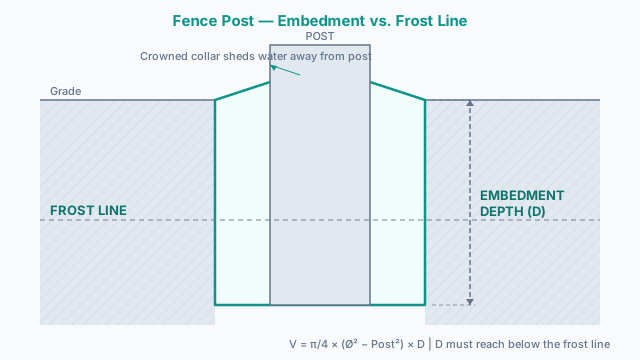
Source: Industry standards including IRC 2021 Table R403.1 and fence manufacturer installation guides. Embed depths assume no frost depth requirement — increase depth to match your local frost line per IRC R403.1.4.
Entering Your Fence Run Dimensions
- 1Select a project type preset — Privacy, Picket, or Farm fence — to load typical spacing, hole size, and post defaults. You can adjust any value after selecting a preset.
- 2Enter total fence length and choose its unit (ft, yd, or m). This is the full linear run you're installing, end to end.
- 3Enter post spacing (on-center) — the distance from the center of one post to the next. The calculator adds the terminal end post and shows a live post count as you type.
- 4Enter hole diameter and hole depth. A good starting rule is a hole diameter about 3× the actual post width, and a depth that reaches at or below your local frost line.
- 5Choose post shape — Square/Rectangular or Round — then enter the actual post dimension (a '4×4' is really 3.5" × 3.5") and the post's embed depth.
- 6Set a waste percentage (10% is a good default for fence post work) to cover spillage, uneven holes, and early mixing.
- 7In Advanced mode, pick a preferred bag size and optionally enter price per bag and labor cost for a full material and labor estimate.
- 8Click Calculate to reveal post count, net concrete volume, cubic yardage, and the three-way bag comparison.
How the Fence Post Bag Count Is Calculated
- 1) Number of PostsPosts = ⌈ fenceLength ÷ postSpacing ⌉ + 1
The ceiling function ensures enough interior posts; the +1 adds the terminal end post. For example, a 100 ft fence with 8 ft spacing: ⌈100 ÷ 8⌉ + 1 = 13 + 1 = 14 posts. - 2) Hole Volume (Cylindrical)Vhole = π × (D ÷ 2)² × depth
Standard formula for a cylindrical auger-drilled hole. D is the hole diameter. A 12-inch diameter, 24-inch deep hole yields approximately 0.1963 ft³ per hole. - 3) Post Displacement — Round PostVpost = π × (d ÷ 2)² × embedDepth
d is the actual post diameter. This volume is subtracted from the hole volume because the post itself occupies that space. - 4) Post Displacement — Square / Rectangular PostVpost = width × length × embedDepth
For a 4×4 post (3.5" × 3.5" actual) embedded 24 inches (2 ft): Vpost = (3.5/12) × (3.5/12) × 2 ≈ 0.0170 ft³ per post. - 5) Net Concrete Per HoleVnet = max(0, Vhole − Vpost)
The post displaces some concrete in the hole. Subtracting it prevents over-ordering, especially significant across large post counts or large post sizes. - 6) Total Volume with WasteVtotal = (Vnet × numPosts) × (1 + waste% ÷ 100)
A 10% waste factor on 14 posts adds roughly 1–2 extra bags depending on hole size — worth it to avoid a mid-project run to the store. - 7) Bag Countbags = ⌈ Vtotal ÷ yield_per_bag ⌉
Yield per bag: 40 lb = 0.30 ft³ · 60 lb = 0.45 ft³ · 80 lb = 0.60 ft³. All counts round up to the nearest whole bag.
Worked Takeoff: 100 ft Privacy Fence at 8 ft Spacing
You are installing a 100 ft privacy fence with posts on 8 ft centers. Each post is a 4×4 (actual 3.5″ × 3.5″), set in a 10-inch diameter hole, 24 inches deep.
- Post count = ⌈100 ÷ 8⌉ + 1 = 13 + 1 = 14 posts
- Hole volume = π × (5 in)² × 24 in ≈ 1.09 ft³ per hole
- Post displacement = (3.5/12) ft × (3.5/12) ft × 2 ft ≈ 0.017 ft³ per post
- Net concrete per hole = 1.09 − 0.017 ≈ 1.07 ft³
- 14 holes total = 14 × 1.07 ≈ 15.0 ft³
- 10% waste factor = 15.0 × 1.10 ≈ 16.5 ft³ ≈ 0.61 yd³
- 80 lb bags needed = ⌈16.5 ÷ 0.60⌉ = 28 bags
That works out to about 2 bags of 80 lb mix per post, which lines up with the field rule of thumb for a standard line post. The calculator runs all seven steps instantly, and the Print / Save button exports a formatted bag list you can take straight to the hardware store.
Quantity Mistakes That Leave a Fence Run Short
- 1Using nominal lumber sizes instead of actual dimensions
A '4×4' post measures 3.5" × 3.5" and a '6×6' measures 5.5" × 5.5". Entering nominal dimensions overstates post displacement and understates the concrete needed — the gap compounds across every post in the run.
- 2Forgetting the terminal end post
Dividing fence length by post spacing alone undercounts by one post. The calculator's +1 rule accounts for the terminal end post, but a manual estimate that skips this step will come up one hole — and one to two bags — short.
- 3Ignoring auger flare on hand-dug or worn-bit holes
Augered holes are rarely a true cylinder. A worn bit or loose, sandy soil flares the top of the hole as you drill, and that flare alone can add 15–20% more volume than the nominal diameter suggests. If you're digging by hand and watch the hole widen as you go, bump the waste factor toward 15–20% rather than the 10% default.
- 4Treating every hole in the run as identical
Gate posts and corner posts on the same run typically use a larger hole and deeper embedment than standard line posts. Running the calculator once for the whole fence at line-post dimensions under-orders for the gate and corner holes — total those separately and add the two figures.
- 5Digging above the local frost line
Frost heave lifts footings that don't extend into undisturbed soil below the frost penetration depth. IRC R403.1.4 requires posts to extend at least 24 inches — or below the local frost line, whichever is deeper — to resist frost heave and post movement.
When to Use This vs. Related Calculators
The Fence Post Concrete Calculator is designed for fence runs: enter total fence length and post spacing and it auto-computes post count, total concrete, and bag requirements. For a single post — or a handful of individual posts at different depths or diameters — the post hole concrete calculator calculates each hole independently with gravel base and post displacement options. For concrete tube-form piers (sonotubes) used for deck posts, the sonotube concrete calculator is optimized for cardboard-form geometry. Once the volume is set, the concrete bag calculator converts it to 40/60/80 lb bag counts. For gravel base material around fence posts, the gravel calculator estimates volume and tonnage.
Product Standards & Specs
Provides the mix design basis for concrete used in fence post installations, including water-cement ratios and aggregate proportions that determine the 2,500–3,000 PSI strength typically specified for post footings.
Covers the 40-lb, 60-lb, and 80-lb pre-mixed concrete bags most commonly used for fence post installation, specifying minimum yield per bag and minimum compressive strength requirements after mixing.
Fence post concrete collar depth must resist overturning from wind loads — embedment of 1/3 to 1/2 of total post length is typical, but final depth depends on fence height, post spacing, and local wind exposure category.
Quantity & Ordering Questions
What is a fence post concrete calculator?
A fence post concrete calculator estimates how much concrete you need to set fence posts in the ground. You enter your fence length, post spacing, hole diameter, hole depth, and post size — and the calculator outputs the total concrete volume and the number of bags to buy. This prevents guesswork at the hardware store and ensures you don't run short mid-project.
How does the calculator determine the number of fence posts?
The calculator uses the formula: Posts = ⌈ fenceLength ÷ postSpacing ⌉ + 1. The ceiling function rounds up to ensure enough interior posts, and the +1 accounts for the terminal end post. For example, a 100-foot fence at 8-foot spacing requires ⌈100 ÷ 8⌉ + 1 = 14 posts.
How much concrete do I need per fence post?
It depends on hole size and depth. A common 12-inch diameter hole drilled 24 inches deep (minus a 3.5" × 3.5" 4×4 post displacement) requires about 0.18 cubic feet of concrete — roughly 0.3 bags of 80 lb Quikrete. Larger holes, deeper holes, or gate posts require significantly more. Use the calculator to get an exact number for your specific dimensions.
How deep should fence post holes be?
A common rule of thumb is to bury one-third of the total post length below grade — so a 9-foot post would need a 3-foot hole. However, the hole must also extend below the local frost line per IRC R403.1.4. In colder climates (USDA Zones 5–7), the frost line can be 36–48 inches, which may govern. Always check your local building department for the required depth.
What hole diameter should I use for a 4×4 post?
The standard recommendation is a hole diameter 3 times the post width. A 4×4 post has an actual width of 3.5 inches, so 3 × 3.5 = 10.5 inches — meaning a 10- or 12-inch hole is appropriate. Using a 12-inch hole gives a bit more concrete around the post for better stability, which is recommended for privacy fence line posts.
What hole diameter should I use for a 6×6 post?
A 6×6 post has an actual dimension of 5.5 inches. Applying the 3× rule: 3 × 5.5 = 16.5 inches. In practice, a 12- to 16-inch hole is common for 6×6 gate posts and corner posts. A 16-inch hole with a 6×6 post embedded 30 inches requires about 1.9 cubic feet of concrete — roughly 3 bags of 80 lb Quikrete per post.
How many bags of concrete do I need per fence post?
For a standard residential line post (10-inch hole, 24-inch depth, 4×4 post), you'll need approximately 1–2 bags of 80 lb Quikrete per post. Gate posts and corner posts with larger holes and deeper embedment can require 3–5 bags each. Always calculate your specific dimensions rather than relying on rule-of-thumb bag counts.
What is post displacement and why does it matter?
Post displacement is the volume of concrete displaced by the post itself. When you set a post in a hole, the post takes up space — you're not filling a completely empty cylinder. Subtracting post displacement gives you the true volume of concrete needed. For a 4×4 post in a 12-inch hole at 24 inches deep, the displacement is about 0.017 cubic feet — small but meaningful across 20+ posts.
Should I subtract the post volume from my concrete estimate?
Yes, for the most accurate estimate. The calculator does this automatically using the post's actual cross-section × embed depth. In practice, small errors in hole diameter and shape mean you should still include a 5–10% waste factor on top. The displacement subtraction is most impactful for large posts (6×6 or round) in smaller holes.
What concrete strength should I use for fence posts?
Most residential fence posts use standard 3,000 PSI concrete mix (ACI 211.1). Quikrete's 80 lb Concrete Mix (#1101) and Fast-Setting Concrete (#1004) both target approximately 4,000 PSI at 28 days, which exceeds the minimum for residential use. For gate posts and corner posts that carry higher lateral loads, use at least 4,000 PSI mix.
Can I use quick-set concrete for fence posts?
Yes — products like Quikrete Fast-Setting Concrete are popular for fence posts because you can pour dry mix directly into the hole around the post and add water on top, without mixing. This method works well for line posts and is IRC-compliant for residential fencing. However, mix the concrete for gate posts, corner posts, and deck posts where structural strength is critical.
What is the 1/3 rule for fence post depth?
The 1/3 rule states that the buried portion of a fence post should be approximately 1/3 of the total post length. For example, to have 6 feet of fence above grade, you'd need a 9-foot post buried 3 feet deep (⅓ of 9). This is a starting point — local frost line requirements and soil conditions may dictate a deeper hole, and that depth always takes precedence.
Is the fence post concrete calculator free?
Yes, completely free. No account, no subscription, and no limit on how many times you can use it. You can also use the Print / Save feature to export your estimate as a PDF at no cost.
Can I print or save my fence post estimate?
Yes. After clicking Calculate, a Print / Save button appears in the results section. Clicking it opens a print-optimized version of your estimate in a new tab. In your browser's print dialog, select 'Save as PDF' to export a digital copy. The printout includes all your inputs, the post count, volume breakdown, and bag comparison.
How accurate is the fence post concrete calculator?
The calculator uses exact cylindrical volume and post displacement formulas, so the math is accurate given your inputs. Real-world accuracy depends on how precisely your holes are drilled — hand-dug holes or worn auger bits can result in holes larger than the nominal diameter. Including a 10% waste factor accounts for typical field variability and ensures you don't run short.
Related Calculators
Post Hole Concrete Calculator
Estimate concrete, gravel, and bag counts for fence posts, gate posts, deck posts, and more.
Sonotube Concrete Calculator
Volume, cubic yards & bag counts for cylindrical tube forms.
Concrete Bag Calculator by Project
Turn slab, footing, post hole and sonotube dimensions into an exact bag count — five shape modes, imperial or metric, with +5%/+10% waste buffers.
Pier / Caisson Concrete Calculator
Cylindrical shafts and drilled piers by length.
Gravel Calculator
Calculate gravel volume, tons, cubic yards, and estimated cost.