How Rebar Footage Becomes Tonnage
The Rebar Weight Calculator is a procurement and logistics tool that converts rebar linear footage to weight in pounds, US tons, and kilograms — and can also work in reverse, converting a known steel tonnage specification back to the equivalent linear footage and bar count. It uses ASTM A615 and A706 published unit weights for deformed bars #3 through #10, giving accurate results that match supplier invoices and structural engineer specifications. For the bar sizes and spacing behind those footages, see our pillar guide on rebar sizing & spacing.
This calculator solves three distinct problems that contractors, estimators, and engineers encounter on every reinforced concrete project: converting a takeoff footage list to a delivery weight for freight planning, combining multiple bar sizes into a single total tonnage for commercial procurement, and reverse-calculating footage from a weight-based specification on structural drawings. All three modes are available in one tool, with optional per-ton steel pricing for full cost estimation. For where the bars go, see our guide on how to reinforce a concrete slab; for slab and steel dead loads, how much concrete weighs; and for footing reinforcement, our concrete footing calculations.
Assumptions Behind the Rebar Weight Calculation
- Unit weights are theoretical, per ASTM A615/A706. The calculator uses the published theoretical unit weight for each bar size (e.g., #5 = 1.043 lb/ft), not a measured mill weight. ASTM allows a ±3.5% tolerance per bar and per lot, so an actual delivery may weigh slightly more or less than the calculated figure.
- A615 and A706 share identical weights. The two specifications differ in steel chemistry and weldability, not in cross-sectional dimensions, so this calculator applies the same unit-weight table to both grades interchangeably.
- Waste factor is a flat percentage applied to net footage. The model adds a single waste percentage per bar size to cover lap splices, hooks, and off-cut trim — it does not calculate lap length from bar diameter or development-length tables.
- Bars-to-order always rounds up. Gross footage divided by stock bar length is rounded up to the next whole bar in every mode, matching how suppliers can only sell full-length stock bars.
- Steel is priced per US ton, matching commercial invoicing. The cost estimate assumes your supplier quotes a flat $/ton rate; it does not model quantity break discounts, mill surcharges, or grade premiums (e.g., A706 typically commands a premium over A615).
How Rebar Weight Is Calculated
- 1) Gross footage (with waste)Gross LF = Net LF × (1 + Waste % ÷ 100)
Waste covers lap splices, hook extensions, and off-cut trim. Use 10% for standard layouts; 15% for complex or heavily lapped designs. - 2) Weight from footageWeight (lbs) = Gross LF × Unit Weight (lb/ft)
Weight (US tons) = Weight (lbs) ÷ 2,000
Weight (kg) = Weight (lbs) × 0.453592
Unit weights per ASTM A615/A706. Example: #5 bar = 1.043 lb/ft, so 500 ft = 521.5 lbs = 0.261 US tons. - 3) Bars to orderBars = ⌈Gross LF ÷ Stock Bar Length⌉
Always rounded up to the next whole bar. A 20 ft stock bar is the most common standard length in North America. - 4) Multi-bar total weightTotal Weight = Σ (Gross LF₍ᵢ₎ × Unit Weight₍ᵢ₎) for each bar size i
Each bar size uses its own gross footage (with its own waste factor) and its own unit weight from the ASTM table. - 5) Reverse calculation (target weight → footage)Linear Footage = Target Weight (lbs) ÷ Unit Weight (lb/ft)
Converts a structural tonnage specification or delivery manifest weight back to the equivalent footage. Then rounds up to whole bars using stock length. - 6) Unit conversions1 US ton = 2,000 lbs
1 lb = 0.453592 kg
1 metre = 3.28084 ft
All metric inputs are converted to imperial internally. Output is shown in all three weight units simultaneously. - 7) Cost estimateMaterial Cost = Total Weight (US tons) × Price per Ton
Grand Total = Material Cost + Delivery / Misc Cost
Commercial rebar pricing is always quoted per US ton, not per bar or per linear foot. This matches standard steel supplier invoicing practice.
Running the Rebar Weight Calculator
- 1Select a project type preset — Residential, Commercial Mix, Bridge/Civil, or Target Weight — to load sensible defaults, or enter your own values.
- 2Choose a calculation mode: Single bar size to convert one bar's footage to weight; Multi-bar mix for projects with multiple bar types; Target weight for reverse lookup from a spec or delivery quantity.
- 3For Single mode: select your bar size (#3–#10), enter total linear footage, and set a waste percentage (10% is typical for most projects).
- 4For Multi-bar mix: add a row for each bar size. Enter the net footage, stock bar length, and waste percentage for each. Add up to 6 bar types.
- 5For Target weight mode: enter the weight from your structural spec or delivery manifest and select the bar size. Choose the unit — lbs, US tons, or kg.
- 6Enter the stock bar length (default 20 ft) to get the exact number of bars to purchase. This rounds up to the nearest whole bar.
- 7Optionally enter a price per US ton to generate a material cost estimate. Add a delivery or misc cost for a complete project total.
- 8Press Calculate. Review the weight in lbs, US tons, and kg, bars to order, and the ASTM A615/A706 reference table with your active bar highlighted.
- 9In multi-bar mode, review the per-bar breakdown showing each size's weight as a percentage of total steel — useful for procurement and logistics.
- 10Use Print / Save to export a PDF of all inputs and results for RFQs, purchase orders, or project records.
ASTM A615 / A706 Rebar Weight Design Values
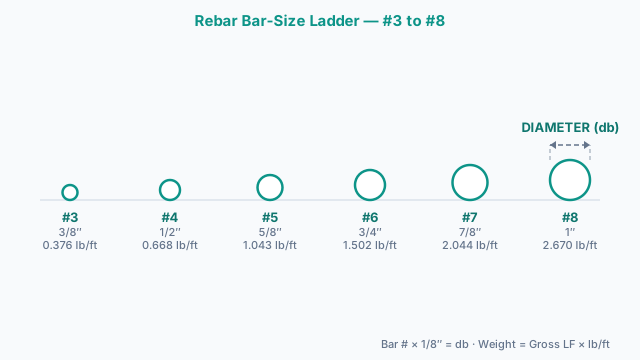
All rebar weight values in this calculator are based on ASTM A615 (carbon steel) and ASTM A706 (low-alloy steel for weldability) published unit weights. Both standards specify identical theoretical unit weights for each bar size — the difference between A615 and A706 lies in chemistry and mechanical properties, not weight. The table below covers #3 through #10, which accounts for the overwhelming majority of concrete reinforcement applications.
| Bar size | Diameter | Area (in²) | lb / ft | kg / m |
|---|---|---|---|---|
| #3 | 0.375" | 0.11 | 0.376 | 0.560 |
| #4 | 0.500" | 0.20 | 0.668 | 0.994 |
| #5 | 0.625" | 0.31 | 1.043 | 1.552 |
| #6 | 0.750" | 0.44 | 1.502 | 2.235 |
| #7 | 0.875" | 0.60 | 2.044 | 3.042 |
| #8 | 1.000" | 0.79 | 2.670 | 3.973 |
| #9 | 1.128" | 1.00 | 3.400 | 5.060 |
| #10 | 1.270" | 1.27 | 4.303 | 6.404 |
Weights are theoretical per ASTM A615/A706. Actual mill weights may vary ±3.5% for individual bars and ±3.5% for lots per ASTM tolerances. Always verify with certified mill test reports for structural applications.
Quick Reference — Common Quantities
Values include no waste factor — add 10–15% to all figures for a real procurement order.
100 ft of #3
37.6 lbs · 0.019 tons
Typical tie quantity, small footing
100 ft of #4
66.8 lbs · 0.033 tons
Small residential driveway section
500 ft of #4
334 lbs · 0.167 tons
Typical residential driveway
1,000 ft of #5
1,043 lbs · 0.522 tons
Medium structural slab
1 ton of #4
2,000 lbs · 1.000 ton
= 2,994 linear feet of #4
1 ton of #5
2,000 lbs · 1.000 ton
= 1,918 linear feet of #5
1 ton of #6
2,000 lbs · 1.000 ton
= 1,332 linear feet of #6
1 ton of #8
2,000 lbs · 1.000 ton
= 749 linear feet of #8
Worked Analysis: Converting a Footing Takeoff to Tonnage
A continuous strip footing takeoff calls for 620 linear feet of #5 bar (two runs, longitudinal) and 340 linear feet of #4 bar (ties and dowels). Using Multi-bar mix mode with a 10% waste factor on each: #5 gross footage = 620 × 1.10 = 682 LF → 682 × 1.043 lb/ft = 711.3 lbs. #4 gross footage = 340 × 1.10 = 374 LF → 374 × 0.668 lb/ft = 249.8 lbs. Combined total = 711.3 + 249.8 = 961.1 lbs (0.48 US tons), with #5 bar making up 74% of the total steel weight. At 20 ft stock length, that is ⌈682 ÷ 20⌉ = 35 bars of #5 and ⌈374 ÷ 20⌉ = 19 bars of #4 to order. At a supplier quote of $850/ton, material cost is 0.48 × $850 ≈ $408, before delivery. This is exactly the kind of mixed-bar procurement problem the multi-bar mode is built for — a single footing rarely uses only one bar size.
Limits of This Rebar Weight Estimate
- ⚠️Theoretical weights carry a ±3.5% mill tolerance
ASTM A615/A706 unit weights are highly accurate for estimation, but ASTM allows a ±3.5% tolerance per bar and per lot. A 1,000-lb order may actually weigh 965–1,035 lbs. For certified-weight or structural-acceptance purposes, verify against mill test reports.
- ⚠️A flat waste factor does not replace a lap-splice calculation
The 10–15% waste allowance is a planning shortcut, not a substitute for calculating actual lap splice lengths (typically 40–60 bar diameters) or development lengths per ACI 318 §25.4–25.5 for structural design. Complex layouts with many bends or hooks may need a higher waste factor than a simple rectangular grid.
- ⚠️A footage entry over 50,000 LF often signals a unit error
The calculator warns above this threshold because it most commonly indicates metres entered as feet. Always double-check the unit selector before trusting a large-quantity result — this single mistake is the most common source of a bad procurement order.
This calculator converts footage to weight; it does not count bars or plan spacing. For the layout step — spacing, layers, bar count — use the rebar calculator. To verify a target spacing meets ACI 318 §25.8.1 clear-spacing limits, use the rebar spacing calculator. For projects where wire mesh is an acceptable alternative to discrete bars, estimate rolls and sheets with the wire mesh calculator. Once the steel is quantified, the slab concrete calculator or footing concrete calculator complete the full material takeoff.
ACI / ASTM Basis
Specifies the theoretical unit weights (lb/ft and kg/m) for #3 through #18 deformed steel bars — the definitive source for all rebar weight values used in this calculator and cross-referenced on mill test reports and supplier invoices.
Specifies identical unit weights to A615 for each bar size, with different chemistry for improved weldability. Required in seismic zones and wherever structural drawings call for weldable rebar — the calculator applies A615/A706 weights interchangeably.
Standards cited for reference. Always verify with certified mill test reports for structural applications.
Rebar Weight — Technical Questions
What is a rebar weight calculator?
A rebar weight calculator converts rebar linear footage to weight in lbs, US tons, and kg using published ASTM A615/A706 unit weights. It can also reverse the calculation — converting a target weight from a structural spec or delivery manifest back to the equivalent footage and bar count.
How much does rebar weigh per foot?
Rebar weight per foot depends on bar size per ASTM A615/A706: #3 = 0.376 lb/ft, #4 = 0.668 lb/ft, #5 = 1.043 lb/ft, #6 = 1.502 lb/ft, #7 = 2.044 lb/ft, #8 = 2.670 lb/ft, #9 = 3.400 lb/ft, #10 = 4.303 lb/ft. These are theoretical unit weights; actual mill weights may vary ±3.5%.
How do I convert rebar linear footage to tons?
Multiply total linear footage by the unit weight in lb/ft for your bar size, then divide by 2,000 to convert to US tons. For example: 1,000 ft of #5 bar × 1.043 lb/ft = 1,043 lbs ÷ 2,000 = 0.522 US tons. Our calculator performs this conversion automatically for all bar sizes.
How do I convert rebar weight to linear footage?
Divide the weight in lbs by the unit weight in lb/ft for your bar size. For example: 2,000 lbs of #5 bar ÷ 1.043 lb/ft = 1,918 linear feet. This is the reverse calculation mode in our calculator — enter the weight in lbs, tons, or kg and select a bar size to get the equivalent footage.
What is the difference between ASTM A615 and ASTM A706 rebar?
Both standards specify identical unit weights for each bar size, so weight calculations are the same. The difference is in steel chemistry and mechanical properties: A615 is standard carbon-steel rebar used in most applications; A706 is a low-alloy steel with controlled chemistry for better weldability and ductility, required in seismic zones and applications where rebar must be welded.
Why is rebar priced per ton, not per bar?
Steel commodities — including rebar — are traded and priced by weight globally because weight is the fundamental measure of material content and production cost. A ton of #5 bar and a ton of #8 bar contain the same mass of steel, making per-ton pricing consistent across bar sizes. Our calculator converts your footage to tonnage so you can apply supplier per-ton quotes directly.
How many linear feet are in a ton of rebar?
It depends on bar size: #3 = 5,319 ft/ton, #4 = 2,994 ft/ton, #5 = 1,918 ft/ton, #6 = 1,331 ft/ton, #7 = 979 ft/ton, #8 = 749 ft/ton, #9 = 588 ft/ton, #10 = 465 ft/ton. Use the Target Weight mode in our calculator to reverse-calculate footage from any tonnage.
What waste percentage should I use for rebar weight calculations?
Use 10% for simple rectangular layouts with standard laps. Use 15% for complex layouts with many bends, hooks, or irregular shapes. The waste factor covers lap splice lengths (typically 40–60 bar diameters), hooks and bends, and off-cut trim from cutting to length. Waste increases gross footage, which increases the total weight and cost.
Can I calculate the weight of multiple bar sizes at once?
Yes. Switch to Multi-bar mix mode and add a row for each bar size. Enter the footage, stock length, and waste for each. The calculator produces individual weights per bar size — shown as a percentage of total steel — plus a combined total weight, tonnage, and bars to order.
What is a standard stock bar length for rebar?
In North America, 20-foot bars (6.1 m) are the most common standard stock length for #3 through #8 bars. Some suppliers also stock 30-foot (9.1 m) and 40-foot (12.2 m) lengths for larger projects. Our calculator lets you enter any stock length; it divides the gross footage by your stock length and rounds up to the nearest whole bar.
How accurate is the ASTM rebar weight table?
ASTM A615/A706 theoretical unit weights are highly accurate for estimation purposes. However, ASTM allows a ±3.5% weight tolerance per bar and ±3.5% per lot. This means a 1,000-lb order may actually weigh 965–1,035 lbs. For structural and certified-weight applications, always verify with mill test reports from your supplier.
Can I calculate rebar weight in metric units?
Yes. You can enter dimensions in metres and receive weight output in kilograms and kg/m values alongside imperial results. The Target Weight mode accepts weight in kg as well as lbs and US tons. All conversions use standard ASTM values: 1 lb = 0.453592 kg, 1 metre = 3.28084 ft.
Is the rebar weight calculator free?
Yes. The Rebar Weight Calculator on Concrete Calculator Max is completely free with no registration, subscription, or hidden fees. All three calculation modes — Single bar, Multi-bar mix, and Target weight reverse — are available at no cost.
Can I print or save my rebar weight estimate?
Yes. After calculating, press the Print / Save button to open a print-optimized report with all inputs and results. In your browser's print dialog, choose Save as PDF to keep a digital copy for purchase orders, RFQs, supplier quotes, or project records.
What is the rebar weight for a 20-foot bar?
It depends on bar size: #3 = 7.5 lbs, #4 = 13.4 lbs, #5 = 20.9 lbs, #6 = 30.0 lbs, #7 = 40.9 lbs, #8 = 53.4 lbs, #9 = 68.0 lbs, #10 = 86.1 lbs. These are the weights of a single standard 20-foot stock bar per ASTM A615/A706.
Related Calculators
Rebar Calculator
Estimate rebar bars, linear footage, weight, and cost for slabs, footings, and walls.
Rebar Spacing Calculator
Calculate rebar bar count from a target c-t-c spacing or find spacing from a bar count, with ACI 318-19 compliance checks for slabs, footings, walls, and beams.
Wire Mesh Calculator
Estimate welded wire fabric rolls, sheets, weight, and cost for concrete slabs, driveways, sidewalks, and industrial floors.
Concrete Weight Calculator
Convert any concrete volume (yd³, ft³, m³) or pour dimensions to weight in lb, short tons, and kg — with normal-weight, lightweight, and bag-mix presets.
Footing Concrete Calculator
Continuous, isolated, and combined footings.